Ina Garten's Perfect Roast Chicken (a.k.a. the 'Engagement Chicken')
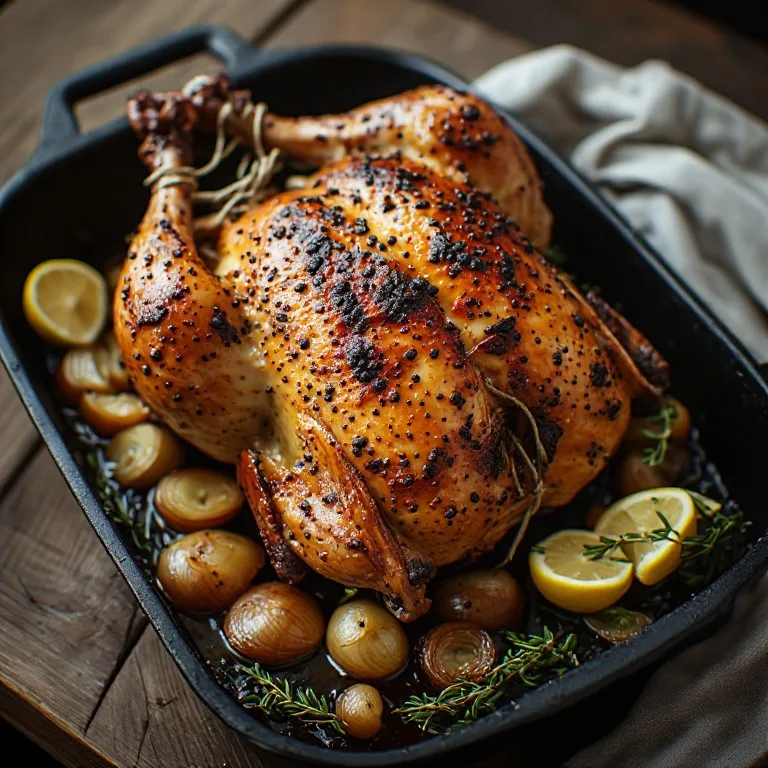
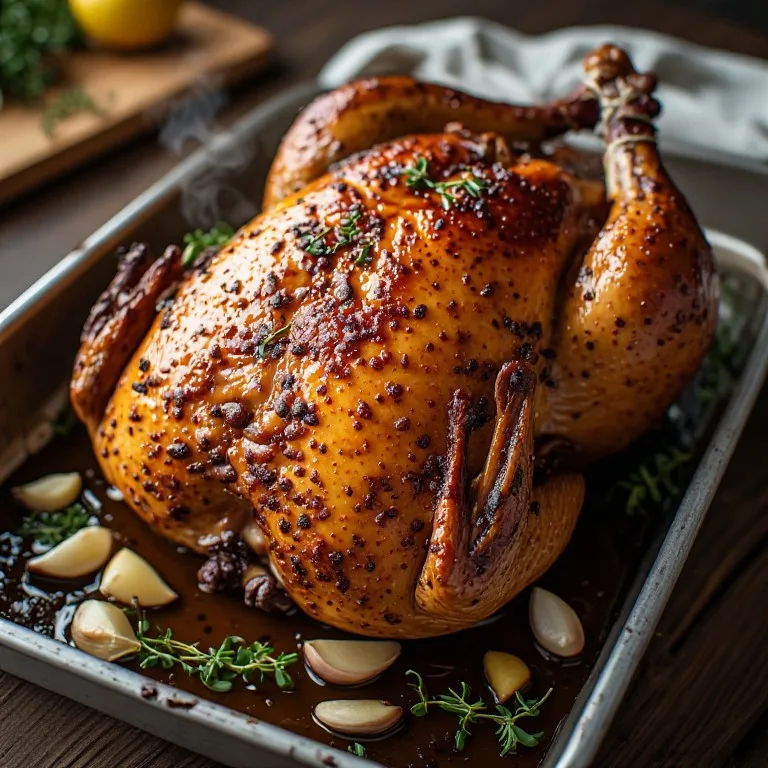
Quick answer: Preheat oven to 425°F. Pat a 5 to 6 lb roasting chicken completely dry with paper towels — every bit of surface moisture. Season the cavity generously with kosher salt and black pepper, then stuff it with a whole bunch of fresh thyme, both halves of a lemon, and a head of garlic cut in half crosswise. Brush the outside all over with 2 tablespoons of melted butter and season generously with salt and pepper. Truss the legs together with kitchen twine and tuck the wing tips under the body. Arrange a thickly sliced Spanish onion in the bottom of a snug roasting pan and set the chicken on top, breast side up. Roast at 425°F for 1 hour 30 minutes, until the skin is deep golden-brown and the juices run clear when you cut between the leg and the thigh (or an instant-read thermometer reads 165°F at the thickest part of the thigh, not touching the bone). Rest covered loosely with foil for 15 minutes. For the pan gravy: pour off the fat, reserving 2 tablespoons; add 1 cup of chicken stock to the roasting pan and boil, scraping up the browned bits and caramelized onion, until slightly reduced; whisk in the reserved fat mashed with 2 tablespoons of flour and simmer until thickened, 3 to 5 minutes; strain, season with salt and pepper, and keep warm.
Shop the tools
Gear matched to this recipe. These are Amazon affiliate links — we may earn a small commission if you buy, at no extra cost to you.
 Illustrative imageLodge 10.25" Cast Iron SkilletThe restaurant-grade sear most copycats depend onCheck price on Amazon →
 Illustrative imageInstant-Read Digital ThermometerNail fry-oil and doneness temps every timeCheck price on Amazon →
 Illustrative imageNordic Ware Half Sheet PanCommercial-quality aluminum, bakes dead evenCheck price on Amazon →
As an Amazon Associate, Copycat Spices earns from qualifying purchases. Product images are generic illustrations, not the exact item listed.
Ina Garten's Perfect Roast Chicken (a.k.a. the 'Engagement Chicken')
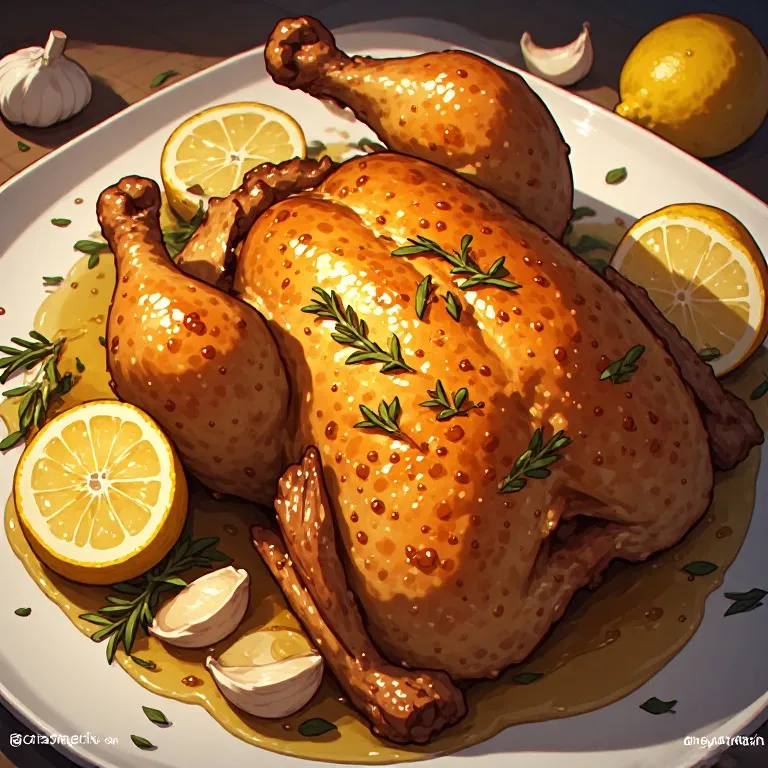
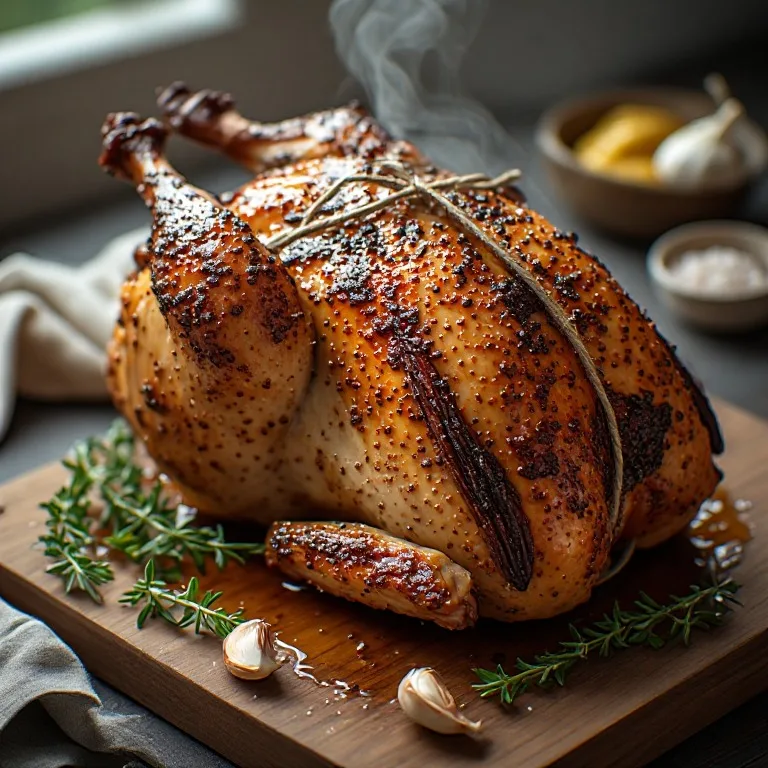
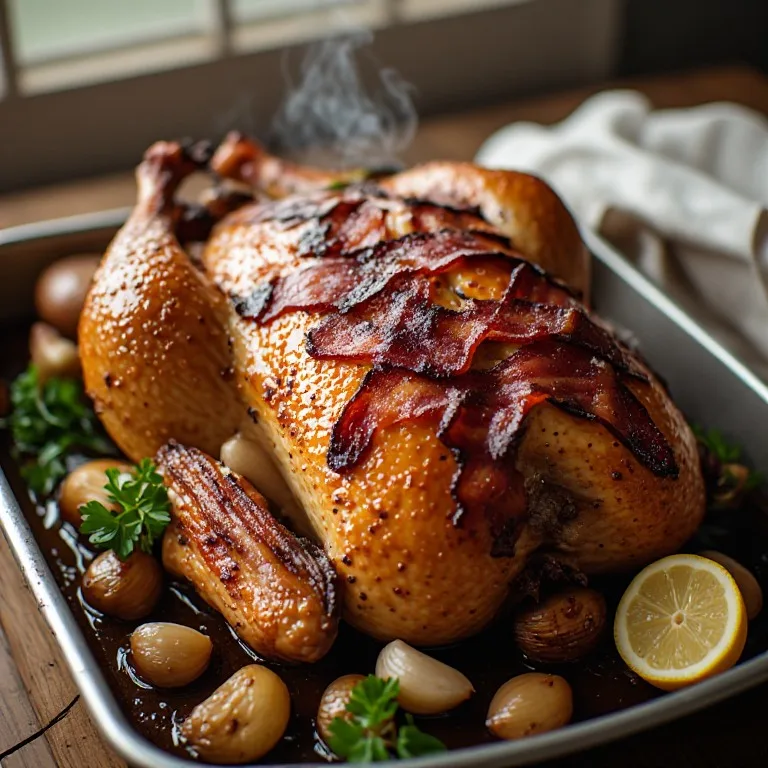
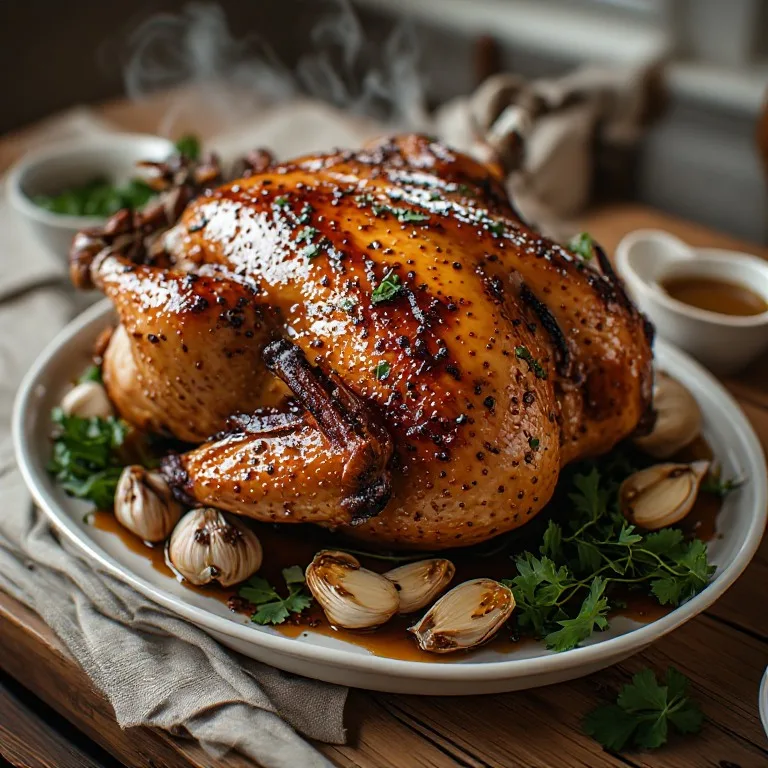
Ina Garten's Perfect Roast Chicken is the most famous celebrity chef roast chicken in the US — a 5 to 6 lb bird stuffed with lemon, garlic, and a whole bunch of thyme, roasted at 425°F on a bed of Spanish onion until the skin is mahogany-crisp and the pan drippings make a pan gravy that outshines the chicken. From The Barefoot Contessa Cookbook (1999), it became known as the 'engagement chicken' after Ina mentioned hearing about proposals that followed it. This is the exact Barefoot Contessa method.
Easy
Prep: 15 min
Cook: 1 hr 30 min
Total: 1h 45m4 servings
~$4.20/serving
At home~$4.20/serving
vs
Restaurant~$18.90/serving
You save ~78%
The Story Behind the Recipe
Ina Garten ran The Barefoot Contessa specialty food store in East Hampton, New York for 18 years before selling it in 1996 to write cookbooks. The store sold prepared foods — roast chickens, salads, pastries — and its success was entirely built on the idea that good ingredients and simple techniques could produce restaurant-quality food at home. Her first cookbook, The Barefoot Contessa Cookbook (1999), translated that philosophy directly: fewer than 150 recipes, no elaborate techniques, nothing requiring equipment most home kitchens don't have. The perfect roast chicken was on page one of the main courses, and it became the book's signature recipe. The "engagement chicken" nickname actually began at Glamour magazine, not with Ina: in 1982 a Glamour editor shared a simple lemon-and-herb roast chicken with a colleague who got engaged about a month later, and the magazine coined the name when it published the recipe two decades on. Garten's Perfect Roast Chicken is a separate, earlier recipe (1999), but because of her fame and how close the two dishes are, hers became the version most people now associate with the legend — helped along by reports that both Meghan Markle (for Prince Harry) and Emily Blunt served a version before getting engaged. A whole roast chicken at a good restaurant runs $45 to $65; this bird costs about $14 in groceries and takes 15 minutes of hands-on work.
The technique is deliberately minimal, because the technique IS the recipe. Most roast chicken problems come from too-low heat, a wet bird, and no resting time. At 425°F, the skin begins to render and blister within the first 20 minutes — something that cannot happen at 375°F, where the chicken just steams in its own moisture. Patting the skin bone-dry before butter and seasoning is not a suggestion; water turns to steam in the oven and puffs the skin away from the meat instead of crisping it against it. The Spanish onion scattered around the bird isn't garnish — it softens and caramelizes in the rendered chicken fat, and those drippings become the base of the pan gravy. Deglazed with a cup of stock and thickened with a little flour, that gravy is more intensely flavored than anything you can buy. The 15-minute rest isn't optional: it's when the juices redistribute, and a chicken carved straight from the oven loses those juices onto the cutting board, not onto the plate.
Nutrition Facts
Per serving (4 servings)Calories420
Total Fat26g
Total Carbs7g
Dietary Fiber1g
Sugars2g
Protein38g
Sodium520mg
* Estimated values based on standard recipe preparation. Actual values may vary.
Ingredients
- For the pan gravy
Instructions
Pro tip: This recipe tastes even better the next day. The flavors need time to meld together in the fridge.
Storage: Keeps in an airtight container in the fridge for up to 2 weeks. Freezer-friendly for up to 3 months.
Free PDF — instant download. We'll also send new seasonal copycat recipes now and then; unsubscribe anytime. Or just download it →
🎉 Your Thanksgiving Cookbook is ready!
It's free — but if it's worth something to you, you can pay what you want. It keeps the recipes coming.
$
✓ Downloading your free Thanksgiving Cookbook — check your downloads folder. Happy cooking!
Make It Healthier
Love Ina Garten's Perfect Roast Chicken (a.k.a. the 'Engagement Chicken') but want a lighter version? Try these simple swaps:
- ✓Remove the skin before eating — it holds about 60% of the fat in each serving. The meat underneath is still juicy because the skin protected it during roasting; you get all the flavor benefits without the saturated fat on your plate.
- ✓Replace the butter brush with 1 tablespoon of olive oil — it achieves similar browning at a slightly lower saturated fat profile, and olive oil's smoke point is high enough to handle 425°F without burning.
- ✓Swap the pan gravy flour for 1 tablespoon of cornstarch whisked into cold water — it produces the same glossy texture with half the carbs per serving, and it's naturally gluten-free.
- ✓Serve half-portions (about 3 oz of meat) and bulk out the plate with the caramelized onions and a green vegetable — the chicken has plenty of flavor, and the vegetables from the pan are rich with the drippings.
Frequently Asked Questions
What is the 'engagement chicken' and is it the same as Ina Garten's roast chicken?
They are related but different recipes. The 'engagement chicken' legend traces to Glamour magazine: in 1982 a Glamour editor, Kim Bonnell, shared a simple lemon-and-herb roast chicken — reportedly her riff on a Marcella Hazan recipe — with a colleague, who received a marriage proposal about a month later. The dish quietly circulated among the staff for two decades before Glamour formally published it and coined the name 'Engagement Chicken' around 2003–2004. That original version is a straightforward lemon-and-herb roast chicken, without the Spanish onion and pan gravy that define Ina Garten's. Ina's Perfect Roast Chicken appeared earlier, in The Barefoot Contessa Cookbook (1999), and over time — thanks to her fame and how similar the two dishes are — hers became the version most people associate with the 'engagement chicken' name. Reports that Meghan Markle made a version for Prince Harry, and that Emily Blunt served one before her own engagement, kept the nickname attached to Garten's recipe. The bottom line: both are simple lemon-herb roast chickens, but Ina's has the Spanish onion and the pan gravy that the original Glamour version does not. (Want the original? We have the Glamour engagement chicken written up separately.)
Why 425°F and not a lower temperature like 350°F or 375°F?
High heat is what produces golden, crispy skin — and crispy skin is the whole point of a roast chicken worth making. At 350°F, a chicken takes about 90 minutes to cook through, but the skin never gets hot enough to fully render its fat and crisp; instead, it steams in the ambient moisture of the oven and stays soft. At 425°F, the skin begins rendering and blistering within the first 15 to 20 minutes, while the interior is still largely cool — which means by the time the meat reaches temperature, the skin has had nearly the full cooking time to become deep brown and shatteringly crisp. The high heat also accelerates Maillard browning on the skin surface, producing the complex, roasted flavors that lower-temperature chicken lacks. The risk at 425°F is over-browning the skin before the interior is done, but with a properly sized bird (5 to 6 lbs) in a hot oven starting from room temperature, this is not a problem in the 90-minute window. If your skin is darkening too fast at the 60-minute mark, tent the breast loosely with a sheet of foil — this is a normal adjustment, not a sign the temperature is wrong.
Do I actually need to truss the chicken, and what happens if I skip it?
You don't have to truss, but the result is noticeably better when you do. The legs of a chicken are the last part to cook through — they need more time and heat than the breast. Without trussing, the legs splay outward, exposing the thigh meat to direct oven heat but leaving the cavity open so the heat escapes rather than building up inside the bird. The breast, which is in the center and naturally more protected, finishes faster than the legs — so an untrussed chicken almost always produces overcooked breast or undercooked thighs. Trussing pulls the legs tight against the body, which three things accomplish: it closes the cavity opening (so the steam from the aromatics stays inside instead of blowing out), it brings the legs into a position where they cook at roughly the same rate as the breast, and it gives the bird a compact shape that browns evenly on all sides. The truss is simple: a 12-inch piece of kitchen twine, passed under the back of the bird, crossed over the top of the legs, wrapped once around both leg ends and tied off. The wing tips can just be folded under the body. If you genuinely don't have kitchen twine, truss with a strip of aluminum foil twisted into a cord — it holds at oven temperatures and is easy to cut before carving.
What kind of garlic goes inside the chicken?
One whole head of garlic, cut in half crosswise through the equator — not peeled, not separated into cloves. This is intentional. The unpeeled head releases its flavor slowly as aromatic steam rather than sharp raw garlic: the heat inside the cavity renders the garlic soft and sweet over 90 minutes, and because the skin is intact the flavor is gentle and perfumed rather than pungent. After the chicken comes out of the oven, the roasted garlic can be squeezed out of its papery skin and either spread on bread or stirred into the pan gravy — it will be completely soft, caramelized, and sweet. If you want a stronger garlic presence in the meat itself (rather than just the aromatics), smash 4 to 5 garlic cloves and tuck them under the skin of the breast before roasting — this is not part of Ina's recipe but it is a common and good modification.
Why does the recipe use a Spanish onion specifically?
Spanish onions are large and mild with high water content, so sliced thickly and roasted in the chicken fat for 90 minutes they soften and caramelize slowly and sweetly rather than scorching, and their size gives you plenty of liquid and jammy onion to work into the pan gravy. Ina's recipe calls for a Spanish onion specifically, but it's really just a large, sweet yellow onion — if your store doesn't label one 'Spanish,' any large yellow onion (or even a large sweet onion like Vidalia) works fine. The one thing that matters: slice it no thinner than 1/2 inch so the rings hold together through the roast instead of collapsing into mush.
How do I know when the chicken is done without a thermometer?
The two traditional checks are the juice test and the leg test, though an instant-read thermometer is the most reliable method. For the juice test: tilt the pan and use a spoon or bulb baster to pull some of the juices from the cavity — if they run clear with no trace of pink, the chicken is done; if they're rosy or red, return it to the oven for another 10 minutes and check again. For the leg test: grasp the end of a drumstick with a kitchen towel and twist gently — on a fully cooked chicken, the leg joint moves freely and the bone wiggles loosely; an undercooked chicken feels stiff and locked. A good instant-read thermometer inserted into the thickest part of the thigh (pointing away from the bone) should read 165°F. Note that carryover cooking will bring it to about 170°F after the 15-minute rest, which is fine for dark meat.
Can I prepare anything the day before?
Yes — the step most worth doing ahead is the dry brine. Season the interior and exterior of the bird generously with kosher salt, place it uncovered on a wire rack set over a baking sheet, and refrigerate overnight or up to 48 hours. The salt draws out surface moisture and then reabsorbs it over 12 to 48 hours, seasoning the meat from the inside and drying the skin further than a same-day pat-down can achieve. A dry-brined chicken roasts crispier and seasons more evenly than a same-day bird. On roasting day, there's no need to add more salt — just apply the butter, stuff the cavity, and roast. The pan gravy can also be made ahead: roast the chicken without the gravy step, let the pan cool, and store the pan drippings refrigerated overnight. The fat will solidify on top and can be lifted off in one piece, leaving the concentrated drippings below; use those as the base for the gravy when reheating.
Love this recipe? Share it!
Made it? Buy us a coffee
Every recipe here is free, with no paywalls. If this one was a hit at your table, a small tip keeps new copycats coming.
$
💛 Support checkout is coming soon — the cookbook stays free either way.
Ratings & Reviews
Rate this recipe
Click a star to rate