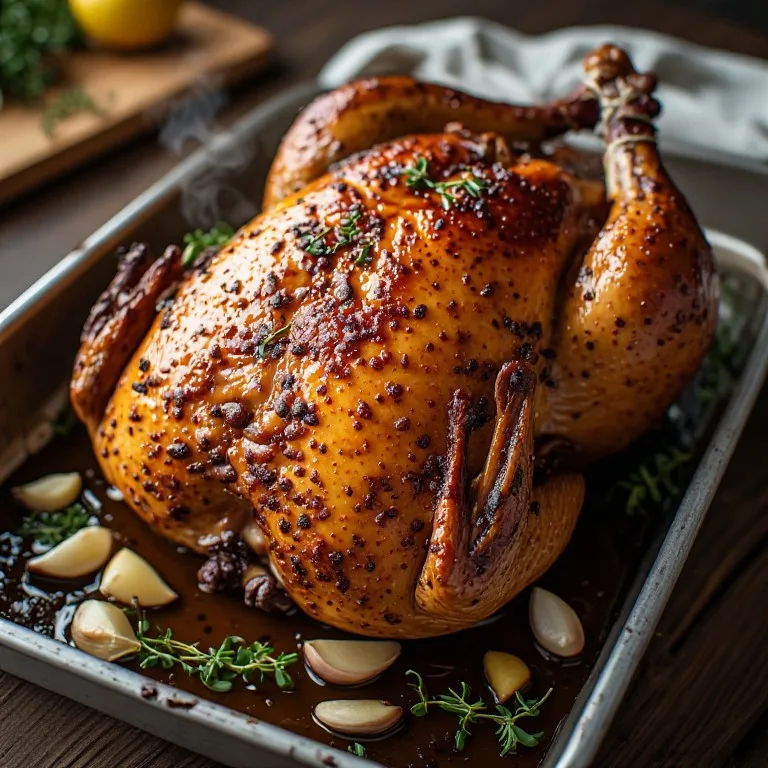
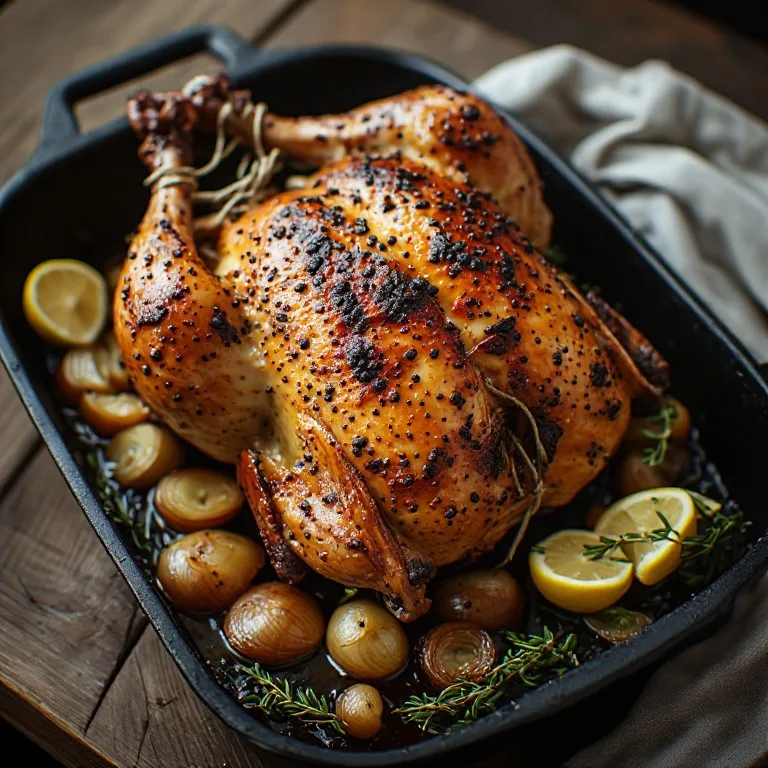
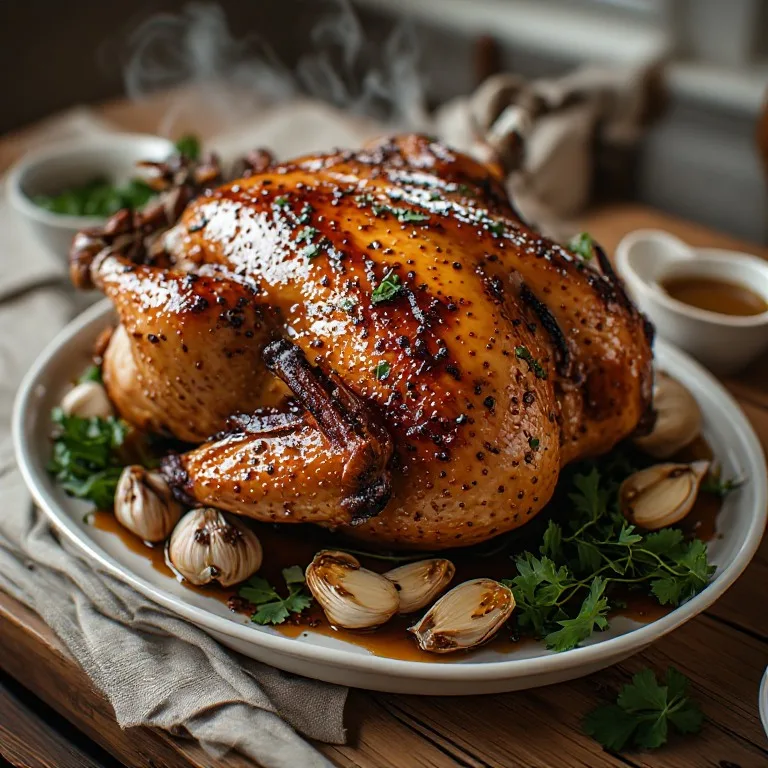
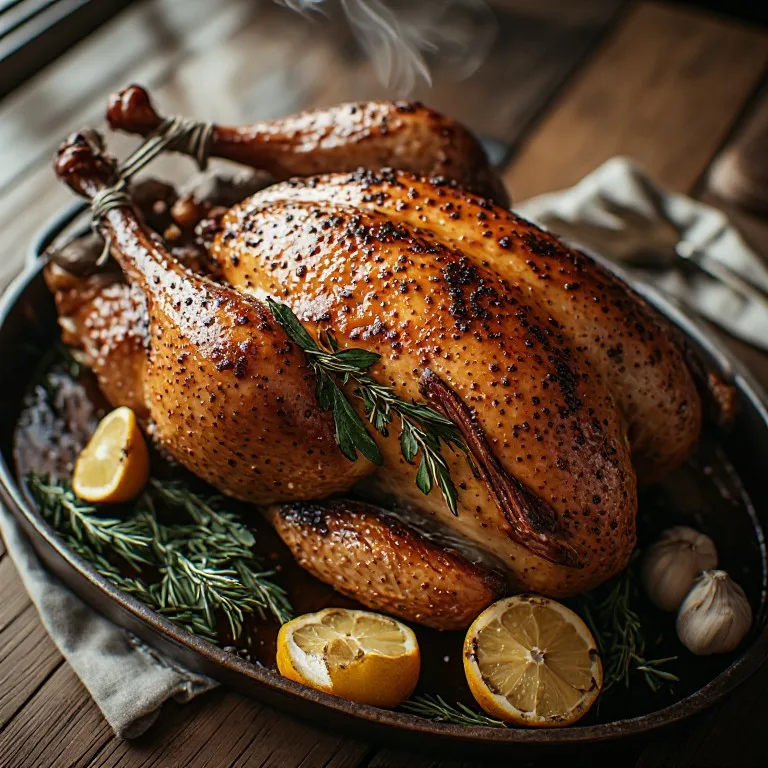
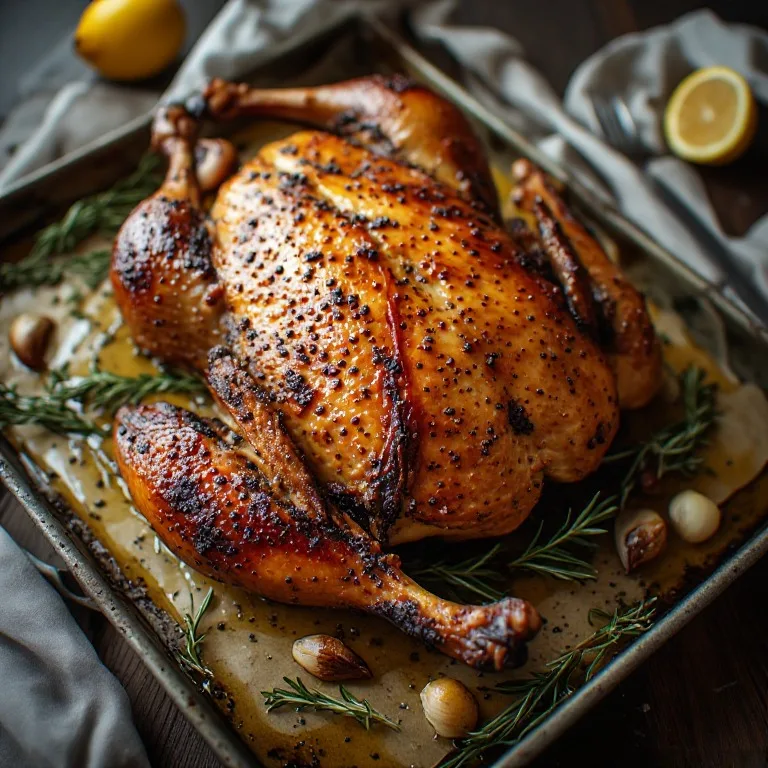
Quick answer: Preheat the oven to 350°F. Remove the giblets and neck, then pat the turkey completely dry inside and out with paper towels. Season the cavity generously with kosher salt and black pepper, then stuff it with a large bunch of fresh thyme, 1 lemon halved, 1 Spanish onion quartered, and 1 head of garlic halved crosswise through the equator. Melt 4 tablespoons (½ stick) of unsalted butter and brush it all over the outside of the turkey, then season the skin generously with kosher salt and black pepper. Truss the legs together with kitchen twine and tuck the wing tips under the body. Set the turkey breast-side up in a large roasting pan and roast at 350°F for about 2 hours 30 minutes, basting occasionally with the pan juices, until the juices run clear when you cut between the leg and thigh (an instant-read thermometer in the thickest part of the thigh, not touching bone, should read 165°F). Tent the breast loosely with foil if it browns too fast. Transfer the turkey to a cutting board, tent with foil, and rest 20 minutes before carving.
Shop the tools
Gear matched to this recipe. These are Amazon affiliate links — we may
earn a small commission if you buy, at no extra cost to you.
As an Amazon Associate, Copycat Spices earns from qualifying purchases.
Product images are generic illustrations, not the exact item listed.
Ina Garten's Perfect Roast Turkey (Barefoot Contessa)
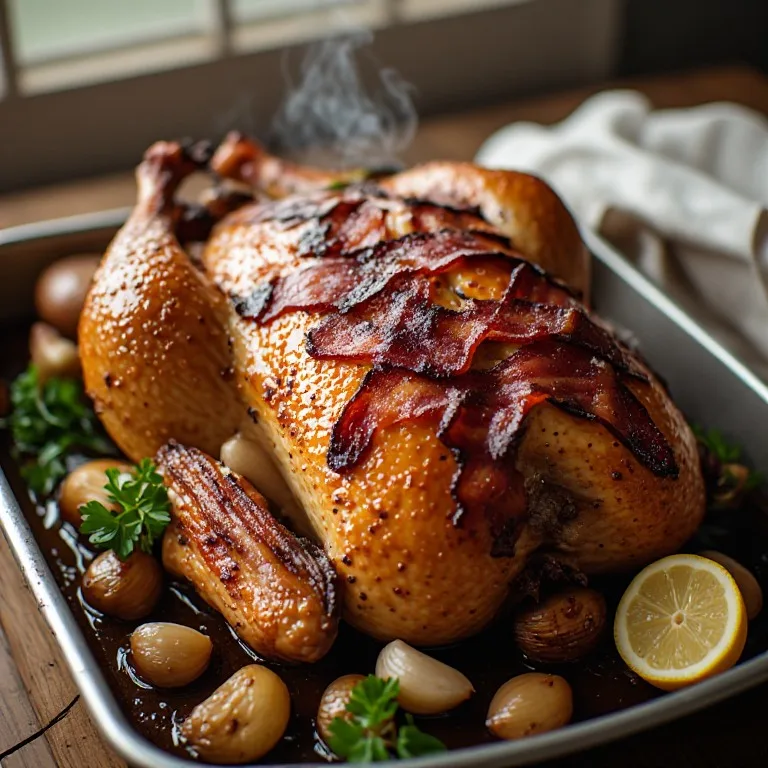
Ina Garten's Perfect Roast Turkey is the Thanksgiving answer to her famous roast chicken — a 12-pound fresh bird, cavity stuffed with thyme, lemon, onion, and garlic, brushed with melted butter and roasted at 350°F for 2½ hours. This is the exact Barefoot Contessa method from Food Network, explained step-by-step so the turkey comes out juicy, golden, and ready to carve, plus an optional simple pan gravy from the drippings.
Easy
Prep: 20 min
Cook: 2 hr 30 min
Total: 2h 50m8 to 10 servings
~$4.20/serving
Prep20 min
Cook2 hr 30 min
Total2h 50m
Servings
8
At home~$4.20/serving
vs
Restaurant~$18.90/serving
You save ~78%
The Story Behind the Recipe
Ina Garten's Perfect Roast Turkey is the Thanksgiving counterpart to the dish that made her a household name — the Barefoot Contessa roast chicken nicknamed "engagement chicken." It follows the same philosophy she built her first cookbook around: buy a genuinely good bird, keep the ingredient list short and honest, fill the cavity with aromatics you can actually taste, and let the oven do the work at the right temperature. The recipe has lived on Food Network for years, pulled straight from her Barefoot Contessa repertoire, and it resurfaces in search every November because it is almost aggressively simple: a fresh turkey, a bunch of thyme, a lemon, an onion, a head of garlic, and half a stick of melted butter. No brine, no compound butter forced under the skin, no basting liquid to babysit — just pan juices spooned back over the bird.
The one technique that actually matters is the oven temperature: 350°F, not the 425°F she uses for her smaller roast chicken. A whole 12-pound turkey has too much mass for high heat — at 425°F the breast overcooks and dries out long before the thigh joint reaches a safe 165°F. At a steady 350°F the heat penetrates slowly and evenly over about 2½ hours, the skin browns gradually under its coat of melted butter, and the thighs catch up to the breast instead of lagging behind. A restaurant-prepared or specialty-market turkey of this size runs $175 to $300; the groceries for this version cost roughly $35 to $55, and you carve it at the table instead of reheating it hours after it was cooked. If you want to cook ahead, Ina also published a separate Make-Ahead Roast Turkey (from her 2014 book Make It Ahead) she once called "the best turkey I've ever made" — but the recipe on this page is the original same-day classic.
Nutrition Facts
Per serving (8 to 10 servings)
Calories355
Total Fat18g
Total Carbs3g
Dietary Fiber0g
Sugars1g
Protein38g
Sodium460mg
* Estimated values based on standard recipe preparation. Actual values may vary.
Ingredients
Optional simple pan gravy (not part of Ina's original recipe)
Instructions
💡
Pro tip: This recipe tastes even better the next day. The flavors need time to meld together in the fridge.
❄️
Storage: Keeps in an airtight container in the fridge for up to 2 weeks. Freezer-friendly for up to 3 months.
🦃 Free Thanksgiving cookbook — download now
The Copycat Thanksgiving Cookbook
A ready-made, photo-illustrated PDF of our best thanksgiving copycat
recipes — free to download, no building required. Pay what you want to support if you love it.
Free PDF — instant download. We'll also send new seasonal copycat recipes now
and then; unsubscribe anytime.
Or just download it →
🎉 Your Thanksgiving Cookbook is ready!
It's free — but if it's worth something to you, you can pay what you want.
It keeps the recipes coming.
$
✓ Downloading your free Thanksgiving Cookbook — check your downloads folder. Happy cooking!
CopycatSpices
Ina Garten's Perfect Roast Turkey (Barefoot Contessa)
Ina Garten's Perfect Roast Turkey is the Thanksgiving answer to her famous roast chicken — a 12-pound fresh bird, cavity stuffed with thyme, lemon, onion, and garlic, brushed with melted butter and roasted at 350°F for 2½ hours. This is the exact Barefoot Contessa method from Food Network, explained step-by-step so the turkey comes out juicy, golden, and ready to carve, plus an optional simple pan gravy from the drippings.
ina-garten · american · turkey · thanksgiving
🕑Prep20 min
🍳Cook2 hr 30 min
⏱Total2h 50m
🍽Serves8 to 10
⭐DifficultyEasy
Ingredients
1 fresh turkey (12 pounds), neck and giblets removed
Kosher salt and freshly ground black pepper
1 large bunch fresh thyme
1 lemon, halved
1 Spanish onion, quartered
1 head garlic, halved crosswise through the equator (skin on)
4 tablespoons (½ stick) unsalted butter, melted
Optional simple pan gravy (not part of Ina's original recipe)
2 tablespoons reserved pan fat (skimmed from drippings)
2 tablespoons all-purpose flour
2 cups turkey or chicken stock (low-sodium)
Kosher salt and freshly ground black pepper
Instructions
1.Bring the turkey to room temperature and preheat. Remove the turkey from the refrigerator about 1 hour before roasting — a 12-pound bird is cold all the way to the bone, and a cold bird cooks unevenly, with the skin finishing before the thighs reach temperature. Preheat the oven to 350°F.
2.Dry the turkey completely. Remove the neck and giblets from the cavity. Pat the outside of the turkey thoroughly dry with paper towels, then dry inside the cavity as well. Surface moisture turns to steam in the oven and keeps the skin soft instead of crisping — the skin should feel almost papery before you proceed.
3.Season the cavity and stuff with aromatics. Season the inside of the cavity generously with kosher salt and freshly ground black pepper. Stuff it with the large bunch of fresh thyme, both lemon halves, the quartered Spanish onion, and the garlic head (cut side facing out). Don't pack it tightly — a loosely filled cavity lets aromatic steam circulate through the bird.
4.Butter and season the outside. Brush the turkey all over with the melted butter — the back, legs, wings, and breast. Season the skin generously with kosher salt and freshly ground black pepper. More than you think is right; the skin is thick and takes the seasoning well.
5.Truss. Cut a 24-inch piece of kitchen twine. Slide it under the tail of the turkey, bring both ends up alongside the legs, cross them over the top, loop once around each drumstick end, and tie firmly. Fold the wing tips under the body.
6.Roast. Set the turkey breast-side up in a large roasting pan and place it in the preheated 350°F oven. Roast for about 2 hours 30 minutes, basting occasionally with the accumulated pan juices. If the breast is browning too fast, tent it loosely with a sheet of foil (shiny side up) for the rest of the cooking time.
7.Check for doneness. The turkey is done when the juices run clear as you cut between the leg and thigh, and an instant-read thermometer in the thickest part of the thigh (not touching the bone) reads 165°F. Start checking with the thermometer at the 2-hour mark — oven temperatures vary, so use temperature, not the clock, as your final guide.
8.Rest. Transfer the turkey to a large cutting board, tent loosely with foil, and let it rest at least 20 minutes before carving. Do not skip this step — the internal temperature rises a few more degrees from carryover heat, and the muscle fibers relax and reabsorb the juices that would otherwise pour out on the board.
9.(Optional) Make a simple pan gravy. Pour the pan drippings through a strainer into a fat separator or heatproof measuring cup and let stand 5 minutes until the fat rises. Pour off all but 2 tablespoons of fat. Set the roasting pan over medium-high heat, add the 2 cups of stock, and bring to a boil, scraping up the browned bits from the bottom of the pan. Mash the reserved 2 tablespoons of fat with 2 tablespoons of flour into a smooth paste and whisk it into the boiling liquid; simmer 3 to 5 minutes until slightly thickened. Season with salt and pepper and keep warm. (Ina's original recipe skips gravy — this is an easy same-day addition.)
10.Carve and serve. Remove the twine. Carve by first taking off the legs and thighs at the joint, then slicing down alongside the breastbone to remove each breast half in one piece and slicing it crosswise at an angle. Arrange on a warmed platter and serve hot, with the pan gravy alongside if you made it.
Notes
Ina Garten’s Perfect Roast Turkey is the Thanksgiving answer to her most-searched recipe — the same Barefoot Contessa philosophy (a genuinely good bird, real butter, simple aromatics, the right temperature) scaled from a 5-pound chicken to a 12-pound turkey that feeds a table.
There’s no brine and no compound butter here. The whole method is honest and short: pat the bird bone-dry, season and stuff the cavity with a bunch of fresh thyme, a halved lemon, a quartered Spanish onion, and a head of garlic, brush the skin with 4 tablespoons of melted butter, truss the legs, and roast — basting now and then with the pan juices the bird gives up on its own.
The one number that matters is 350°F (not the 425°F of her roast chicken): low enough that the breast doesn’t dry out before the thighs reach 165°F, high enough that the butter-brushed skin goes golden over about 2½ hours. A 20-minute rest is the other non-negotiable step — the juices redistribute, carryover cooking finishes the job, and the turkey carves cleanly instead of flooding the board. Ina’s classic doesn’t come with gravy, so there’s an easy same-day pan gravy below if you want one.
🥗
Make It Healthier
Love Ina Garten's Perfect Roast Turkey (Barefoot Contessa) but want a lighter version? Try these simple swaps:
✓Remove the skin before serving — it holds most of the added fat from the butter brush, while the meat underneath stays moist because the skin shielded it during roasting. Removing it at the table cuts about 5 to 7g of fat per serving without any loss of tenderness.
✓The recipe brushes the bird with 4 tablespoons of melted butter — brush with just 2 tablespoons and swap the other 2 for olive oil. You get the same golden, crisp skin with slightly less saturated fat, and the pan still yields enough drippings for a sauce.
✓Serve the white-meat breast: at roughly 160 calories per 5 oz (versus 200-plus for dark meat with skin), turkey breast is one of the leanest high-protein proteins you can eat, and the thyme-and-lemon aromatics give it enough flavor that the difference from dark meat is barely noticeable.
✓If you make the optional pan gravy, use the drippings and stock only and skip the flour-butter thickener for a lighter, broth-style pan sauce. It will be thinner but fully flavored, and saves about 40 calories and 3g of fat per serving.
Frequently Asked Questions
What is the difference between Ina Garten's Perfect Roast Turkey and her Make-Ahead Roast Turkey?
The recipe on this page is the original Perfect Roast Turkey — a same-day bird: stuffed with aromatics, brushed with melted butter, roasted at 350°F, rested, and carved for the table. The Make-Ahead Roast Turkey (from her 2014 cookbook Make It Ahead) is a different, more involved recipe engineered so you can carve the turkey a day or two before Thanksgiving, layer it over her Make-Ahead Turkey Gravy with Onions and Sage, refrigerate the whole thing, and reheat it covered on the day. The Make-Ahead version is the one Ina called 'the best turkey I've ever made' on Instagram in 2021, and its advantage is practical: the carving mess is gone before guests arrive and the bird reheats in its own gravy. The classic version here is simpler and uses no gravy at all unless you make the optional pan sauce below.
Why does this recipe use 350°F instead of the high heat Ina uses for her roast chicken?
The mass of the bird is the reason. Ina's Perfect Roast Chicken is a 5- to 6-pound bird; this is a 12-pound turkey — more than twice the weight and twice the depth from surface to bone. At 425°F, a whole 12-pound turkey would develop deep, dark skin within the first 30 minutes while the interior is still largely cold, and by the time the thigh reaches 165°F the breast would be overcooked and dry. At 350°F the oven delivers gentler, even heat that penetrates the whole bird over about 2½ hours; the exterior browns gradually and the interior comes up to temperature at roughly the same rate as the surface. If you want extra skin-crisping you can blast the turkey at 425°F for the first 20 to 30 minutes, then drop to 325°F for the remainder — but the classic Barefoot Contessa method stays at 350°F throughout and produces reliably golden, juicy results.
Fresh or frozen turkey — does it matter?
Ina's recipe specifically calls for a fresh turkey, and it matters for more than pedantry. Fresh turkeys have never been frozen, so their cell walls are intact — freezing and thawing ruptures cells and causes moisture loss, which is part of why a thawed frozen turkey can come out slightly drier than a fresh bird cooked the same way. For a Thanksgiving centerpiece, the fresh bird is usually worth the extra cost (typically $3 to $5 more per pound). The tradeoff: fresh turkeys must be ordered from a butcher or specialty grocery 1 to 2 weeks ahead during the Thanksgiving season and keep refrigerated for only 1 to 2 days before roasting. If you use a frozen turkey, thaw it completely in the refrigerator (about 24 hours per 5 pounds, so roughly 60 hours for a 12-lb bird) and pat it extremely dry — a thawed-from-frozen surface is wetter than a fresh bird and needs more thorough drying to crisp.
What does 'trussing' mean and do I need to do it for turkey?
Trussing means tying the legs together with kitchen twine so they hold close to the body during roasting, and tucking the wing tips under so they don't burn. For turkey it matters: an untrussed bird splays its legs outward, exposing the thigh meat to direct heat while the breast is shielded — making it hard to cook the thighs through without overdrying the breast. Trussing pulls the legs in close, which closes the cavity so the aromatic steam from the thyme, lemon, onion, and garlic stays inside the bird, brings the legs into a position where they cook at roughly the same rate as the breast, and produces a compact, evenly shaped bird that browns uniformly. The simplest truss: slide a 24-inch piece of twine under the tail end, bring both ends up alongside the legs, cross them over the top, loop around both drumstick ends, and tie firmly. Wing tips fold under with your hands — no twine needed.
How long do I roast a turkey per pound at 350°F?
The standard guideline for an unstuffed fresh turkey at 350°F is 13 to 15 minutes per pound. For a 12-pound bird that works out to roughly 2 hours 36 minutes to 3 hours — which is why Ina's recipe gives a total roasting time of about 2½ hours. Never rely on time alone, though: oven temperatures vary, turkey shapes vary, and a bird that went into the oven cold from the refrigerator needs extra time. An instant-read thermometer in the thickest part of the thigh, not touching the bone, is the reliable indicator — pull the turkey when it reads 165°F (the USDA-recommended safe temperature; carryover cooking during the 20-minute rest brings it up a few more degrees). The recipe's own cue is that the juices should run clear when you cut between the leg and thigh. Plan for the 2½-hour estimate but start checking at the 2-hour mark.
Does Ina's Perfect Roast Turkey come with a gravy?
The classic Perfect Roast Turkey recipe does not include a gravy — it's just the roasted bird, basted with its own pan juices. If you want gravy, you have two good options. The simplest is the optional pan gravy in the recipe below: skim the fat from the drippings, deglaze the roasting pan with stock, and thicken with a quick flour-butter paste. For something you can make entirely ahead, Ina's separate Make-Ahead Turkey Gravy with Onions and Sage (from Make It Ahead, 2014) is built without this year's drippings at all — you roast split turkey wings, brown onions and sage in butter, add stock, and simmer about 45 minutes into a finished gravy that keeps refrigerated for up to a week, then stir in any fresh pan drippings on the day.
How do I prevent the turkey breast from drying out?
Three things protect the breast: the melted-butter brush, a foil tent, and the rest. The butter brushed on before roasting creates a coating that slows moisture loss from the breast's surface and helps the skin crisp. As the turkey roasts, baste occasionally with the pan juices for a second and third wave of browning. If the breast looks like it's heading toward deep brown before the thigh is cooked, tent it loosely with a sheet of foil (shiny side up, not pressed against the skin) for the remaining time — the foil reflects heat off the breast while the thigh keeps climbing. Finally, the 20-minute rest is when the breast recovers moisture: the muscle fibers that contracted during roasting and squeezed out their juices relax as the temperature stabilizes and reabsorb most of them. A turkey carved 5 minutes out of the oven loses far more moisture onto the cutting board than one given a full rest.
What should I do with the leftover turkey — and the carcass?
For the meat, the standard leftover window is 3 to 4 days refrigerated or 3 to 4 months frozen. The carcass is the most underrated part: put it in a large stockpot, cover with cold water, add a quartered onion, celery, a carrot, any leftover thyme, and the garlic from the cavity, and simmer 3 to 4 hours into turkey stock — far richer than anything from a carton and the best base for a turkey-and-vegetable soup over the weekend. If the carcass won't fit your largest pot, break it into pieces with kitchen shears first. Homemade turkey stock keeps refrigerated for about 5 days or frozen for up to 6 months. Scrape any pan drippings and browned bits into a container too — they're pure flavor stirred into mashed potatoes, a pot pie filling, or that soup.
Researched + fact-checked. Every recipe on Copycat Spices is built from published sources — official ingredient lists, brand-published recipes, interviews and food-science references — and fact-checked before it goes live, then written as clear, step-by-step instructions for home cooks of all skill levels.
Before you go — grab The Copycat Halloween Cookbook 🎃
Our best Halloween copycat recipes in one photo-illustrated PDF. Free, instant download.
Free PDF — instant download. We'll also send new seasonal copycat recipes now
and then; unsubscribe anytime.
Or just download it →
✓ Downloading your free Halloween Cookbook — check your downloads folder. Happy cooking!
We use privacy-friendly analytics to understand what recipes people love. By continuing, you consent to our use of cookies. Learn more
🎃 Get The Copycat Halloween Cookbook — freeInstant PDF, no sign-in. Pay what you want only if you'd like to support us. One email a week, unsubscribe anytime.