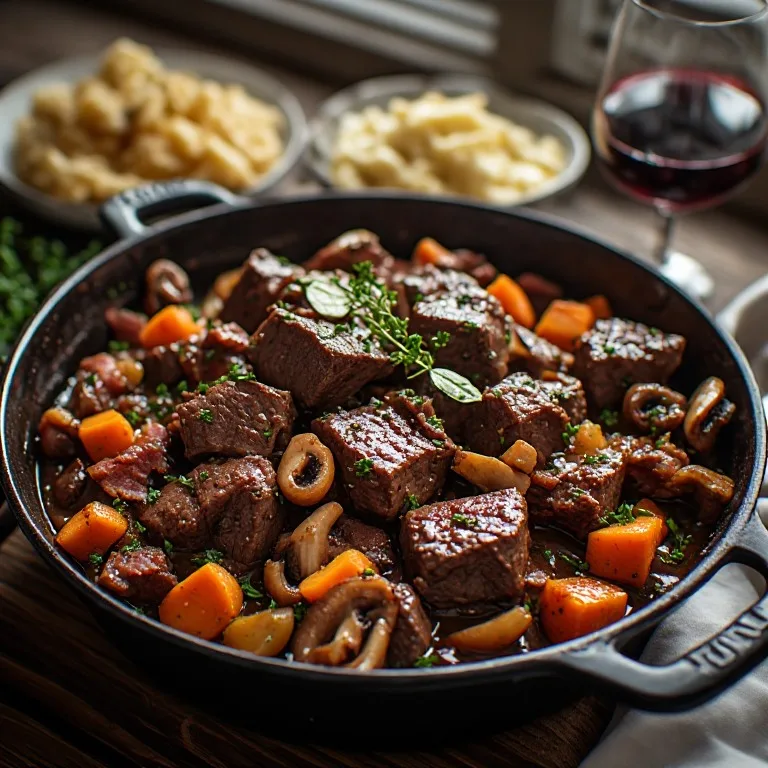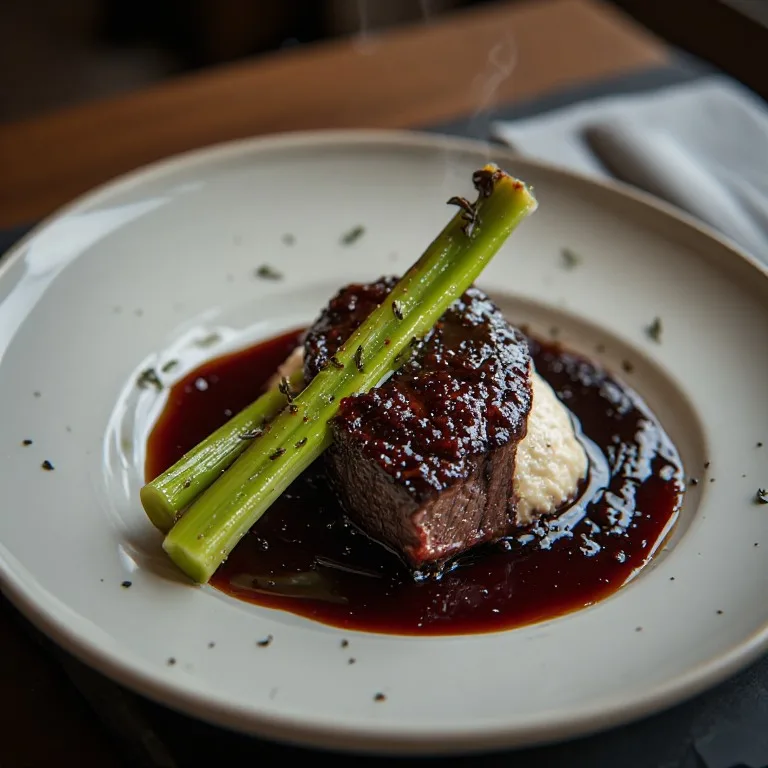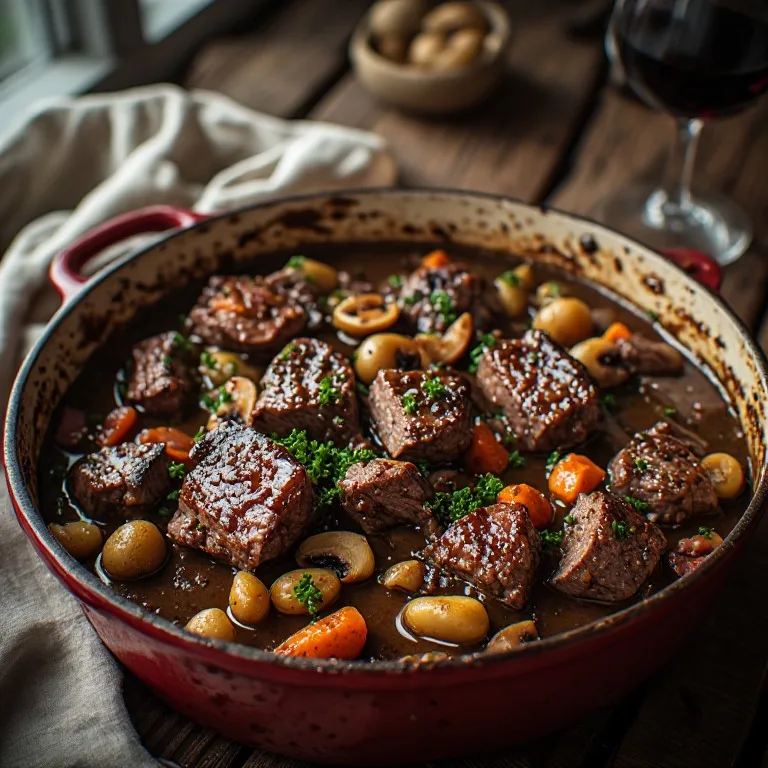



Julia Child called her Boeuf Bourguignon “certainly one of the most delicious beef dishes concocted by man,” and after 60 years, no one has seriously argued otherwise.
This is the recipe from Mastering the Art of French Cooking (1961) — the landmark book Julia Child co-wrote with Louisette Bertholle and Simone Beck after eight years of training and teaching at Le Cordon Bleu in Paris. It is a long recipe by modern standards (about 4 hours start to finish), but most of that time is unattended braising. The active work is under an hour.
What makes Julia Child’s version different
The techniques are the recipe. Three things separate this from a generic “beef in wine” braise:
Drying the beef before searing. Every piece of beef must be completely dry before it touches the hot fat. Wet meat steams; dry meat browns. Julia is emphatic about this. The deep, mahogany crust that forms from a dry sear is what gives the sauce its color, richness, and depth. Rushing this step produces gray, steamed beef and a wan sauce.
Searing in uncrowded batches. One batch at a time, never touching. When pieces touch, they trap steam between them and can’t form a crust. Julia specifically warns against crowding in the headnote.
A low, long oven braise at 325°F. Not a stovetop simmer. The gentle, all-around heat of the oven produces a more evenly braised result than direct stovetop heat, which concentrates at the bottom. The braise takes 3 to 3.5 hours at 325°F — patient and hands-off.
The “Julie & Julia” connection
The dish found a second audience in 2009, when Nora Ephron’s film Julie & Julia opened with Amy Adams (as food writer Julie Powell) attempting the boeuf bourguignon — and failing on the first try. The film was a hit and sent Mastering the Art of French Cooking back onto the bestseller list, 48 years after its first printing.
How to serve it
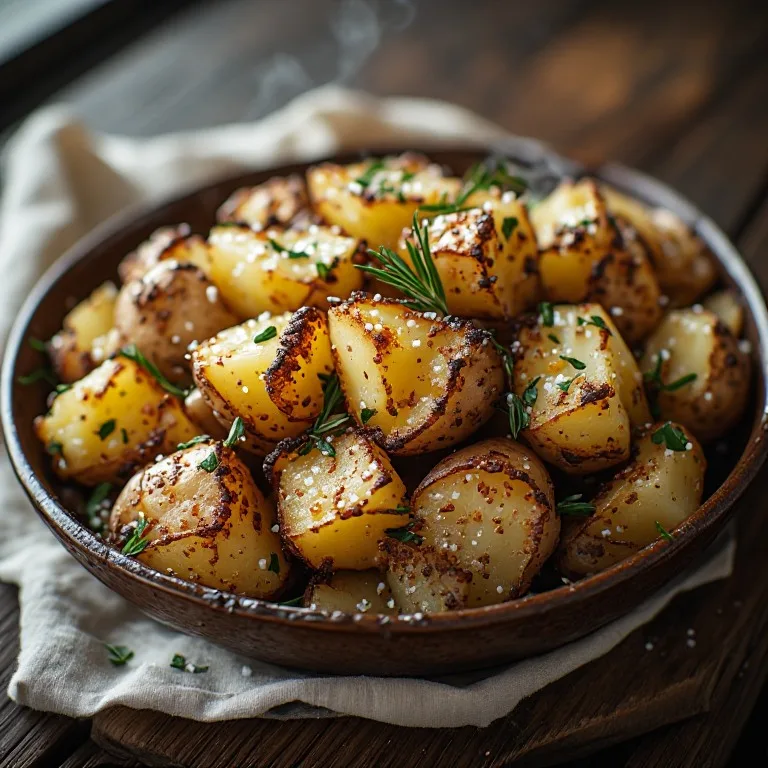
Julia Child serves boeuf bourguignon with boiled potatoes, egg noodles, or steamed rice. The sauce is rich enough to soak into any starch. A crusty baguette is non-negotiable. The dish holds well for 3 days in the refrigerator and is genuinely better the next day — the flavors meld overnight and the solidified fat layer lifts off cleanly, producing a leaner, cleaner sauce on reheating.