


Pin It

Viral TikTok Beef Bourguignon (Julia Child's Classic, Actually Doable at Home)

Viral TikTok Beef Bourguignon (Julia Child's Classic, Actually Doable at Home)
Jump to Recipe
Prep 40 min Cook 3 hr 20 min Serves 6
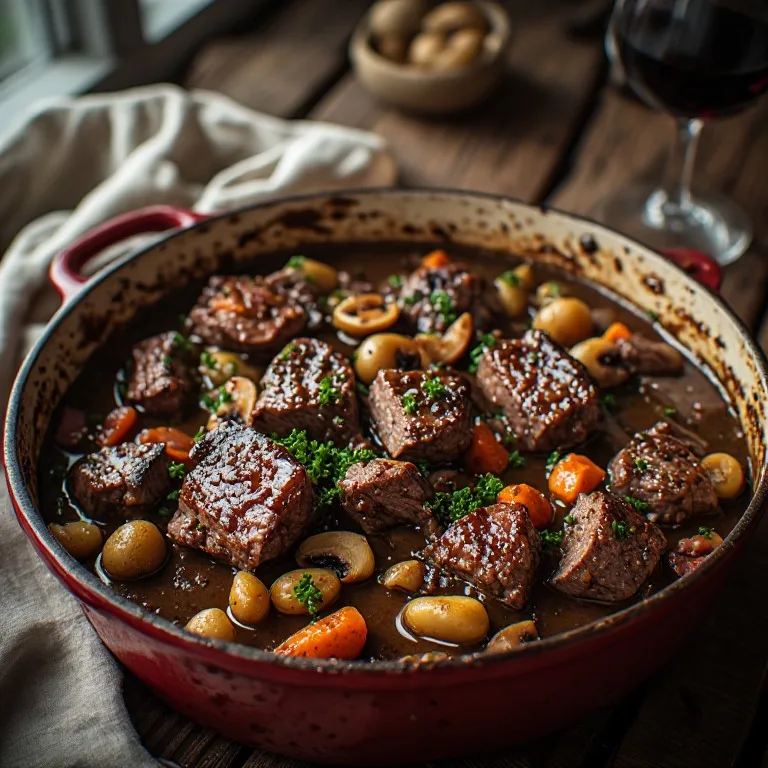
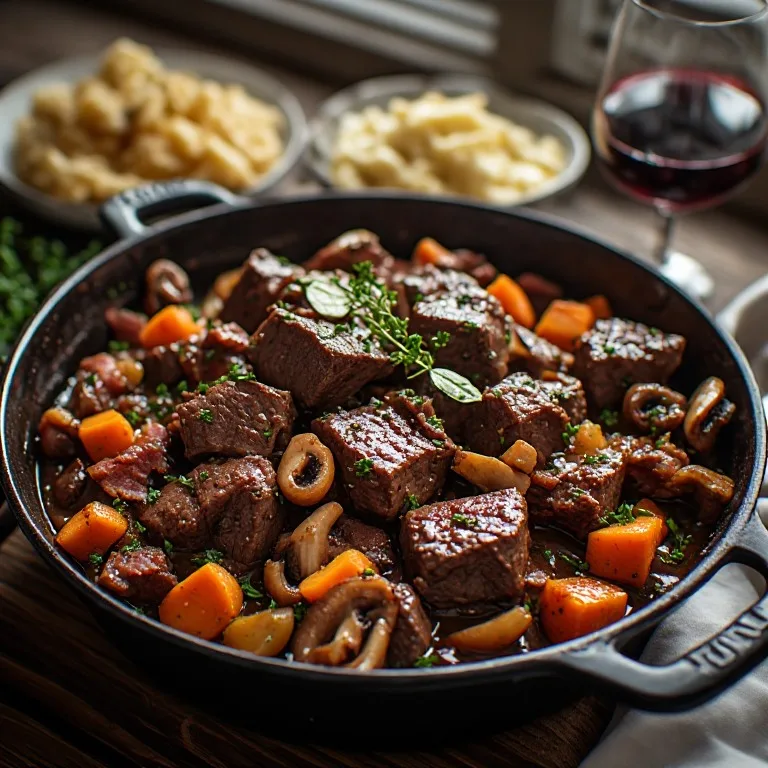
Quick answer: Pat 3 lbs of beef chuck cubes completely dry and season generously with salt and pepper. In a large Dutch oven, render 6 oz of lardon-cut bacon until golden, then remove it. Brown the beef in batches in the bacon fat — single layer, 3 to 4 minutes per side, no crowding — until deeply seared all over. Remove beef, soften 1 diced onion and 2 sliced carrots in the same pot. Add 3 garlic cloves, 1 tablespoon tomato paste, and 2 tablespoons flour; stir 2 minutes. Return beef and bacon to the pot. Pour in 1 full bottle (750ml) of dry Burgundy or Pinot Noir plus 2 cups beef stock — liquid should nearly cover the beef. Add a bouquet garni (bay leaf, thyme, parsley). Bring to a simmer, cover, and transfer to a 325°F oven for 2.5 to 3.5 hours until the beef is fork-tender but still holding its shape. In the last 45 minutes, separately sauté 1 lb halved cremini mushrooms in 2 tablespoons butter over high heat until golden, then add to the braise. Skim the fat from the surface before serving over egg noodles, mashed potatoes, or crusty bread.

Shop the tools

Gear matched to this recipe. These are Amazon affiliate links — we may earn a small commission if you buy, at no extra cost to you.

As an Amazon Associate, Copycat Spices earns from qualifying purchases. Product images are generic illustrations, not the exact item listed.

Viral TikTok Beef Bourguignon (Julia Child's Classic, Actually Doable at Home)

The TikTok beef bourguignon trend is real: a full bottle of wine, salt pork lardons, separately sautéed mushrooms, and 3 hours in the oven produce a braise that tastes like a Burgundy bistro. Three technique fixes make or break it.

Medium Prep: 40 min Cook: 3 hr 20 min Total: 4h 0m6 servings ~$4.50/serving
Prep40 min
Cook3 hr 20 min
Total4h 0m
Servings
6
At home~$4.50/serving
vs
Restaurant~$20.25/serving
You save ~78%

The Story Behind the Recipe

The TikTok beef bourguignon trend is real: a full bottle of wine, salt pork lardons, separately sautéed mushrooms, and 3 hours in the oven produce a braise that tastes like a Burgundy bistro. Three technique fixes make or break it.

Nutrition Facts

Per serving (6 servings)
Calories580
Total Fat32g
Total Carbs18g
Dietary Fiber3g
Sugars6g
Protein42g
Sodium780mg

* Estimated values based on standard recipe preparation. Actual values may vary.

Ingredients

  • For the braise
  • Mushroom garnish (do not skip)
  • Pearl onion garnish (optional but worth doing)
  • To serve

Instructions

💡
Pro tip: This recipe tastes even better the next day. The flavors need time to meld together in the fridge.
❄️
Storage: Keeps in an airtight container in the fridge for up to 2 weeks. Freezer-friendly for up to 3 months.
🎃 Free Halloween cookbook — download now The Copycat Halloween Cookbook A ready-made, photo-illustrated PDF of our best halloween copycat recipes — free to download, no building required. Pay what you want to support if you love it.

Free PDF — instant download. We'll also send new seasonal copycat recipes now and then; unsubscribe anytime. Or just download it →

Beef bourguignon has a reputation for being a weekend project — something you tackle when you want to feel like a serious cook. Julia Child made it famous in America in 1961, and for decades it was the recipe that home cooks either tackled once with great ceremony or bookmarked and never actually made.

TikTok changed the framing. Starting around 2024, a wave of creators began showing the Dutch oven version: one pot, one bottle of wine, a Sunday afternoon, and a result that looks and tastes like a Burgundy bistro. The format went wide because the dish has genuine TikTok DNA — the moment you pull the lid off a braised-for-three-hours pot of wine-dark beef is immediately watchable, and the gap between “this seems intimidating” and “oh, that’s just browning things in sequence” is real and satisfying to close on camera.

The recipe is not difficult. It is long. There is a difference. Understanding what each step actually does — why you dry the beef, why you sear in batches, why the mushrooms get their own pan — turns a checklist into a logical sequence you can execute without looking at your phone every 30 seconds.

The Three Things That Separate Good Beef Bourguignon from Great

1. The sear is the flavor. Every bite of the finished dish tastes of the Maillard reaction that happened in the first 20 minutes. The brown crust on each cube of beef, plus the dark fond built up on the bottom of the Dutch oven, dissolves into the wine-stock liquid and becomes the sauce. Beef that is wet when it hits the pan cannot brown — the moisture forms steam, the pan temperature drops, and the beef turns gray. The fix: dry the beef with paper towels until the surface is genuinely dry, not just not-wet. Then sear in a single layer with space between pieces, on a properly hot surface, without moving the beef until it releases naturally with a real brown crust.

2. Mushrooms get their own pan. Mushrooms added to the beginning of a 3-hour braise become pale, waterlogged, and invisible — they surrender all their moisture to the liquid and soften into nothing. Mushrooms sautéed separately in butter over high heat until they’re golden and dense, then added in the last 30 to 45 minutes, stay present in the finished dish. They have their own texture, their own depth, and they absorb the braising liquid without dissolving into it. This is the step most TikTok shortcuts drop — and it’s the one that most noticeably separates a restaurant version from an approximation.

3. The wine matters more than the technique. A $12 Pinot Noir or Côtes du Rhône used correctly produces a better result than a $40 bottle handled carelessly. What matters: it must be dry (not sweet, not semi-sweet), it must be something you’d actually drink, and there must be a full bottle of it. The wine reduces significantly over three hours. Watering it down with only half a bottle makes a fine beef stew but not beef bourguignon — the Burgundy-wine character is the point, and you need the full volume to get the concentrated depth that makes the sauce glossy and complex.

Oven vs. Slow Cooker vs. Instant Pot: Times at a Glance

All three start the same way — render the lardons, sear the beef, build the base on the stovetop. That browning step is non-negotiable in every method; it’s where the flavor comes from, and no slow cooker or pressure cooker can create it. Only the braise changes:

  • Dutch oven (best flavor): covered at 325°F for 2.5 to 3.5 hours. The long, even, low-moisture heat develops the most layered flavor and reduces the sauce naturally.
  • Slow cooker (most hands-off): LOW for 8 to 10 hours. More fall-apart than the oven version; add the sautéed mushrooms in the last 45 minutes.
  • Instant Pot (fastest): high pressure for 45 to 50 minutes with a natural release, then reduce the sauce on sauté mode for 10 to 15 minutes since pressure cooking doesn’t evaporate liquid.

The oven method wins on flavor because of the extended Maillard-reaction exposure; the Instant Pot wins on speed. All three produce fork-tender beef.

Make It a Day Ahead

Beef bourguignon is genuinely better reheated. As it cools overnight in the refrigerator, the fat solidifies on the surface and can be lifted off cleanly — a step that’s nearly impossible with hot liquid. The flavors integrate more fully. The beef firms up slightly and holds together better when reheated gently over low heat. If you’re cooking this for a dinner party, make it the day before and you’ll serve a calmer, better dish while your guests arrive.
🥗

Make It Healthier

Love Viral TikTok Beef Bourguignon (Julia Child's Classic, Actually Doable at Home) but want a lighter version? Try these simple swaps:

  • ✓The bacon lardons contribute significant fat and sodium to the dish. For a lighter version, replace them with pancetta (leaner than American bacon) or skip entirely and use 2 tablespoons of olive oil for searing. The dish loses some pork depth but gains about 20g fat reduction per serving.
  • ✓Beef chuck is higher in fat than round or eye of round, but the fat is what keeps the meat tender during the long braise. A leaner cut like beef round technically works but produces a drier, less satisfying result. If fat is a concern, the better adjustment is a smaller serving size with more egg noodles, which dilutes the fat per bowl without changing the recipe.
  • ✓The recipe is naturally gluten-free if you skip the 2 tablespoons of flour — the sauce will be slightly thinner but can be reduced more aggressively on the stovetop after braising. Alternatively, whisk 1 tablespoon of cornstarch into 2 tablespoons of cold water and stir it into the hot liquid after removing the beef; simmer 3 minutes to thicken.

Frequently Asked Questions

Why does my beef bourguignon turn out gray and stew-like instead of deep and glossy?

The answer is almost always the sear. Beef that isn't completely dry before it hits the pan steams instead of browns — the surface moisture turns to steam, the temperature of the fat drops below the Maillard reaction threshold (~280°F), and the beef turns gray rather than developing the brown crust that becomes the flavor base for the entire braise. You need three things: pat the beef dry with paper towels until the surface is genuinely dry, not just 'not dripping'; cook in a single layer with space between pieces (crowding causes the same steaming problem); and wait until the fat in the pan is truly hot before the beef touches it — a drop of water should evaporate in under a second. One batch of properly seared beef generates more fond (the browned bits stuck to the bottom) than three batches of improperly seared beef, and that fond is the entire flavor foundation of the finished dish.

Do I have to use a full bottle of wine? Can I use half?

A full 750ml bottle is the standard and it's correct. During the 3-hour braise, the wine reduces significantly, the alcohol cooks off entirely, and what's left is concentrated grape depth and acidity that balances the richness of the beef fat. Using half a bottle makes the braise too stock-forward — it tastes like a good beef stew rather than beef bourguignon. The wine also tenderizes the muscle fibers during the long cook (acidic liquid breaks down connective tissue more effectively than neutral stock alone). One critical rule: use a wine you'd drink. It doesn't need to be expensive Burgundy — a $12–15 Pinot Noir or Côtes du Rhône is ideal — but avoid anything labeled 'cooking wine' (it contains salt and preservatives that become concentrated and unpleasant in a long reduction). Cheap, very jammy wines like some Merlots can also turn muddy. Dry, earthy, relatively tart red wine is what you want.

What cut of beef should I use?

Beef chuck — specifically the chuck roast, cut yourself into 2-inch cubes — is the correct choice. Chuck has a high concentration of collagen-rich connective tissue and intramuscular fat that dissolves into gelatin over the long braise, giving the finished sauce its silky, sticky body. Lean cuts like sirloin or round steak become stringy and dry; they need short, high-heat cooking, not 3-hour braising. Pre-cut 'stew beef' from the supermarket works but the pieces are often inconsistent in size, which means some are overcooked while others are undercooked. Buying a chuck roast and cutting it yourself takes 5 minutes and gives you even 2-inch cubes that cook uniformly. Beef short ribs (bone-in) work beautifully and produce an even more luxurious sauce but are harder to serve and more expensive.

Should I marinate the beef overnight?

Julia Child did not include an overnight wine marinade in her original recipe, and many serious cooks (including many who've analyzed the dish on Serious Eats and in French culinary texts) argue the marinade step adds little once the beef braises in wine for 3-plus hours anyway. The main argument for marinating: the wine begins the tenderizing and flavor-penetration process earlier. The argument against: acid marinades can alter the surface texture of the beef, making it harder to sear cleanly (the surface becomes slightly sticky and more prone to steaming). If you want to marinate, 4 to 8 hours is enough — overnight is overkill for beef chuck because the collagen breakdown at room temperature is negligible without heat. The more useful advance step is making the entire dish a day ahead and reheating it; like most braises, beef bourguignon tastes better on day two.

Can I make this in a slow cooker or Instant Pot instead of the oven?

Both work with adjustments. Slow cooker: still sear the beef and render the lardons on the stovetop first — do not skip this step, as slow cookers cannot develop fond or achieve the browning temperature. Transfer everything to the slow cooker, add the wine and stock, cook on LOW for 8 to 10 hours. The result is more fall-apart than the oven version (the constant temperature and steam create a more aggressive braise). Add the mushrooms in the last 45 minutes or sauté and stir in right before serving. Instant Pot: sear in sauté mode, then pressure cook on high for 45 to 50 minutes with a natural release. The sauce won't reduce as much — after pressure cooking, remove the beef, then use sauté mode to reduce the liquid for 10 to 15 minutes until it coats a spoon. The Instant Pot version is faster but the oven version develops better layered flavor from the longer Maillard-reaction exposure.

Why cook the mushrooms separately and add them late?

Mushrooms added at the beginning of a 3-hour braise become waterlogged, pale, and soft — they release all their moisture into the liquid, lose their texture entirely, and contribute nothing visible to the finished dish. Mushrooms sautéed separately in butter over high heat for 6 to 8 minutes until they're golden and slightly shrunken produce a completely different ingredient: dense, meaty, with caramelized depth from their own Maillard reaction. Adding those mushrooms to the braise in the last 30 to 45 minutes gives them enough time to absorb some of the wine-beef liquid and contribute to the sauce without dissolving. The same logic applies to the pearl onions — they're sautéed separately with butter and a pinch of sugar until lightly glazed, then added late to keep their shape. Both steps are extra work, but they are why a proper beef bourguignon has distinct components with different textures rather than an undifferentiated stew.

What do I serve beef bourguignon with?

Classic accompaniments in order of authenticity: (1) Egg noodles — the most traditional French pairing; the wide, slightly slippery noodles hold the sauce well and the neutral wheat flavor doesn't compete with the wine-beef depth; (2) Boiled or mashed potatoes — mashed potatoes are arguably the best vehicle because you can drag them through the sauce; pommes purée (50% butter French-style mashed potatoes) is the restaurant version; (3) Crusty bread — baguette or sourdough to mop the sauce; (4) Polenta — a modern adaptation that works beautifully, especially soft polenta with Parmesan; (5) Steamed white rice — not traditional but extremely practical; the sticky grains absorb the sauce efficiently. Avoid pasta shapes with ridges or holes (rigatoni, penne) — they compete with the sauce rather than carrying it.

Can I make beef bourguignon ahead? How does it reheat?

Beef bourguignon is actually better made a day or two ahead. As it cools, the fat solidifies on the surface and can be lifted off cleanly (this deglazing step is nearly impossible with hot liquid), and the flavor of the wine and beef continue to integrate overnight. The beef also holds together better when cold — it firms up slightly during refrigeration and reheats to a better texture than freshly braised beef, which can be too soft straight from the oven. To reheat: remove the solidified fat cap, then warm gently over low heat on the stovetop with the lid on, adding a splash of beef stock if the sauce has reduced too thick overnight. Never bring it to a boil when reheating — aggressive heat at this stage will make the already-tender beef fall apart into shreds. Target temperature: hot through but not bubbling. It keeps refrigerated for up to 4 days and freezes well for up to 3 months.

Do I need to make the pearl onion garnish? It seems like a lot of work.

The pearl onion garnish — blanched, peeled, and glazed in butter and sugar — is the most labor-intensive component of a traditional beef bourguignon, and it's also the component most consistently skipped by TikTok recipe creators. The honest assessment: the glazed pearl onions add a sweet-savory pop and a contrasting texture that is genuinely worth having in the final dish, but they're not essential to the braise itself. If you're making this for a dinner party, do the pearl onions — they're the visual and textural detail that elevates the dish from 'excellent beef stew' to 'something from a Burgundy bistro.' If you're making it for a weeknight or don't want to peel 20 tiny onions, substitute 1 cup of frozen pearl onions (thawed and sautéed in butter and sugar for 5 minutes) or skip the step entirely and add a few extra shallots to the braise itself. The frozen pearl onion substitution captures 80% of the effect at 10% of the effort.

Love this recipe? Share it!

Free PDF: our 12 most-wanted copycat recipes — instant download.

Made it? Buy us a coffee

Every recipe here is free, with no paywalls. If this one was a hit at your table, a small tip keeps new copycats coming.

$

Ratings & Reviews

—
No ratings yet

Rate this recipe

Click a star to rate

Leave a Review

0/500

CS

Copycat Spices Editorial

Researched + fact-checked. Every recipe on Copycat Spices is built from published sources — official ingredient lists, brand-published recipes, interviews and food-science references — and fact-checked before it goes live, then written as clear, step-by-step instructions for home cooks of all skill levels.

Learn more about our mission →