

Copycat La Scala Beverly Hills Chopped Salad (The 1956 Kardashian-Famous Original)
Prep time: 25 min (plus 30 min to marinate chickpeas) Cook time: None Servings: 4
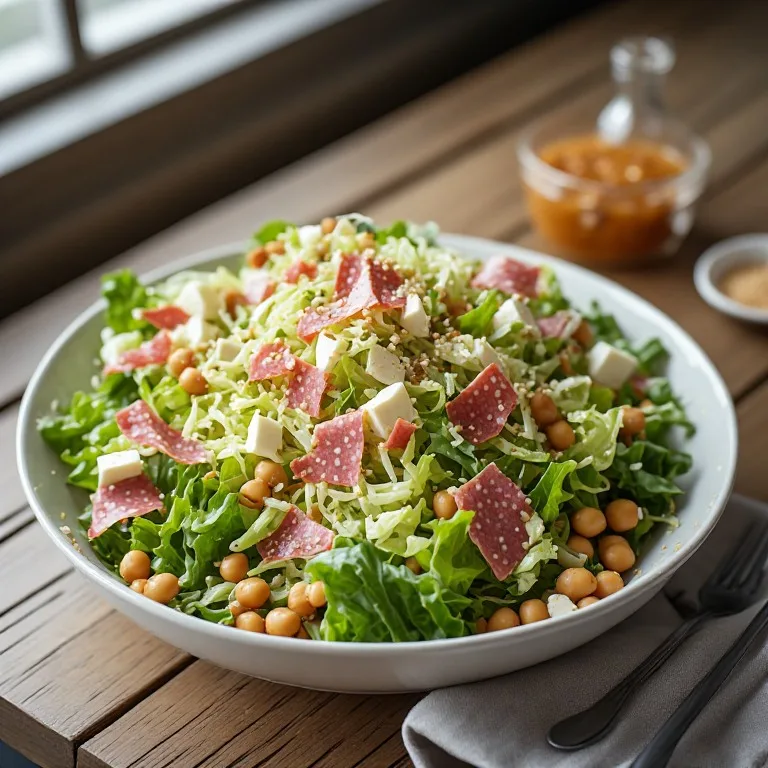
The short version: La Scala’s chopped salad is Genoa salami, fresh mozzarella, and marinated chickpeas over cut iceberg lettuce, dressed in the original “Leon dressing” — red wine vinegar, dry mustard powder, and garlic, in a ratio that is intentionally more acidic than a standard vinaigrette. Every ingredient is cut to the same 1/2-inch size so every forkful has everything. It has been on the menu in Beverly Hills since 1956. Kim Kardashian made it viral; Jean Leon made it first.
Jean Leon opened La Scala at 434 N Canon Drive in Beverly Hills in April 1956. Leon had come from Spain — born Juan Lleonart Molet in Santander, he fled Franco’s Spain, worked his way into the American restaurant industry (including time at Villa Capri in Hollywood, where he crossed paths with Frank Sinatra), and built La Scala with the specific intention of creating the kind of restaurant Beverly Hills lacked: Italian-American, elegant without being stiff, with a kitchen that understood produce.
The restaurant attracted a remarkable clientele quickly. Frank Sinatra became a regular. Marilyn Monroe, Elizabeth Taylor, Judy Garland, Jack Nicholson, Sammy Davis Jr. — the list reads like a decade of Oscar nights. Six U.S. presidents have dined there over the restaurant’s history. John F. Kennedy was among the regulars before his 1960 presidential campaign; JFK’s name is associated with the restaurant throughout multiple accounts from the period.
The chopped salad was part of the menu from the beginning, though not in the precise form it took later. The original version was a gourmet salad with larger pieces; the story goes that celebrities found it messy to eat without a knife, so Jean Leon and his daughter Gigi developed a fully chopped version — everything cut uniformly small enough to eat in single forkfuls. That solved the problem and created a signature. The Los Angeles Times published the original “Leon dressing” recipe in 1989, making it widely reproducible outside the restaurant for the first time.
Jean Leon died in 1996, and his daughter Gigi Leon has run the restaurant since. Around 2020, Kim Kardashian was filmed eating the salad on Keeping Up with the Kardashians and referenced it on social media, setting off a wave of people calling it the “Kardashian salad” and hunting for the recipe. La Scala is celebrating its 70th anniversary in 2026. The salad is still on the menu.
Three Things Most Copycats Get Wrong
1. Not marinating the chickpeas
This is the most consistently skipped step, and it is the one that most determines whether the salad tastes like the restaurant version or a sad deli salad.
Canned chickpeas straight from the can are starchy, mildly salty, and bland. In a salad with only four main components, every element needs to carry flavor. The La Scala version marinates the chickpeas — tossed with olive oil, garlic, and dried oregano for at least 30 minutes, and ideally overnight. After marinating, the chickpeas have absorbed the olive oil and garlic; they taste of both, and they contribute something specific to the salad rather than just adding bulk.
The marinade oil also has a secondary effect: it coats the chickpeas so they do not immediately absorb all the dressing when tossed. Marinated chickpeas hold their flavor longer once the salad is dressed. Uncoated canned chickpeas act like sponges.
Plan this ahead. Marinate the chickpeas the night before and they are ready to go at assembly time.
2. Using Dijon mustard instead of dry mustard — or using too mild a vinegar ratio
The original Leon dressing uses dry mustard powder, not Dijon. This is not a minor variation. Dijon adds creaminess and a forward, punchy mustard flavor. Dry mustard adds a clean, background heat without changing the texture of the vinaigrette. In the Leon dressing, the vinegar stays dominant and the mustard stays in the background — it sharpens rather than thickens.
The ratio also matters more than most vinaigrettes. The original runs closer to 2:1 oil-to-vinegar, considerably more acidic than the standard 3:1 ratio most recipes use. This aggression is deliberate: the dressing needs to cut through Genoa salami’s fat and fresh mozzarella’s creaminess. A standard mildly acidic vinaigrette disappears. The Leon dressing should taste almost sharp on its own — assertive enough to register against the other ingredients.
3. Cutting to inconsistent sizes
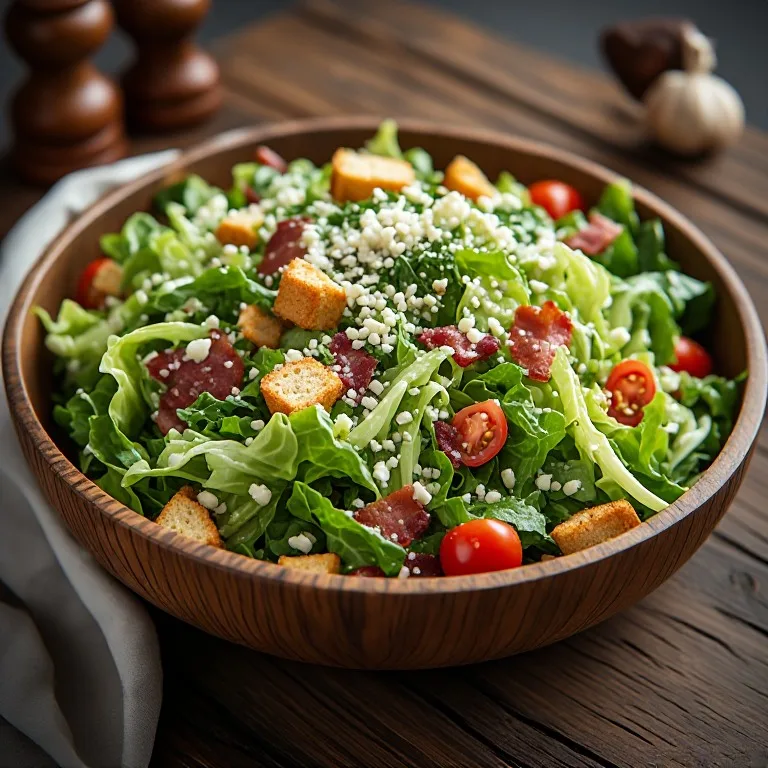
“Chopped salad” describes a technique, not a presentation style. The point is that every ingredient is cut to the same size — roughly 1/2 inch — so every forkful of the salad contains a piece of salami, a piece of mozzarella, a chickpea, and a piece of lettuce simultaneously.
When the salami is in long strips, the mozzarella is in 1-inch wedges, and the lettuce is roughly torn, what you have is a salad where the bites vary: some bites are mostly cheese, some are mostly lettuce, some are all salami. The flavor is inconsistent from one forkful to the next. The uniform-cut version requires more knife work, but the result is a completely different eating experience — every bite tastes like the whole dish.
Take the time to cut the salami into 1/2-inch pieces, cut the mozzarella into 1/2-inch cubes, and cut the iceberg into 1/2-inch pieces. Use the chickpeas as your visual guide — everything should be roughly chickpea-sized.
Why Iceberg and Not Romaine
The original La Scala recipe uses iceberg, which surprises people accustomed to seeing romaine in modern salads. Iceberg is not a lesser lettuce here — it is the right one.
Iceberg has a firm, crunchy structure that holds up to dressing significantly longer than romaine. In a chopped salad where everything is the same small size, you need a lettuce that stays crispy for the first ten minutes of eating. Romaine, at 1/2-inch pieces, wilts quickly once dressed — the dressing infiltrates the cut edges and the leaves lose their structure fast. Iceberg at the same size stays firm.
Iceberg also has a neutral, clean flavor that does not compete with the salami, mozzarella, or dressing. Romaine has a slightly bitter, more pronounced flavor that can introduce a competing note. In a minimal four-ingredient salad, each element’s flavor contribution is magnified.
A mix of iceberg and romaine is a reasonable modern adaptation if you prefer a little more texture contrast. Pure romaine works if that is what you have. But iceberg is the original and it is the more forgiving choice.
The Leon Dressing
The Los Angeles Times published the original Leon dressing recipe in 1989, making it the authoritative source for proportions. The key points:
- Dry mustard, not Dijon — fully whisk the powder into the vinegar before adding oil, or it will clump
- More vinegar than standard — the roughly 2:1 oil-to-vinegar ratio sounds sharp until you taste it against salami and mozzarella, at which point it is exactly right
- Two cloves of garlic, grated — not minced, not sliced; grating the garlic disperses it through the dressing rather than leaving pieces that hit someone in a forkful
- No herbs in the dressing itself — the herbs go in the chickpea marinade, not the vinaigrette
The dressing can be made up to two days ahead and kept refrigerated. Whisk or shake before using; the dry mustard emulsification is not as stable as Dijon’s and the dressing may separate on standing.
Make-Ahead Strategy
The components all prepare ahead; the assembled salad does not:
- Marinated chickpeas: make up to 2 days ahead, refrigerated in their marinade
- Leon dressing: make up to 2 days ahead, refrigerated; re-whisk before using
- Salami: cut up to 4 hours ahead, stored in the refrigerator
- Mozzarella: cut no more than 1 hour ahead — fresh mozzarella releases moisture as it sits
- Iceberg: cut up to 4 hours ahead, dried thoroughly, wrapped in paper towels, refrigerated
With all components ready, assembly takes under two minutes. This makes it a reliable party salad — everything prepped, assembled at the last possible moment.