


Copycat Canlis Salad (Seattle’s Legendary Salad Since 1950, Made at Home)
Prep time: 20 min Cook time: 15 min Servings: 4 to 6
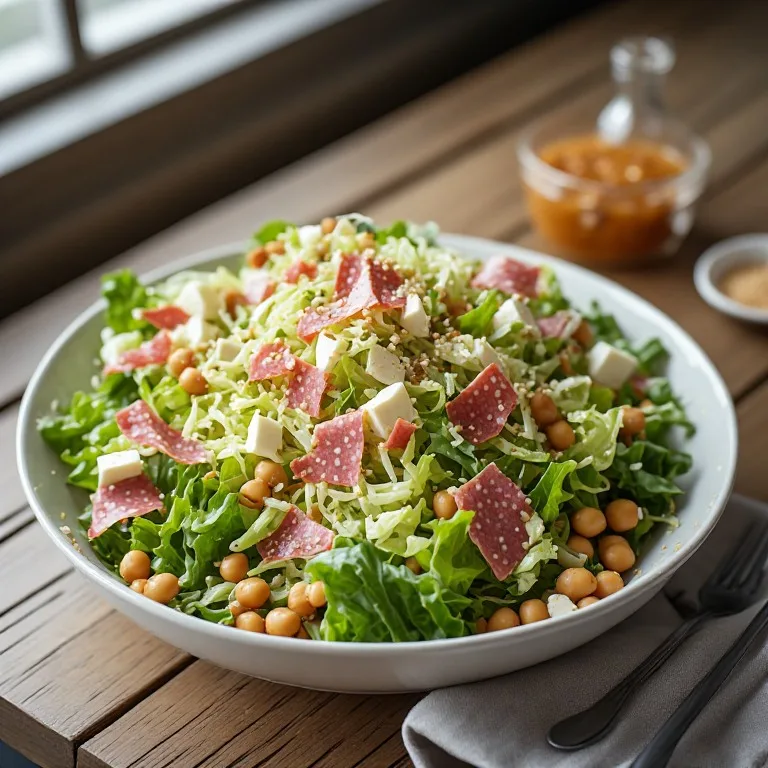
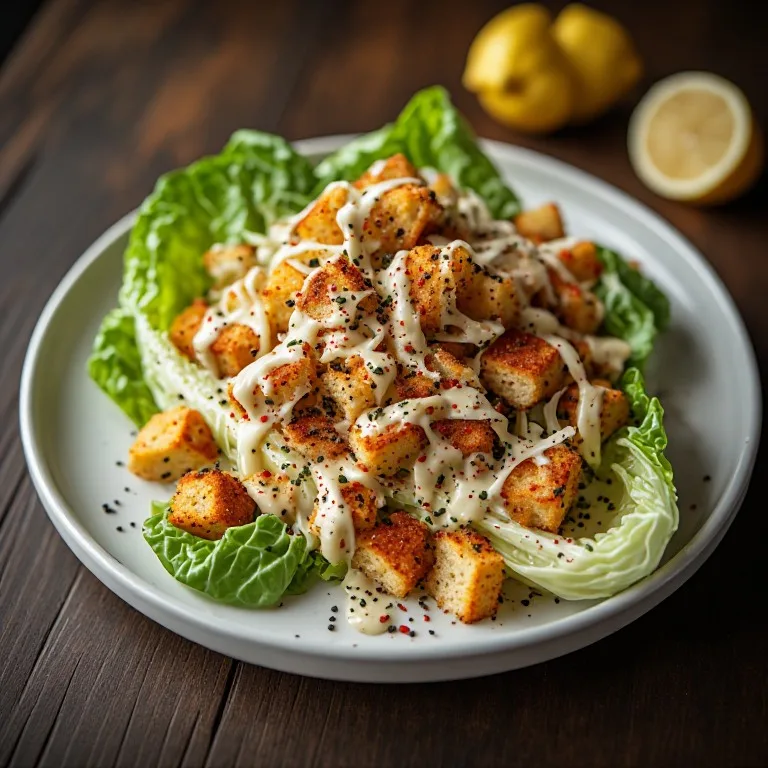
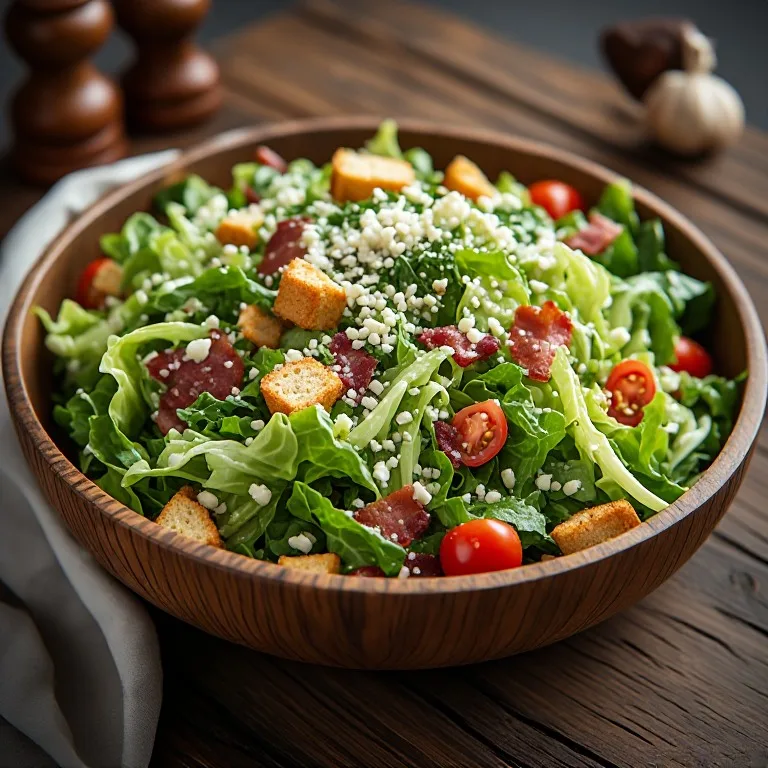
The short version: The Canlis Salad is a garlic-bowl-tossed romaine salad with crispy bacon, a full cup of fresh mint, fresh oregano, cherry tomatoes, croutons, and Pecorino Romano, dressed in a bright lemon-and-olive-oil vinaigrette bound with a one-minute coddled egg. It looks like a Caesar but shares none of its defining ingredients — no anchovy, no Worcestershire, no Dijon, and sharp sheep’s-milk Romano instead of Parmesan. The mint and the Romano are what make it taste like nothing else. It has been on the menu at Seattle’s Canlis restaurant since 1950.
Canlis opened in Seattle in 1950. Peter Canlis had spent time in Hawaii running restaurants there before moving to the Pacific Northwest, and he built the restaurant he wanted to eat in — an open-air mid-century design perched above Lake Union with views across the water, designed by Roland Terry, with service modeled on European fine dining. The restaurant is still in the same building. The Canlis family — now in its third generation — still runs it. It has never closed.
The salad has been on the menu since the beginning. The family traces the recipe to Peter Canlis’s Lebanese mother, and before her to a great-grandmother. It has evolved in small ways over the decades — the herbs shifted from dried to fresh; cherry tomatoes replaced sliced ones — but the architecture has not changed. Tableside preparation was the original format, and it is still performed at the restaurant today: a server builds the salad in a wooden bowl at the table, rubbed with garlic, dressed with a lemon-egg vinaigrette, and tossed to order.
Mark Canlis, the current co-owner, is on record saying two things about the salad. First: use as much mint as you want — you cannot over-mint it. Second: it is not a Caesar salad. Both pieces of guidance are more meaningful than they appear.
This Is Not a Caesar Salad
The comparison to Caesar comes up constantly, and it is understandable — both salads use romaine, both use an egg-based dressing, both use lemon and garlic, both are built in a bowl tableside. But the comparison misses what makes the Canlis Salad distinct.
Caesar salad is built on anchovy. The paste goes into the dressing, and the dressing’s savory, umami-forward punch is the point. Worcestershire sauce and Dijon reinforce that depth. The cheese is Parmesan — nutty, rich, and comparatively mild.
The Canlis Salad has no anchovy, no Worcestershire, no Dijon. The dressing is a simple lemon-and-olive-oil emulsion with a coddled egg as the binder — it is bright and acidic, not thick and savory. The cheese is Pecorino Romano, not Parmesan. Romano is aged sheep’s milk; it is sharper, saltier, and more assertive than Parmesan. In a clean lemon dressing with no anchovy backdrop, the Romano’s edge does work that Parmesan cannot.
And then there are the herbs. Caesar has no herbs. The Canlis Salad uses a full cup of fresh mint and two tablespoons of fresh oregano. This is not a garnish — it is a flavor lane. The mint runs through every bite. The combination of mint, oregano, lemon, and Romano has roots in Lebanese and Greek cooking, which tracks directly to the recipe’s origin in Peter Canlis’s family.
The result is a salad that is herbal, acidic, and bright where Caesar is savory, umami-rich, and coating. Both are excellent. They are not the same dish.
The Four Failure Modes
1. Substituting Parmesan for Romano
This is the most common substitution and the one that does the most damage. Parmesan is a milder, less salty, more broadly appealing cheese than Romano — which is exactly why it fails here. The Canlis Salad has no anchovy and no Worcestershire to provide savory depth. Without those flavors, the cheese and the lemon are the two dominant voices in the dressing. Romano’s sharp edge is essential to the balance. Parmesan in the same quantity produces a flat, slightly bland salad that has the right structure but missing the tension. Buy a block of Pecorino Romano and grate it to order.
2. Cutting the mint
Home cooks see “1 cup fresh mint, thinly sliced” and assume it is a typo, or they reduce it to a modest garnish. A cup of fresh mint, thinly sliced across every bite of romaine, is what the salad is. It is not optional and it is not a small amount. The combination of mint and oregano in a lemon-based dressing is where the distinctive, memorable quality of the Canlis Salad lives. Reducing it produces a good green salad; keeping it produces the specific salad that has been on a Seattle menu for 75 years.
3. Dressing wet lettuce
The romaine must be bone-dry before it is tossed. Moisture on the leaves dilutes the dressing immediately, preventing it from coating and clinging. Even a small amount of surface moisture — residual from washing, from the refrigerator, from the air — creates a pooled, diluted dressing in the bottom of the bowl within two minutes. Wash the romaine, spin it dry, pat with paper towels, and refrigerate until the moment you are ready to toss.
4. Overdressing
The recipe makes a full half-cup of dressing for a reason: extra dressing is at the table if the salad needs it after tossing. You should use roughly two-thirds of the batch. A heavily dressed Canlis Salad goes heavy and wet; the lemon vinaigrette is not a thick Caesar that clings on its own — it needs restraint. Dress in stages, toss, and taste before adding more.
The Bacon Method
The water-start technique for bacon is worth understanding. When you drop bacon cubes directly into a hot dry pan, the exterior protein sets and starts to brown before the internal fat has had time to render — the result is bacon that looks done outside but has a slightly under-rendered, chewy center.
Starting in water changes the dynamic: the water brings all surfaces of the bacon to the same temperature gradually, and as it evaporates, the internal fat has already begun to melt. By the time the pan goes dry and the bacon starts crisping in its own rendered fat, it is crisping from a fully rendered interior rather than a raw one. The result is uniformly crispy bacon with noticeably less grease. It takes a few extra minutes but produces better texture.
The Coddled Egg
Coddling sounds technical and is not. Boil water, pour it into a mug, drop in the whole egg in its shell, wait one minute, remove. One minute in water that started at boiling but immediately begins to cool produces an egg where the outermost layer of white is barely set and the yolk is completely liquid. This is the emulsifier for the dressing — it gives the lemon-oil combination the slight body that keeps it from immediately separating on the cold romaine.
The difference from a raw egg is minimal in practice — a coddled egg produces a slightly creamier, less liquidy texture than raw, and the brief heat exposure reduces (though does not eliminate) the raw egg risk. Either a coddled egg or a pasteurized raw egg works here.
Tips & Variations
- Romaine hearts beat whole heads. The pale inner leaves of romaine hearts have a sweeter flavor and a firmer crunch than the outer dark-green leaves, and they are less bitter. Canlis uses the inner leaves. If you start with whole heads, discard the outer leaves and use only the interior.
- The garlic-rubbed bowl is not decorative. Pressing a cut garlic clove hard into the wooden bowl interior, covering all surfaces, deposits garlic oil directly into the wood. Every subsequent leaf of romaine picks up a trace of that garlic as it is tossed — more evenly distributed and more subtle than minced garlic added to the dressing.
- Do not use bottled lemon juice. The acidity in bottled lemon juice (citric acid) has a slightly sharper, chemical character compared to fresh. In a dressing with only four ingredients, the lemon is the dominant acid note — bottled juice changes it noticeably.
- Fresh oregano, not dried. The recipe calls for fresh oregano. Dried oregano works as an emergency substitute at about one-third the quantity, but fresh oregano has a less pungent, more delicate quality that suits the light vinaigrette better than dried. Many produce sections carry fresh oregano year-round.
- Make it gluten-free by omitting croutons. The croutons are excellent and add crunch, but the salad holds up without them. A handful of toasted pine nuts or roughly chopped walnuts adds back the textural interest without gluten.
- For a dinner party: prep everything except the toss. The Canlis Salad is unusually well-suited to dinner party service — all components prep ahead, the bowl is prepped ahead, and the final toss takes under a minute tableside. The theatrical element of tossing at the table in the garlic-rubbed wooden bowl is part of the restaurant experience and completely replicable at home.
Canlis at Home vs. Making a Reservation
Canlis is not Carbone-difficult to book, but it is not a casual walk-in. Dinner reservations are generally available a few weeks out through their website; same-day and last-minute seats are rare. The restaurant is in Seattle’s Queen Anne neighborhood at 2576 Aurora Ave N, open for dinner nightly. The salad has been on the menu continuously since 1950.
The home version eliminates the view of Lake Union. It replicates the salad itself completely — the mint, the Romano, the lemon, the crispy bacon, the garlic bowl. Canlis the restaurant has made the salad recipe publicly available over the years in interviews and published sources precisely because they trust the dish. The salad’s identity is the technique and the ingredients, not a secret ratio you need to travel to Seattle to discover.
Storage
The dressed salad does not store — it wilts within fifteen minutes. Components hold well separately: cooked bacon covered at room temperature for two hours, or refrigerated for three days; croutons in an airtight container for up to three days; dressing refrigerated for up to twenty-four hours (whisk to recombine before using, as the emulsion will have broken); prepped romaine wrapped in paper towels and refrigerated for up to one day.
If you have leftover dressing, it is excellent on sliced tomatoes, roasted vegetables, or grilled fish.
More Famous Restaurant Salads and Starters
- Copycat Via Carota Insalata Verde — the legendary simple green salad from the West Village restaurant that built its reputation on this dish alone
- Copycat Charlie Bird Farro Salad — the warm farro salad with lemon, olive oil, Parmesan, and whatever is in season, from the SoHo restaurant that made farro salad a category
- Copycat Balthazar French Onion Soup — the classic French bistro standard, done the way Balthazar does it: long-caramelized onions, proper beef stock, and a broiled Gruyère cap