

Copycat Momofuku Bo Ssam (The Legendary Korean Pork Feast, Made at Home)
Prep time: 20 min (plus overnight cure) Cook time: 6 hr 30 min Servings: 10
There are dishes that are merely very good. Then there are dishes that change what you think a feast is supposed to feel like. Bo Ssam is the second kind.
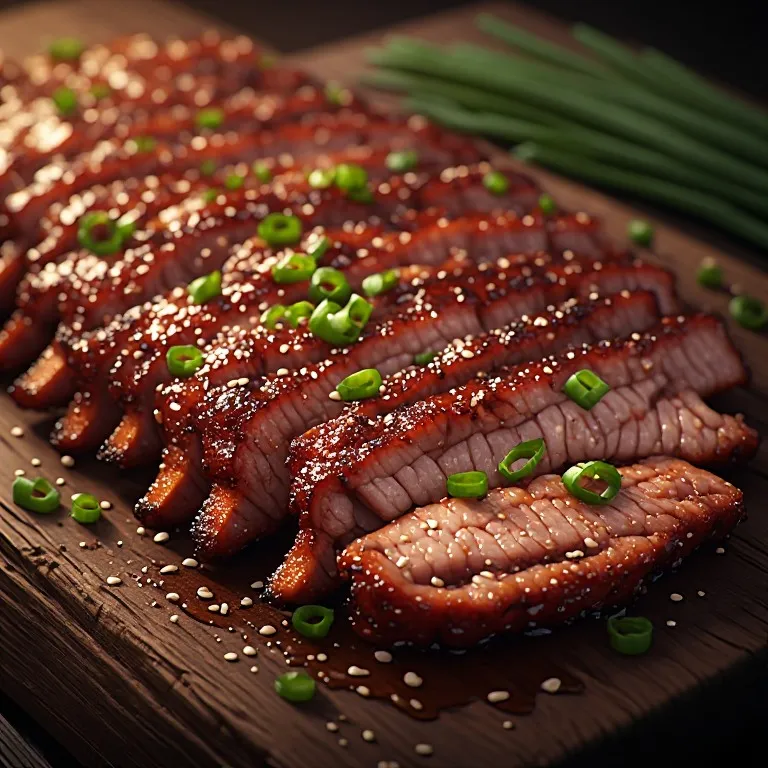
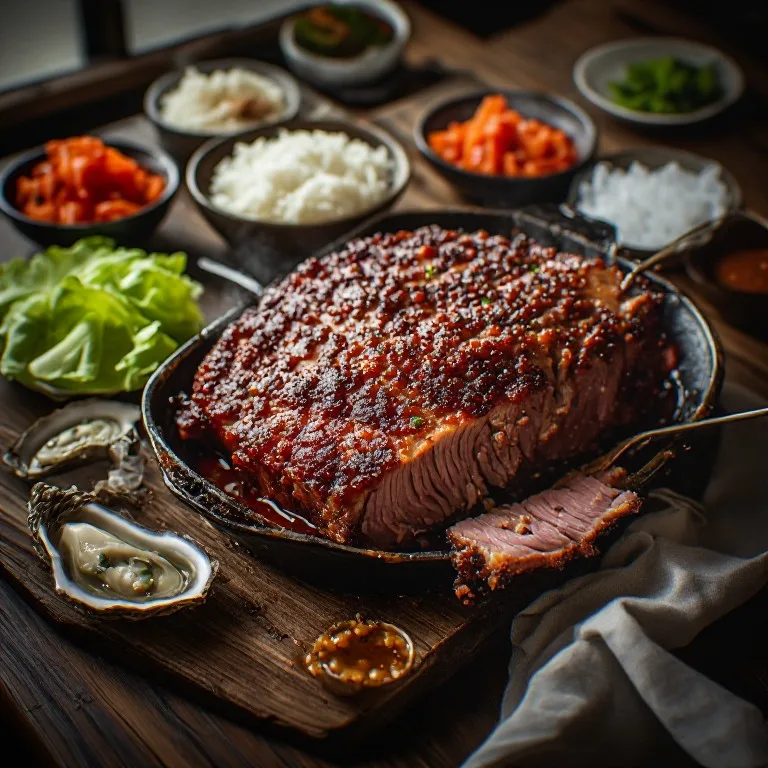
David Chang’s slow-roasted pork shoulder — cured overnight in sugar and salt, roasted at 300°F for six hours until it collapses, then finished in a 500°F oven with a brown sugar crust that caramelizes dark amber — was the signature offering at Momofuku Ssäm Bar from the time the restaurant opened in the East Village in 2006. It was designed to be ordered by a whole table, not a single person. You reserved it a day or two ahead. It arrived whole. You pulled it apart at the table with two forks.
Ssäm Bar served its last dinner on September 30, 2023 and is permanently closed. That is the practical case for learning this recipe: making Bo Ssam at home is now the only way to eat the real thing — and it costs roughly $80 to feed ten, about $8 to $10 a head.
The recipe is not difficult. It is mostly time. The hands-on work — the cure, the sauces, the crust — takes about 40 minutes across two days. The rest is the oven.
Why This Is the Easiest Technically Impressive Dish You Can Make for a Crowd
Most feast-level dishes require either skill (dry-aged beef, whole fish en croûte) or equipment (a smoker, a deep fryer, a proper tandoor). Bo Ssam requires neither. The cure is salt and sugar rubbed by hand. The roast is a single temperature for six hours. The glaze is brown sugar stirred with salt.
What makes it technically impressive is the outcome: a whole pork shoulder with a caramelized, slightly crackling crust that shatters under fork pressure to reveal falling-apart meat that tastes both deeply porky and subtly sweet. People who eat it for the first time at a dinner party frequently ask what restaurant supplied it.
The secret is time, not technique. Six hours at 300°F converts the collagen in a pork shoulder from tough connective tissue into liquid gelatin — which is why the meat collapses rather than slices, and why each pull of meat has a rich, glossy quality that does not come from fat alone.
The Cure: Why Both Sugar and Salt Are Required
The cure is not decorative. It does two distinct things.
The salt draws moisture out of the outermost layer of the pork through osmosis, then migrates back into the meat — seasoning the pork well below the surface and changing its texture at the molecular level. Pork that has been dry-cured overnight tastes differently from pork that has just been seasoned at the surface before roasting: the flavor is in the meat, not on it.
The sugar does something the salt cannot: it creates the foundation for the caramelized crust at the end of the recipe. During the six-hour low roast, the sugar that remains on the surface begins to dry and partially caramelize. When you apply the brown sugar rub and blast it with 500°F heat, the residual sugar from the cure bonds with the fresh brown sugar to form a dark, complex crust rather than a thin, even glaze.
This is also why you brush the cure off rather than washing it. Washing removes the sugar that the long roast has begun to incorporate into the meat’s surface layer. Brushing removes the thick excess while leaving the thin layer of dissolved cure that will become part of the crust.
The Roast: What “Done” Actually Looks Like
The recipe says six hours at 300°F. That is the target, not a guarantee. A very large, dense shoulder may need six and a half or seven hours. A smaller one may be done at five and a half.
The correct test is the fork: insert a fork into the thickest part of the meat, away from the bone, and twist gently. When the pork is done, it will collapse with almost no resistance and the meat will fall apart in large chunks. The texture you are looking for is fully yielding — not just soft, but structurally without tension. If there is any springback when you press the fork, it needs more time.
A thermometer reading of 195°F to 205°F in the thickest part (avoiding the bone) correlates with this texture in most cuts. At this internal temperature, the collagen in the connective tissue has fully converted to gelatin. Below 185°F, you will have properly cooked pork, but it will not pull the way Bo Ssam should. Higher than 210°F and you risk drying out the muscle fibers despite the gelatin — pull it before this.
The bone will eventually wiggle and feel loose when the shoulder is fully done. This is a reliable secondary indicator.
The 30-Minute Rest Before the Crust
The rest step confuses people because it seems like you are losing heat at the wrong moment. You are not. You are drying the surface.
A pork shoulder fresh from a six-hour roast is steaming: hot, moist, and coated in rendered fat and basting juices. If you apply brown sugar to this surface and put it back in a 500°F oven, the moisture will flash to steam and the sugar will steam rather than caramelize. The result is a pale, sticky glaze rather than a dark, brittle crust.
Thirty minutes of uncovered resting at room temperature lets the surface lose enough moisture that when the brown sugar touches it, caramelization begins within the first two or three minutes at 500°F. The fat, now less agitated, will begin to bubble gently rather than spatter. The crust forms in distinct patches — darkest over the high points of the pork’s surface — and produces the visual and textural contrast that makes the dish.
Do not tent the resting pork. Tenting traps steam and defeats the purpose of the rest.
The Ginger-Scallion Sauce Is the Dish
This is the opinion of most people who cook Bo Ssam more than once. The pork is extraordinary. But the ginger-scallion sauce is what makes it the specific dish it is.
Sliced raw scallions combined with minced or grated raw ginger, a neutral oil, a small amount of soy sauce, sherry vinegar, and salt — that is the entire sauce. It is not cooked. It is assembled and then left to sit for 15 minutes while the flavors meld.
The function of the sauce is to cut. Six hours of slow-roasted pork shoulder produces rich, fatty, deeply savory meat. The ginger-scallion sauce brings sharpness, heat, green freshness, and acidity. Together they make a wrap that tastes complete in a way that neither element achieves alone.
The sherry vinegar is not optional. Straight vinegar (white or red wine) works but lacks the complexity. Rice vinegar is too mild. Sherry vinegar has a nutty, slightly oxidized character that bridges the raw ginger and the oil in a way the others do not.
The sauce will be noticeably better after 15 minutes of resting than it is immediately after mixing. Make it before the brown sugar crust step.
The Ssam Sauce: Ssamjang vs. Gochujang
The ssam sauce is where the Korean identity of the dish is concentrated. It uses two fermented chili products, which are related but different.
Gochujang is fermented chili paste — predominantly hot, with deep umami from the fermentation process (cooked glutinous rice, fermented soybeans, red pepper). It is intensely flavored and primarily provides heat and umami.
Ssamjang is a compound condiment built on gochujang and doenjang (fermented soybean paste), blended with sesame oil, garlic, and aromatics. It is thicker, earthier, and more complex than gochujang alone — less hot, more layered. The green tub of ssamjang is available at any Korean grocery store, H Mart, and most Asian supermarkets.
The Bo Ssam sauce uses both: ssamjang provides the fermented, complex base, and additional gochujang adds heat. The sherry vinegar lightens the paste and the neutral oil creates a pourable consistency. The ratio matters — do not double the gochujang looking for more heat, or the sauce becomes hot in one dimension without depth.
What It Costs to Make at Home
The restaurant is gone, so there is no reservation to compare against — but the home math is what makes this dish worth the effort: a feast-format centerpiece for a table of ten at roughly the cost of a couple of restaurant entrées.
| Item | Cost |
|---|---|
| Bone-in pork shoulder (8–10 lb) | $25–40 |
| Sugar, salt, scallions, ginger, ssamjang, gochujang | $15–20 |
| Rice, kimchi, bibb lettuce | $10–15 |
| A dozen oysters (optional) | $15–25 |
| Total for ~10 people | ~$60–100 |
| Per serving | ~$8–10 |
The pork shoulder itself is the bulk of the cost — roughly $25 to $40 for an 8 to 10 pound bone-in shoulder at grocery store or butcher prices, about $3 to $4 per pound. Everything else is pantry-scale. The oysters are the one line item that meaningfully moves the total, and they are optional.
The Oyster Question
The Ssäm Bar version of Bo Ssam was served with a dozen raw oysters on crushed ice at the table. They are not a condiment for the pork — they are served separately, and eaten between bites. But the combination of a raw oyster followed immediately by a bibb lettuce wrap with caramelized pork, ginger-scallion sauce, and kimchi is a well-documented experience that regular diners call the best thing about the feast.
The logic: briny, cold, mineral oyster → warm, fatty, sweet-savory pork → sharp, gingery sauce → crunchy, acidic kimchi. Each element in the sequence contrasts with the last. Nothing feels like too much of anything.
You can absolutely skip the oysters — the Bo Ssam is a complete dish without them. But if you have 10 people around a table for this meal, a dozen oysters on ice costs $15 to $25 and converts the dinner from a very good pork roast to a proper event. Buy them from a reputable fish market the same day. East Coast varieties (Wellfleet, Blue Point, Malpeque) have the brine and mineral quality that works best here.
How to Set Up the Table
The traditional Bo Ssam table layout:
- Center: the whole pork shoulder in the roasting pan, two forks for pulling
- Left of pork: steamed rice in a bowl with a small serving spoon
- Right of pork: bibb lettuce leaves fanned on a plate
- Small bowls: ginger-scallion sauce, ssam sauce, kimchi (add sliced fresh jalapeño and thinly sliced garlic if you want more heat options)
- Oysters (if using): on crushed ice in a wide shallow bowl or ice bed, with a small oyster fork or regular fork
People build their own wraps. There is no wrong ratio. The only mistake is to not pile in enough ginger-scallion sauce.
Variations
The overnight bake version: Some cooks do the full roast in two stages — 300°F for 3 hours the evening before (wrapped overnight in the fridge), then back at 300°F for 3 more hours the next day before the brown sugar finish. The result is identical; the split simply makes the timeline easier to manage.
Without a bone-in shoulder: A boneless pork shoulder (butt) at 6 to 8 pounds will work. Reduce the roasting time by about 30 to 45 minutes and check the fork test at the 5-hour mark. The texture is slightly less rich than the bone-in version — expect good pulled pork rather than the unctuously gelatinous quality of the bone-in original.
Smaller format: A 4 to 5 pound bone-in shoulder works for a dinner of 4 to 5 people. Halve the cure quantities; roasting time is approximately 4 to 4.5 hours. The brown sugar finish time is unchanged (10 to 15 minutes at 500°F).
No ssam sauce on hand: Substitute a mix of 2 tablespoons white miso paste, 1 tablespoon gochujang, 1 tablespoon rice vinegar, and 1 tablespoon neutral oil. It captures the fermented-savory quality of ssamjang at the cost of some complexity.
Storage
Leftover Bo Ssam is legitimately excellent. The pork reheats beautifully: pull any leftover meat into chunks, add a splash of water or broth to a covered pan, and reheat over low heat until warm and steaming. The brown sugar crust softens during storage but the flavor persists.
Leftover pork works in:
- Fried rice with kimchi and a fried egg
- Ssam tacos (same concept, corn tortilla instead of lettuce)
- Korean pork ramen (reheat in good chicken stock with gochujang and top with a soft egg — see our spicy miso ramen technique for the tare base)
- Loaded ssam nachos (chips + pulled pork + kimchi + ssam sauce + scallions)
The pork keeps refrigerated for 4 days. The ginger-scallion sauce keeps refrigerated for up to 3 days; it will lose some of its sharp freshness but remains perfectly good. The ssam sauce keeps for 2 weeks.