


Pin It

Lou Malnati's Deep Dish Pizza (The Lou)

Lou Malnati's Deep Dish Pizza (The Lou)
Jump to Recipe
Prep 30 min Cook 35 min Serves 4
Quick answer: Lou Malnati's deep dish is defined by two things almost no copycat recipe gets right: sliced whole-milk mozzarella (not shredded — thick overlapping slabs that melt into a single pulled layer) and a sausage blanket that covers the entire pizza edge to edge, not just the center. The crust is enriched with more butter than other deep dish styles, giving it a distinctly flaky, pastry-like bite. As with all Chicago deep dish, the assembly is inverted: cheese directly on the raw dough first, sausage blanket on top of the cheese, chunky tomatoes last. The pizza opened in Lincolnwood, Illinois in 1971 by Lou Malnati, whose father Rudy Malnati Sr. is credited by food historians with developing the original deep dish recipe at Pizzeria Uno in 1943. Today Lou Malnati's has 60+ locations and ships nationwide; a medium at the restaurant runs about $28.

Shop the tools

Gear matched to this recipe. These are Amazon affiliate links — we may earn a small commission if you buy, at no extra cost to you.

As an Amazon Associate, Copycat Spices earns from qualifying purchases. Product images are generic illustrations, not the exact item listed.

🎃 Free Halloween cookbook — download now The Copycat Halloween Cookbook A ready-made, photo-illustrated PDF of our best halloween copycat recipes — free to download, no building required. Pay what you want to support if you love it.

Free PDF — instant download. We'll also send new seasonal copycat recipes now and then; unsubscribe anytime. Or just download it →

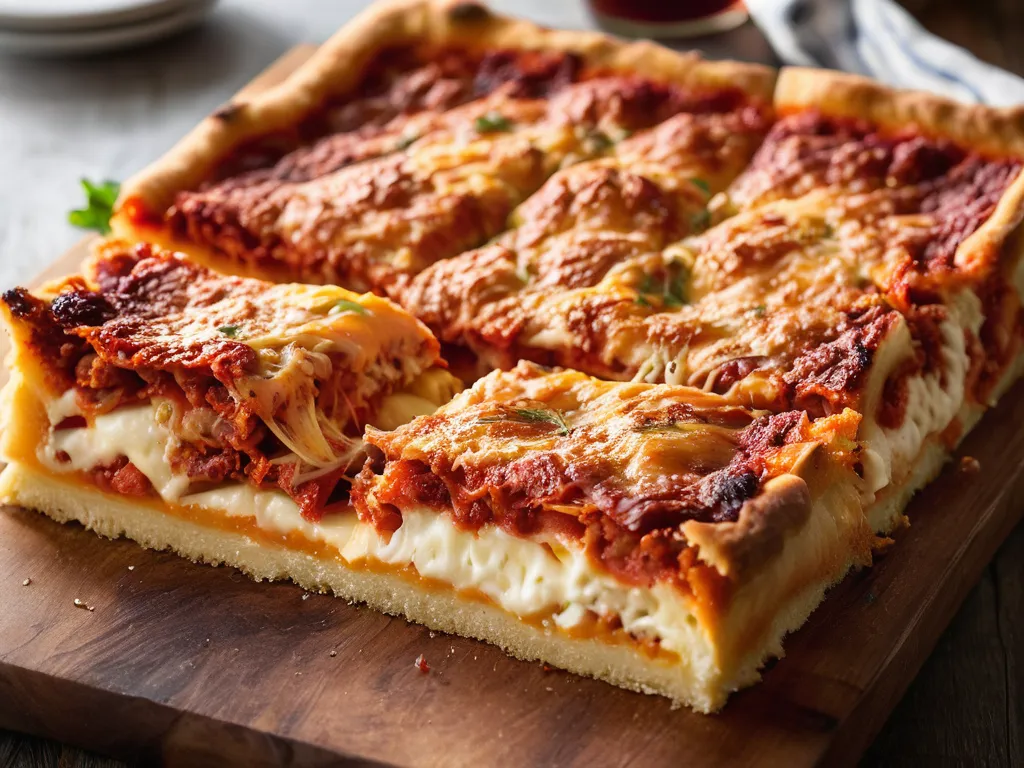
Lou Malnati’s deep dish is not just a thicker pizza. The entire assembly runs backward from every other pizza you’ve made: cheese goes down first on the raw dough, a full blanket of sausage gets pressed on top of the cheese from crust edge to crust edge, and cold chunky tomatoes get spread over everything last. The sauce never touches the dough. The cheese never touches the sauce. And the thing that distinguishes a Lou Malnati’s from every other deep dish is that the mozzarella is sliced, not shredded — thick overlapping slabs that fuse during baking into a single pulled layer, so every slice comes out as a clean cross-section of crust, cheese, sausage, and tomato without anything sliding apart.

Lou Malnati opened his restaurant in Lincolnwood, Illinois in 1971. His father Rudy Malnati Sr. was the chef who developed the deep dish pizza recipe at Pizzeria Uno in 1943. Lou grew up in the pizza business, refined his father’s formula over decades, and built what is now the most-visited deep dish pizzeria in Chicago. The restaurant ships frozen pies nationwide; at the restaurant, the signature medium runs about $28.

The two things most copycat recipes get wrong

Shredded mozzarella. Pre-shredded cheese contains cellulose (an anti-caking coating) that prevents it from melting together. Sliced whole-milk mozzarella — cut 1/4 inch thick from a block — fuses into one cohesive layer. Buy a block, slice it yourself.

Sausage in the center only. The Lou Malnati’s sausage is a blanket, not a patty. It covers the pizza all the way to the crust edge. Press bulk sausage into a flat sheet in the pan, covering every inch of cheese below. This is not optional for the authentic texture — scattered or crumbled sausage migrates into the cheese and loses the cross-section.

The butter crust

Lou Malnati’s calls its crust a “butter crust” explicitly — more enriched than the triple-fat formula at Pizzeria Uno, leaning heavily toward butter. The dough contains more butter per cup of flour than a standard deep dish recipe, which is what produces the flaky, almost pastry-like bite at the edges. Small amount of cornmeal goes on the pan bottom (not in the dough) — this is where the subtle gritty texture comes from. For a crust at the opposite end of the spectrum — thin, hand-tossed, and sweet — see our honey-enriched Papa John’s pizza dough.

What to expect from each component

The crust: golden and flaky at the sides, with a distinct lacy-crisp bottom where the butter fried against the cornmeal-dusted pan. It should hold its structure when you lift a slice — not collapse inward.

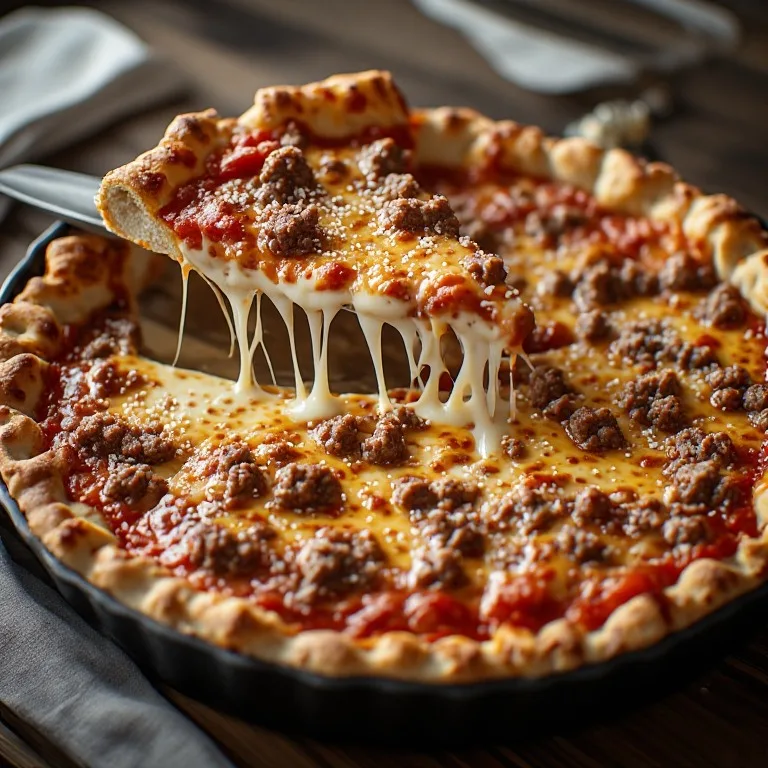
The cheese: one cohesive pulled layer, not individual melted pieces. When you lift a slice, the cheese should stretch between the slice and the rest of the pizza, then snap cleanly. This is only possible with sliced whole-milk mozzarella.

The sausage: a distinct, intact layer — not broken up into crumbles mixed into the cheese. Each bite has a full cross-section of crust, cheese, sausage, and tomato.

The tomatoes: reduced, concentrated, slightly caramelized at the edges. Not wet or soupy — they should hold their position on the slice without running onto the plate.

Cost comparison
RestaurantHome
Small (6”)~$15—
Medium (9”)~$28—
Large (12”)~$35—
Home 9” (4 servings)—~$12
Per serving—~$3
Notes
  • Cheese-only version: Skip the sausage and double the mozzarella (1 lb / 450g sliced). Increase bake time by 3 minutes.
  • Pepperoni version: After the sausage blanket, lay 3 oz (20 slices) of pepperoni over the sausage before adding the tomatoes.
  • Pan size: A 10-inch cast iron skillet produces a thinner, crispier pizza; a 9-inch round cake pan (2 inches deep) produces a taller, more restaurant-like depth. Both work.
  • Shipping: Lou Malnati’s ships frozen deep dish nationwide at loumalnatis.com — the home version here is close but the restaurant’s proprietary sausage seasoning is not publicly available; bulk Italian pork sausage with a little fennel seed added (1/2 tsp per pound) gets very close.

For the pizza that started it all, the Pizzeria Uno Original Deep Dish covers the 1943 Numero Uno build with the slightly different triple-fat crust formula. For a completely different thick-pan style with a caramelized cheese border baked into the edges, the Detroit-Style Pizza uses Wisconsin brick cheese and a rectangular pan. And if you’re going full Chicago, Portillo’s Italian Beef is the other dish the city is most obsessive about recreating at home.
🥗

Make It Healthier

Love Lou Malnati's Deep Dish Pizza (The Lou) but want a lighter version? Try these simple swaps:

  • ✓Swap the bulk Italian pork sausage for turkey Italian sausage — saves about 80 calories and 8g fat per serving with nearly identical seasoning.
  • ✓Use part-skim mozzarella instead of whole-milk to cut about 40 calories per serving, though the melt and pull will be slightly less dramatic.
  • ✓Add a layer of baby spinach or thinly sliced mushrooms between the sausage and tomatoes — it wilts invisibly into the pizza and adds fiber without changing the structure.
  • ✓Make two personal 6-inch pizzas instead of one 9-inch — easier to portion and a smaller pan crisps the bottom edge more aggressively for better crust-to-filling ratio.

Frequently Asked Questions

What makes Lou Malnati's different from Pizzeria Uno?

Three things distinguish them. First, Lou Malnati's uses sliced whole-milk mozzarella instead of shredded — the slices fuse together during baking into a single pulled layer with more stretch than shredded cheese can produce. Second, the sausage at Lou Malnati's is pressed as a full-coverage blanket that reaches the edge of the crust, not a central patty surrounded by bare cheese. Third, the butter content in the crust is higher, producing a crispier, more pastry-like bite. Pizzeria Uno uses a triple-fat formula (butter, olive oil, vegetable oil) in roughly equal measure; Lou Malnati's leans heavier on butter, which is why the restaurant explicitly calls it a 'butter crust.' The sauce philosophy is the same in both: chunky tomatoes always go on top, never underneath.

Does Lou Malnati's use cornmeal in the dough?

It's genuinely debated among people who have reverse-engineered the recipe. The restaurant calls it a 'butter crust,' not a 'cornmeal crust,' and former employees have said cornmeal is not in the dough itself — but it is dusted onto the pan before the dough goes in, which gives the crust bottom a subtle gritty texture and helps the crust release cleanly. This recipe follows that approach: a small amount of cornmeal dusted on the buttered pan rather than worked into the dough. If you want a fully smooth crust bottom, skip it.

Why sliced mozzarella instead of shredded?

Pre-shredded mozzarella contains cellulose (an anti-caking agent) that prevents the strands from fully fusing during baking. You end up with a cheese layer that's melted but grainy — it stretches but doesn't pull as a single cohesive sheet. Sliced whole-milk mozzarella (or mozzarella you shred yourself from a block) contains no anti-caking agents; the slices melt fully together into one thick layer that grabs the sausage above and the crust below, producing the iconic cross-section where a single cheese layer holds everything in place. Buy a block from the deli counter and slice it about 1/4 inch thick.

What is 'The Lou' at Lou Malnati's?

The Lou is the restaurant's signature build and the menu item most people mean when they say 'Lou Malnati's pizza.' It's a butter-crust deep dish with sliced whole-milk mozzarella, a full-coverage Italian sausage blanket, and chunky California vine-ripened tomatoes on top — no additional toppings. It's the purest expression of the restaurant's style: no pepperoni, no vegetables, nothing to compete with the three primary components. At the restaurant it runs about $15 for a small (6-inch) and $28 for a medium (9-inch) — prices vary by location.

What tomatoes does Lou Malnati's use?

Lou Malnati's uses California vine-ripened crushed tomatoes, applied cold directly from the can — they're not cooked into a sauce first. Most researchers identify them as a style similar to Stanislaus 6-in-1 crushed tomatoes or comparable California-grown plum varieties. The key characteristic: the tomatoes are applied very chunky, almost in large crushed pieces rather than a smooth puree, and lightly seasoned (salt, dried oregano at most). The oven heat is what reduces and concentrates them over the bake. Don't use Italian-style plum tomatoes here — they're too sweet and too wet; the California-style crushed tomatoes have a brighter, more acidic flavor that works with the rich cheese and buttery crust.

Can I make the dough ahead of time?

Yes, and a slow cold proof actually improves the crust. After mixing, shape the dough into a ball, cover tightly, and refrigerate for up to 48 hours instead of doing the 1-hour room-temperature rise. The slow fermentation develops more flavor compounds and produces a more extensible dough that presses into the pan without springing back. Pull it from the fridge 45 minutes before baking to let it relax. Cold-proofed dough also produces a crispier crust because less of the butter in the dough has had a chance to coat all the gluten — there's more free fat to fry the exterior against the hot pan.

How do I get the bottom of the crust crispy?

Two things: use a heavy pan (cast iron is ideal) and preheat it. Rub the pan generously with 2 tablespoons of softened butter, then place it in the 425°F oven for 5 minutes before pressing in the dough. The hot pan immediately starts frying the crust exterior the moment it makes contact — that's how you get a golden, lacy bottom rather than a pale, bready one. If using a standard round cake pan (at least 2 inches deep), room temperature is fine but extend the bake by 3–5 minutes. Dust the buttered pan with 1 tablespoon of fine cornmeal before the dough for the authentic slightly gritty crust bottom.

How do leftovers reheat?

Cast iron or a heavy skillet on the stovetop over medium-low heat, covered with a lid for 5–6 minutes. This re-crisps the crust bottom without drying out the cheese or sauce — the microwave produces a steamed, soggy result. If you don't have a skillet, an oven at 375°F for 10 minutes on a bare rack (not a baking sheet) works. Lou Malnati's ships their frozen pies nationwide and advises oven reheating from frozen at 425°F for 35–40 minutes; the same logic applies to leftover home slices, just much shorter.

Love this recipe? Share it!

Free PDF: our 12 most-wanted copycat recipes — instant download.

Made it? Buy us a coffee

Every recipe here is free, with no paywalls. If this one was a hit at your table, a small tip keeps new copycats coming.

$

Lou Malnati's Pizzeria is a trademark of its owner, used here only to describe the dish this recipe recreates. This is an independent copycat written in our own words — Copycat Spices is not affiliated with, endorsed by or sponsored by Lou Malnati's Pizzeria.

Ratings & Reviews

—
No ratings yet

Rate this recipe

Click a star to rate

Leave a Review

0/500

CS

Copycat Spices Editorial

Researched + fact-checked. Every recipe on Copycat Spices is built from published sources — official ingredient lists, brand-published recipes, interviews and food-science references — and fact-checked before it goes live, then written as clear, step-by-step instructions for home cooks of all skill levels.

Learn more about our mission →