


Pin It

Patsy's Italian Restaurant Meat Sauce

Patsy's Italian Restaurant Meat Sauce
Jump to Recipe
Prep 15 min Cook 2 hrs 15 min Serves 8
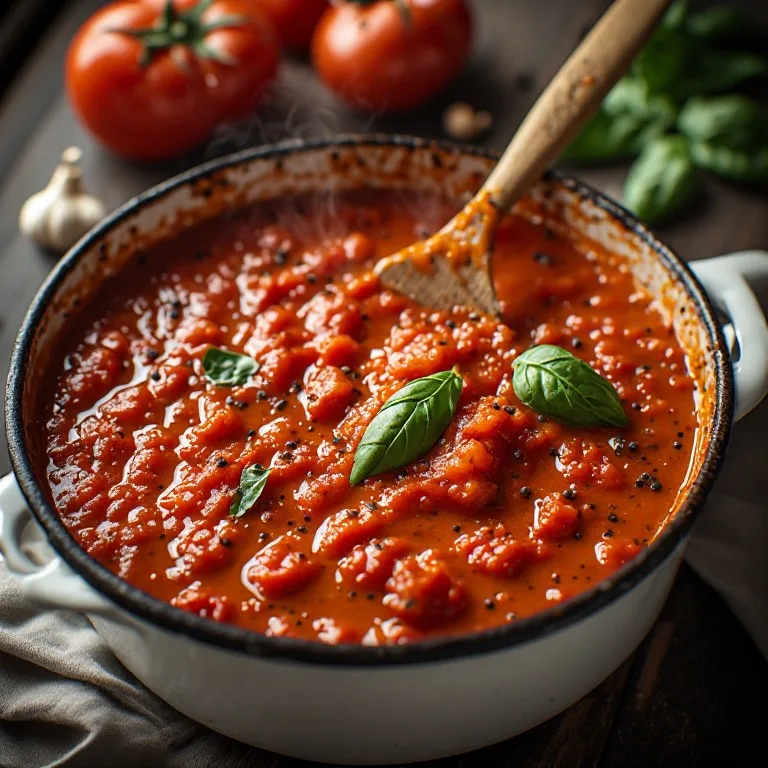
Quick answer: Brown 1 lb sweet Italian sausage (casings removed) and 1 lb ground beef 85/15 in 2 tbsp olive oil in a large Dutch oven over medium-high heat, breaking up the meat, until well-browned in spots — about 12 minutes. Transfer meat to a bowl with a slotted spoon, leaving some fat. Pour off all but 2 tbsp fat. Add 2 more tbsp olive oil over medium heat. Add 1 medium yellow onion (finely diced), cook 5 to 6 minutes until soft and golden. Add 6 minced garlic cloves, cook 1 minute. Add 1/2 cup dry red wine (or water), scrape up browned bits, cook 2 minutes until reduced by half. Open 2 cans (28 oz each) whole San Marzano tomatoes — crush each tomato by hand directly into the pot, pour in all the liquid. Season generously with salt and pepper. Return the browned meat to the pot; add a Parmigiano rind if you have one. Bring to a bare simmer, reduce heat to the lowest possible setting, partially cover, and cook 2 hours, stirring every 20 to 25 minutes. The sauce should shiver but never churn. At 2 hours it will be brick-red, deeply flavored, and noticeably thicker. Remove and discard the cheese rind. Stir in 10 torn fresh basil leaves. Adjust salt. Toss with 1 lb cooked spaghetti, finish with grated Parmigiano.

Shop the tools

Gear matched to this recipe. These are Amazon affiliate links — we may earn a small commission if you buy, at no extra cost to you.

As an Amazon Associate, Copycat Spices earns from qualifying purchases. Product images are generic illustrations, not the exact item listed.

Patsy's Italian Restaurant Meat Sauce

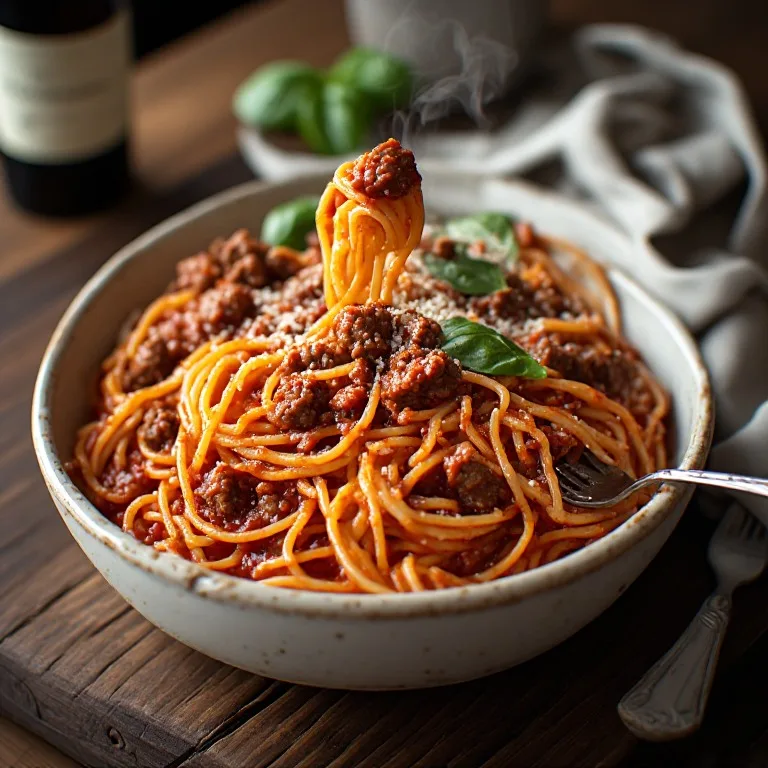
Patsy's Italian Restaurant meat sauce, made at home: sweet Italian sausage and ground beef browned hard, then slow-simmered for two hours in hand-crushed San Marzano tomatoes until the fat and the tomatoes fully merge. The Neapolitan red sauce from the Midtown NYC institution Frank Sinatra ate at every week since the 1950s — for about $16 in groceries.

Easy Prep: 15 min Cook: 2 hrs 15 min Total: 2h 30m8 servings ~$4.50/serving
Prep15 min
Cook2 hrs 15 min
Total2h 30m
Servings
8
At home~$4.50/serving
vs
Restaurant~$20.25/serving
You save ~78%

The Story Behind the Recipe

Patsy's Italian Restaurant has been at 236 West 56th Street in Midtown Manhattan since Pasquale "Patsy" Scognamillo opened it in 1944. Frank Sinatra discovered it in the early 1950s and kept a standing reservation for the better part of five decades — he came with the Rat Pack, held dinner parties there after Carnegie Hall performances, and reportedly had the sauce shipped to friends in California. Sal Scognamillo, Patsy's grandson, is the current chef and owner; he grew up in the kitchen and has published the family's recipes in a cookbook that makes the restaurant's Neapolitan traditions accessible for home cooks. The address has never changed. Neither has the sauce.

The meat sauce belongs to the southern Italian Sunday tradition: sweet Italian sausage and ground beef, browned hard to build a crust, then slow-simmered with hand-crushed San Marzano tomatoes until the fat from the meat and the sugars from the tomatoes have fully merged into something unified and deeply savory. Two hours of very low heat is not optional — it is what transforms the sauce from "meat cooked in tomatoes" into the single-ingredient flavor that defines Neapolitan cooking. Making the full pot costs about $16 in groceries and feeds eight; a bowl of pasta at the restaurant runs $26 to $34. The technique is simple enough to run on a Sunday afternoon without standing at the stove: brown the meat, build the base, combine everything, and leave it alone.

Nutrition Facts

Per serving (8 servings)
Calories310
Total Fat18g
Total Carbs11g
Dietary Fiber2g
Sugars7g
Protein20g
Sodium580mg

* Estimated values based on standard recipe preparation. Actual values may vary.

Ingredients

  • To serve

Instructions

💡
Pro tip: This recipe tastes even better the next day. The flavors need time to meld together in the fridge.
❄️
Storage: Keeps in an airtight container in the fridge for up to 2 weeks. Freezer-friendly for up to 3 months.
🎃 Free Halloween cookbook — download now The Copycat Halloween Cookbook A ready-made, photo-illustrated PDF of our best halloween copycat recipes — free to download, no building required. Pay what you want to support if you love it.

Free PDF — instant download. We'll also send new seasonal copycat recipes now and then; unsubscribe anytime. Or just download it →

Prep time: 15 min Cook time: 2 hrs 15 min Servings: 8

If you search “homemade spaghetti sauce recipe,” you get two kinds of answers: a 20-minute jar-upgrade, or an all-day Sunday gravy with braciole and pork neck bones. This is the one in between — the Southern Italian meat sauce served at Patsy’s Italian Restaurant in Midtown Manhattan, where Frank Sinatra kept a table for fifty years. It is a real recipe you can start at noon and eat at six, and it costs about $16 to feed eight people. A plate of pasta at the restaurant runs $26 to $34.

Patsy’s opened at 236 West 56th Street in 1944 and has never moved. Sinatra found it in the early 1950s and never left; he ate there most weeks until his death in 1998, held post-Carnegie Hall dinners in the upstairs room, and had the food shipped across the country. Sal Scognamillo, the founder’s grandson, still runs the kitchen and cooks the same Neapolitan recipes his grandfather did. The meat sauce is the backbone of that menu, and unlike the restaurant’s reservation book, it is completely reproducible at home.

What makes this different from every other meat sauce

Three decisions separate this from a generic spaghetti sauce. One: you brown the meat hard before anything else. Most weeknight recipes crumble raw meat into simmering tomatoes, which steams it gray and throws away the single biggest flavor opportunity in the pot. Searing the sausage and beef until they’re deeply browned in spots builds Maillard compounds — the savory, roasted notes that make the finished sauce taste like it took all day.

Two: you crush whole San Marzano tomatoes by hand instead of opening a can of “crushed.” Pre-crushed canned tomatoes are milled with added purée and often citric acid, which gives them a flat, uniform, slightly tinny taste. Whole San Marzanos (look for “DOP” on the label — it guarantees the real thing from the Sarno valley near Naples) are lower in acid and higher in natural sweetness. Squeezing them by hand leaves you with a sauce that has texture — soft pieces of tomato suspended in a rich liquid — rather than a smooth paste.

Three: two hours of low, lazy heat. This is the part people skip and the part that matters most. See the FAQ below for the full explanation, but the short version: at 30 minutes you have meat and tomatoes sharing a pot; at two hours you have one unified sauce where the sausage fat has emulsified into the tomato and the whole thing clings to pasta instead of pooling under it.

The one mistake that ruins it

Rushing the simmer by cranking the heat. A hard, rolling boil does not cook the sauce faster in any way that helps — it drives off water too quickly (so the sauce scorches on the bottom before the flavors merge), it toughens the meat, and it breaks the emulsion so you end up with orange grease floating on top. You want the surface to shiver: an occasional lazy bubble, nothing more. If your lowest burner setting is still too aggressive, slide the pot half off the burner or set it on a flame tamer. Low and slow is not a suggestion here; it is the whole technique.

Make it ahead — it only gets better

This sauce is built for batch cooking. The flavor deepens overnight in the refrigerator as the components keep melding, so a pot made Sunday is even better on Tuesday. It keeps 5 days refrigerated and freezes beautifully for up to 3 months — portion it flat in freezer bags and you have a restaurant-quality dinner that reheats in the time it takes to boil pasta. The effort is identical whether you make one pot or two, so make two.
🥗

Make It Healthier

Love Patsy's Italian Restaurant Meat Sauce but want a lighter version? Try these simple swaps:

  • ✓Swap half the ground beef for extra-lean ground turkey (93/7): the sausage carries the fat and fennel flavor that drives the sauce, so the substitution is nearly invisible while cutting total fat by roughly 25 percent.
  • ✓Drain the browned meat in a colander before returning it to the pot — removing the excess rendered fat trims about 3g of fat per serving without affecting the sauce's flavor.
  • ✓Serve over whole-wheat spaghetti or a legume-based pasta (chickpea, lentil) to add 4 to 6g of fiber per serving and lower the glycemic load compared to regular pasta.
  • ✓The sauce itself is naturally dairy-free and gluten-free — check the sausage label (most are GF) and skip the Parmigiano garnish for a fully dairy-free meal.

Frequently Asked Questions

What is Patsy's Italian Restaurant and why is it famous?

Patsy's Italian Restaurant has operated at 236 West 56th Street in Midtown Manhattan continuously since 1944, when Pasquale 'Patsy' Scognamillo opened it. It is a Southern Italian family restaurant in the original sense: Neapolitan recipes, a tightly run dining room, and the same family in the kitchen for three generations. Frank Sinatra is the restaurant's most famous regular — he held a standing reservation for decades, reportedly shipped the food to Las Vegas, and maintained his table there until his death in 1998. Sal Scognamillo, the founder's grandson and current chef, has published the family's recipes in a cookbook and appears regularly on television to demonstrate them. The restaurant's prices are midrange for a New York City establishment of its reputation, making it somewhat more accessible than reservation-impossible places like Carbone or Rao's, though the quality is consistently exceptional.

How is Patsy's meat sauce different from Rao's Sunday Gravy or bolognese?

Three distinct preparations. Rao's Sunday Gravy is an all-day project: whole cuts of meat (braciole, sausage links, large meatballs) slow-cooked together for three hours in a large pot of tomatoes. The meats are served as a second course after the pasta; the sauce is enriched by hours of braising with multiple large-format protein sources. Bolognese (the Northern Italian version) starts with a soffritto, uses white wine, adds only a small quantity of tomato, and often includes milk or cream to round the sauce — it is about fat-coating pasta strands rather than tomato flavor. Patsy's meat sauce is the Southern Italian middle path: ground meat and sausage fully incorporated into the sauce, two hours of low simmering, a generous tomato base. The sauce IS the dish, not a backdrop for pieces of meat. It is simpler to make than Sunday Gravy, more tomato-forward than bolognese, and the kind of recipe you can put on at noon and have ready by dinnertime.

Why does the homemade spaghetti sauce need to simmer for two hours? Can I shorten it?

You can shorten it, but you get a noticeably different result. At 30 to 45 minutes, the sauce tastes like two separate things — tomatoes and meat — that happen to be in the same pot. At 2 hours, the fat rendered from the sausage has emulsified into the tomato liquid, the tomatoes have fully softened and lost their raw edge, the Maillard compounds from the seared meat have distributed through the sauce, and the whole mixture has thickened and merged into a unified flavor. The physical changes are also real: at 2 hours, the sauce poured over pasta clings to the noodles rather than pooling at the bottom of the bowl. If you are genuinely short on time, 90 minutes produces a good sauce; below that, the result is noticeably thinner and less complex. Patsy's Neapolitan tradition specifically values this unhurried approach — the 'long Sunday sauce' is a cultural artifact, not just a recipe instruction.

What wine should I use in the sauce, and can I skip it?

You can skip it — the sauce is excellent without wine. When you add it, use a dry red Italian wine: Chianti, Montepulciano d'Abruzzo, or any inexpensive dry Barbera. The wine goes in after the onion and garlic are softened, before the tomatoes, and cooks down for 2 minutes until the alcohol burns off. What it contributes: acidity that lifts the tomato flavor, subtle tannins that give the sauce structure, and a depth of flavor that the tomatoes alone produce more slowly. You don't need expensive wine — a $10 Chianti is fine. If you skip wine entirely, add a tablespoon of red wine vinegar to the finished sauce to achieve a similar acid balance.

What pasta shape should I serve this with?

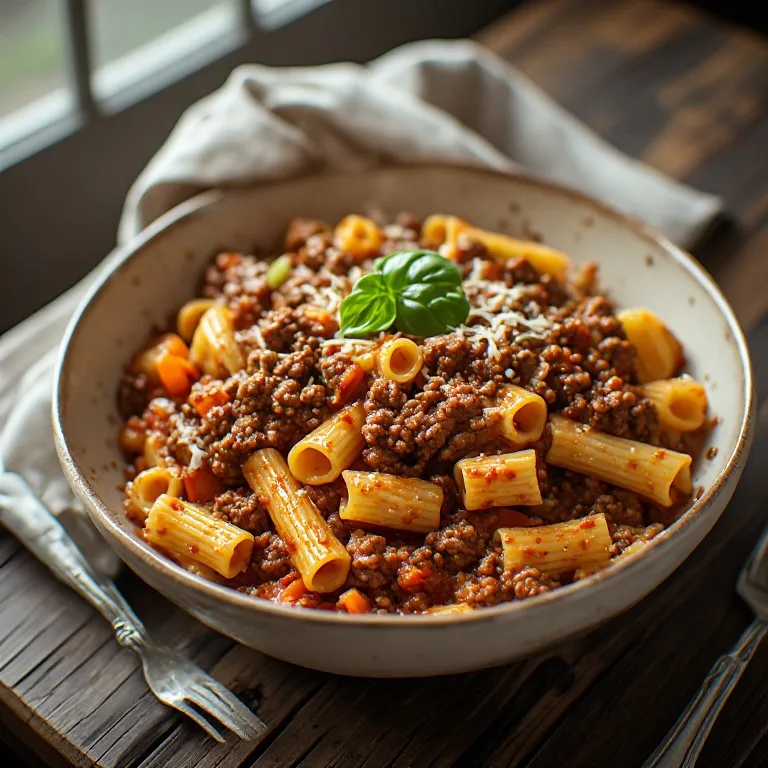
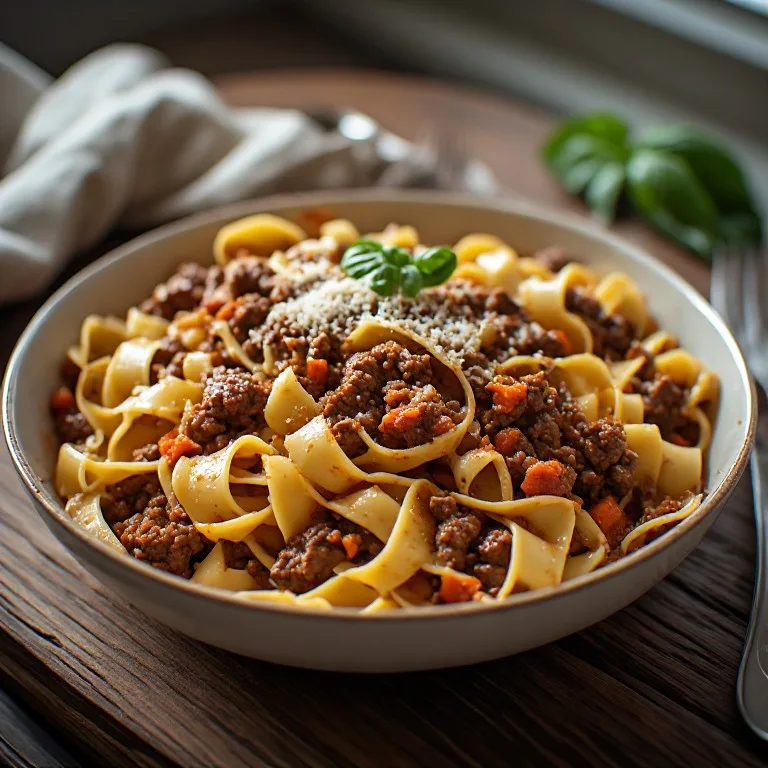
Spaghetti is the traditional choice — it is the pasta shape the sauce is named for, and the long strands pick up the fine-grained meat sauce evenly along their entire length. Rigatoni works nearly as well: the ridged tubes hold the sauce and chunks of meat can nestle inside. Bucatini (thick hollow spaghetti) is a classic Southern Italian choice that carries a large volume of sauce per bite. For a more rustic presentation, pappardelle (broad flat pasta) is excellent. What works less well: very thin pasta (capellini, angel hair), which gets overwhelmed by the weight and texture of the sauce; tiny shapes like orzo or ditalini, which get lost. Use 1 lb of pasta for 8 servings of sauce, cook to al dente, and always finish the pasta in the sauce with a splash of pasta cooking water — the starch emulsifies the sauce and makes it cling.

Can I make this in a slow cooker or Instant Pot?

Slow cooker: yes, and it produces excellent results. Brown the meat and build the base exactly as written (this step cannot happen in the slow cooker — the browning is essential). Transfer everything to the slow cooker and cook on low for 6 to 8 hours. The result is slightly different from stovetop — a touch more steam-cooked in character — but the long low heat produces the same flavor merger. Instant Pot: brown the meat using the sauté function, build the base, seal and cook on high pressure for 20 minutes with a 15-minute natural release. This dramatically compresses the time but the sauce has a pressure-cooked quality — it works, but it lacks the concentration of flavor that comes from 2 hours of evaporation on the stovetop. If you have time, the stovetop or slow cooker version is noticeably better.

How do I store and freeze this sauce?

Refrigerator: up to 5 days in a covered container. The flavor improves overnight as the components continue to meld. Freezer: up to 3 months. Portion into quart-size freezer containers or zip bags (lay flat to freeze, then stand upright to store). The sauce freezes and reheats exceptionally well — the fat that rises to the surface and solidifies in the refrigerator or freezer is not a problem; it re-emulsifies when you gently reheat. To reheat: warm over medium-low heat with a splash of water or pasta cooking water to restore consistency, stirring gently. This is a natural recipe for batch-cooking — the effort is the same whether you make one pot or two, and having this in the freezer means weeknight pasta in 15 minutes.

What is the difference between sweet and hot Italian sausage, and which should I use?

Sweet Italian sausage is seasoned primarily with fennel seed and black pepper; it has no added heat. Hot Italian sausage adds red pepper flakes (and sometimes additional chile) to the same base seasoning. Patsy's traditional Neapolitan style uses sweet sausage — the fennel seed is an essential flavor note in the sauce, and the absence of chile heat lets the tomato and meat flavors read clearly. For most recipes, use sweet sausage. If you like heat, add 1/4 to 1/2 tsp of red pepper flakes to the sauce directly (you have better control over the heat level than using hot sausage). You can use a combination — four links sweet, two links hot — if you want a mild background warmth without overwhelming the sauce.

Love this recipe? Share it!

Free PDF: our 12 most-wanted copycat recipes — instant download.

Made it? Buy us a coffee

Every recipe here is free, with no paywalls. If this one was a hit at your table, a small tip keeps new copycats coming.

$

Patsy's Italian Restaurant is a trademark of its owner, used here only to describe the dish this recipe recreates. This is an independent copycat written in our own words — Copycat Spices is not affiliated with, endorsed by or sponsored by Patsy's Italian Restaurant.

Ratings & Reviews

—
No ratings yet

Rate this recipe

Click a star to rate

Leave a Review

0/500

CS

Copycat Spices Editorial

Researched + fact-checked. Every recipe on Copycat Spices is built from published sources — official ingredient lists, brand-published recipes, interviews and food-science references — and fact-checked before it goes live, then written as clear, step-by-step instructions for home cooks of all skill levels.

Learn more about our mission →