Pin It

The Famous Roberta's Bee Sting Pizza, Made at Home

The Famous Roberta's Bee Sting Pizza, Made at Home
Jump to Recipe
Prep 30 min (plus 48–72 hr cold ferment) Cook 8 min Serves 4 (two 12-inch pizzas, half a pizza per serving)
Quick answer: Make the dough first — it needs 48 to 72 hours in the fridge. Combine 153 grams of 00 flour and 153 grams of all-purpose flour with 8 grams of fine sea salt. Add ½ teaspoon instant yeast, 1 teaspoon olive oil, and 202 grams of lukewarm water. Mix until a shaggy dough forms, then knead 3 to 4 minutes until smooth. Cover and rest at room temperature for 2 hours, then divide into two equal balls, transfer to an oiled container, cover, and refrigerate for 48 to 72 hours. To bake: place a pizza steel or thick pizza stone on the top rack and preheat at 550°F (or your oven's maximum) for at least 45 minutes — the steel needs to fully saturate with heat. Pull the dough out 60 to 90 minutes before baking to come to room temperature. For the Bee Sting, the sauce is pure: one 28-ounce can of San Marzano whole peeled tomatoes, drained of about a third of its liquid, then crushed by hand. Season with salt and a drizzle of olive oil — no cooking required. Stretch each dough ball by hand to roughly 12 inches, lay it on a floured peel, spoon on 3 to 4 tablespoons of sauce (leaving a 1-inch bare edge), cover with torn fresh mozzarella, then scatter 6 to 8 thin slices of hot sopressata. Drizzle with 1 teaspoon of chili oil. Slide the pizza onto the steel and bake 6 to 8 minutes until the crust is dark-spotted and the cheese is bubbling. Remove, slice, then drizzle with honey after slicing — never before. At Roberta's in Brooklyn the Bee Sting is around $23. The dough ingredients for two pies cost about $3. The entire pizza costs under $15.

Shop the tools

Gear matched to this recipe. These are Amazon affiliate links — we may earn a small commission if you buy, at no extra cost to you.

As an Amazon Associate, Copycat Spices earns from qualifying purchases. Product images are generic illustrations, not the exact item listed.

The Famous Roberta's Bee Sting Pizza, Made at Home

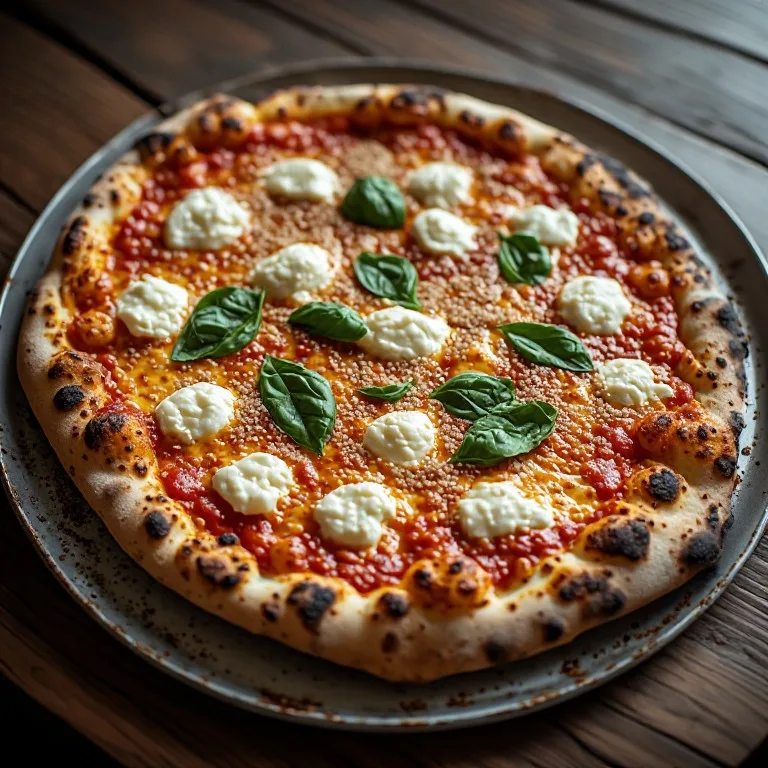
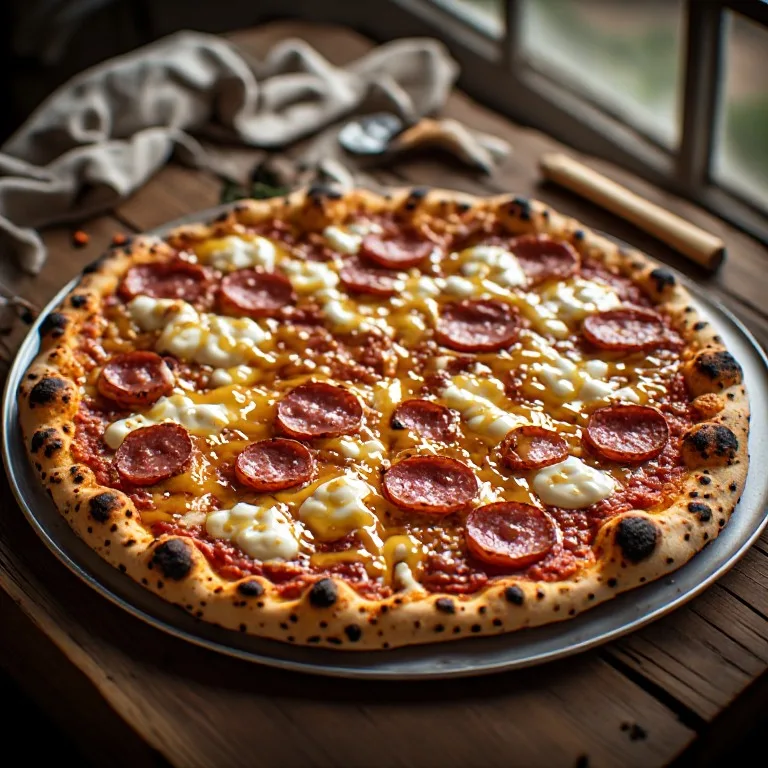
Carlo Mirarchi's iconic Bee Sting pizza from Roberta's in Bushwick — sopressata, fresh mozzarella, chili oil, and honey drizzled after slicing — made at home using their published 50/50 dough with a 48-hour cold ferment. The honey cannot go on before it bakes.

Intermediate Prep: 30 min (plus 48–72 hr cold ferment) Cook: 8 min Total: 72h 38m4 (two 12-inch pizzas, half a pizza per serving) servings ~$4.50/serving
Prep30 min (plus 48–72 hr cold ferment)
Cook8 min
Total72h 38m
Servings
4
At home~$4.50/serving
vs
Restaurant~$20.25/serving
You save ~78%

The Story Behind the Recipe

Carlo Mirarchi's iconic Bee Sting pizza from Roberta's in Bushwick — sopressata, fresh mozzarella, chili oil, and honey drizzled after slicing — made at home using their published 50/50 dough with a 48-hour cold ferment. The honey cannot go on before it bakes.

Nutrition Facts

Per serving (4 (two 12-inch pizzas, half a pizza per serving) servings)
Calories740
Total Fat30g
Total Carbs85g
Dietary Fiber4g
Sugars8g
Protein32g
Sodium1180mg

* Estimated values based on standard recipe preparation. Actual values may vary.

Ingredients

  • Dough (makes two 12-inch pizzas)
  • Tomato sauce
  • Bee Sting toppings (per pizza)

Instructions

💡
Pro tip: This recipe tastes even better the next day. The flavors need time to meld together in the fridge.
❄️
Storage: Keeps in an airtight container in the fridge for up to 2 weeks. Freezer-friendly for up to 3 months.
🎃 Free Halloween cookbook — download now The Copycat Halloween Cookbook A ready-made, photo-illustrated PDF of our best halloween copycat recipes — free to download, no building required. Pay what you want to support if you love it.

Free PDF — instant download. We'll also send new seasonal copycat recipes now and then; unsubscribe anytime. Or just download it →

The Famous Roberta’s Bee Sting Pizza, Made at Home

Prep time: 30 min (plus 48–72 hr cold ferment) Cook time: 8 min Makes: 2 pizzas (serves 2 to 4)

In February 2008, two musicians named Chris Parachini and Brandon Hoy were running out of money while converting an industrial space on Bogart Street in Bushwick, Brooklyn. A third person, Carlo Mirarchi, contributed $30,000 to get the project across the finish line. He said he wanted to be the chef. The oven they installed — a wood-fired unit that came from Fossano, Italy — became the center of the restaurant, which they called Roberta’s.

What began as a neighborhood spot in what was then a seriously unglamorous part of Brooklyn became, over the following decade, one of the most written-about and imitated restaurants in the country. Mirarchi received a James Beard nomination. The New York Times and Bon Appétit and every major food publication eventually made the pilgrimage. The original location on Bogart Street still has a long wait on weekends.

The pizza that people identify Roberta’s with most strongly is the Bee Sting: tomato sauce, fresh mozzarella, hot sopressata, chili oil, and honey. It costs around $23. The name describes what eating it does to you — the spice from the salami and chili oil lands first, and then the honey arrives like the aftermath.

The dough recipe exists. Roberta’s published it in their 2013 cookbook, and The New York Times ran a version of it. It is not a secret. But knowing the recipe and understanding why it works are two different things. If you want a second pizza to make with the same steel and the same 48-hour dough, the Jean-Georges black truffle pizza uses an almost identical base.

The Dough: Why the Blend Matters

Most pizza dough guides tell you that serious pizza requires 00 flour — the finely milled, soft Italian flour that Neapolitan pizzerias have used for generations. This is not wrong for Neapolitan pizza, which bakes in a 900°F wood-fired oven for 60 to 90 seconds and produces a very soft, slightly charred crust.

Roberta’s does not make exactly Neapolitan pizza. What they make is their own thing — Brooklyn style, wood-fired, but with a crust that has more structure than a classic Neapolitan, an edge that holds its shape under toppings, and a bottom that crisps rather than just chars. The way they achieve this is the 50/50 blend: half 00 flour, half all-purpose flour.

The reason matters for home baking specifically. 00 flour alone produces a very extensible, elastic dough that is easy to over-stretch and difficult to manage. It also bakes more softly at the temperatures a home oven reaches — 500 to 550°F instead of 900°F. All-purpose flour has more protein than 00 — roughly 10 to 12 percent versus 00’s 8 to 9 percent — which builds the gluten structure the crust needs to hold shape and produce a crumb with some chew. The 50/50 blend gives you the fine texture and open crumb that 00 provides alongside the backbone that AP delivers. The result is a dough that stretches without fighting back and bakes into something with real texture rather than soft flatbread.

The hydration is 66 percent — 202 grams of water for 306 grams of total flour. This is wetter than many home pizza doughs, which produces a more open crumb but requires flouring your hands and the peel generously when you work with it.

The Cold Ferment: Not Optional

The 48 to 72 hour refrigerator rest is where the flavor develops. At refrigerator temperature, yeast activity slows to nearly nothing — but does not stop. Over two to three days, the small amount of yeast converts flour sugars to carbon dioxide and ethanol and produces flavor compounds that a same-day room-temperature rise cannot generate. The dough also develops a slight acidity from bacteria in the flour, which contributes the faint tang that distinguishes Roberta’s crust from a bland, wheaty base.

The cold rest also changes the dough structurally. The gluten relaxes and aligns over the long fermentation period, making the dough more extensible when you eventually stretch it — easier to work into a 12-inch round without tearing. Cold-fermented dough is also more tolerant: it will not over-proof the way a warm-risen dough can if you leave it an extra hour.

One limit: do not go past 72 hours. Overfermented dough loses its gas-retaining structure and bakes flat and dense, without the oven spring that creates the cornicione. 48 to 72 hours is the window; most people who make this regularly use the full 72.

The Pizza Steel: 45 Minutes Is Not Overkill

The leopard-spot charring on Roberta’s crust — the dark, irregular patches on the rim — comes from sugar in the dough surface caramelizing and carbonizing rapidly when it hits a very hot surface. In a wood-fired oven operating at 800 to 900°F, this happens in 60 to 90 seconds. In a home oven at 550°F, you need the thermal mass of a preheated pizza steel or thick stone and more time — 6 to 8 minutes.

The error most home cooks make is underpredicting preheat time. A pizza steel on a rack in a 550°F oven needs a minimum of 45 minutes — ideally 60 — before it has the thermal mass to bake pizza correctly. The oven itself may reach 550°F in 20 minutes, but the steel has not. When you lay cold dough on an insufficiently preheated steel, the dough surface absorbs the steel’s heat too quickly and the temperature drops; the crust sets without the rapid surface caramelization that creates char and crunch. Fully preheated steel holds its temperature through the first contact with cold dough and gives the bottom of the crust the burst it needs.

A pizza steel is the better tool over a stone. Steel conducts heat roughly 20 times faster than ceramic or cordierite stone, which means it transfers heat into the pizza crust more efficiently. It also does not crack from thermal stress the way a stone can. A ¼-inch steel retains heat well enough for home use. Set it on the top rack, closest to the broiler.

The Sauce: Why It’s Uncooked

Roberta’s tomato sauce for the Bee Sting is pelati: whole peeled San Marzano tomatoes, drained of excess liquid, crushed by hand, and seasoned with salt and olive oil. That is the full preparation. It does not get cooked before it goes on the pizza.

The logic is simple: the pizza bakes at maximum heat for 6 to 8 minutes, which is plenty of time to cook the sauce on the pizza itself. A pre-cooked sauce would overcook, losing brightness and turning sweet and flat. Raw crushed tomatoes applied at room temperature bake into something fresher than any sauce that has spent 20 minutes on the stove.

Use D.O.P.-certified San Marzano whole peeled tomatoes if you can find them — the same tomatoes that carry a restrained, uncooked sauce like Scarpetta’s spaghetti pomodoro. The D.O.P. certification means they are grown in the volcanic soil near Salerno and processed according to regulated standards. They are consistently lower in acidity, meatier in texture, and more complex in flavor than generic crushed canned tomatoes. Cento, Mutti, and La Valle are the most widely distributed. Do not use pre-seasoned tomatoes or crushed tomatoes — the texture is already processed and the sauce will be thin.

Drain about a third of the liquid before crushing. The sauce on the pizza should be thick enough that it does not run into the cornicione and steam it — a wet sauce makes a soft, undercharred rim.

The Bee Sting Assembly: Order Matters

The Bee Sting goes together in a specific sequence for reasons that are not arbitrary.

Sauce first, thin. Three to four tablespoons for a 12-inch pizza, spread to the inner edge of the rim. Too much sauce makes a wet, floppy center. You should see the dough surface through gaps in the sauce.

Torn mozzarella, not shredded. Use fior di latte — the firmer, lower-moisture style of fresh mozzarella made from cow’s milk rather than buffalo milk. Tear it into rough pieces and place them in gaps, leaving sauce visible between pieces. The imperfect shapes melt differently than uniform rounds, creating an uneven, bubbled surface that looks like restaurant pizza. The mozzarella goes on in pieces, not slices.

Sopressata, thin. Lay 6 to 8 thin slices across the surface. The thin slices will curl into cup shapes as the pizza bakes — this is intentional. The cups catch rendered fat and the fat runs onto the cheese beneath, basting it. If your sopressata is pre-sliced thick, press it thinner between two sheets of plastic wrap with a rolling pin.

Chili oil last, before it goes in. A drizzle over the assembled pizza before it bakes. The oil works into the cheese and sauce as they cook.

Honey after slicing, always. Not before baking, not while the pizza is still whole. The honey goes on the sliced pizza, warm from the oven, in the last step before serving. Honey burns in seconds at 550°F — applied before baking, it produces bitter carbon and a sticky cutter. Applied after slicing, it stays raw and floral, with the sweetness completely intact.

One More Thing About the Rim

Roberta’s cornicione — the outer rim of the crust — puffs and chars in the oven because it is untouched by sauce, cheese, or toppings. The dry dough edge is free to rise and caramelize. If sauce reaches the rim, it creates a steam barrier that suppresses rise and prevents charring. Leave a clean 1-inch border when you apply the sauce. This is not about aesthetics — it is the mechanism by which the edge becomes the most interesting part of the pizza.

The Bee Sting should not require hot sauce on the side. The heat is in the pizza.
🥗

Make It Healthier

Love The Famous Roberta's Bee Sting Pizza, Made at Home but want a lighter version? Try these simple swaps:

  • ✓Use part-skim mozzarella instead of fresh fior di latte — this reduces the fat without meaningfully changing the texture, since fresh mozzarella's main role here is mild milky flavor and melt, not the richness you taste in a slow-cooked dish.
  • ✓The sopressata can be halved in quantity (3 or 4 slices instead of 6 to 8) — the Bee Sting flavor profile still comes through from the chili oil and honey. Sopressata is the saltiest and fattest single ingredient in this pizza.
  • ✓If you reduce the honey to 1 teaspoon per pizza (instead of 1½), you still get the sweet-spicy contrast the pizza is built around — the flavor comes through at a lower quantity than you'd expect because it's applied to a hot, savory surface.

Frequently Asked Questions

Why does the dough use a 50/50 blend of 00 flour and all-purpose instead of just 00?

This is the most commonly misunderstood part of the Roberta's recipe. Conventional thinking says Italian pizza requires 00 flour — the fine-milled, low-gluten flour used in Neapolitan pizzerias. But 00 flour alone produces a very extensible, soft dough that is difficult to stretch without tearing and can produce a crust that puffs unevenly and slumps. All-purpose flour has higher protein content (around 10 to 12 percent compared to 00's roughly 8 to 9 percent), which builds the gluten structure the crust needs to hold its shape under toppings and form crisp, stable edges. The 50/50 blend is specifically calibrated: 00 provides the fine texture and characteristic chew; AP provides the backbone. The result is a dough that stretches easily without the elasticity fights of pure high-gluten flour and holds its structure better than pure 00 at home oven temperatures. Roberta's published this blend in The New York Times in their official recipe — it is not a home cook's approximation but the stated formula.

How important is the 48-hour cold ferment, and can I shorten it?

The cold ferment is where the flavor develops. At refrigerator temperature, yeast activity slows dramatically but does not stop — it converts sugars to carbon dioxide and alcohol over a long time, producing complex flavor compounds that a same-day dough simply cannot develop. The ferment also builds acidity (lactic and acetic acid from bacteria in the flour), which contributes a faint tang to the finished crust and helps the dough develop those dark blistered spots called leopard charring. Structurally, the long rest allows gluten to relax and align properly — the dough becomes more extensible and easier to stretch without tearing. You can make this dough with a same-day 2-hour room-temperature rise and it will produce a decent pizza. You will not produce the Roberta's version. At minimum, 24 hours in the fridge gives a meaningful improvement. The full 48 to 72 hours is the window they specify in the published recipe, and 72 hours produces the most developed flavor. Do not go past 72 hours — overfermented dough loses its structure and bakes flat.

Why can't I put the honey on before baking?

Honey is composed primarily of fructose, glucose, and a small amount of sucrose. All three are simple sugars that caramelize and carbonize quickly at high heat. In a 550°F home oven — and especially in a 900°F wood-fired oven — honey goes from golden to black in under 30 seconds. Applied before baking, the honey burns before the cheese melts and the crust develops. The flavor turns bitter, the surface of the pizza turns dark in the wrong way, and the residue on the pizza cutter means every subsequent slice drags the topping. The correct technique: bake the pizza completely, pull it from the oven, slice it, then drizzle the honey over the sliced pizza. The slices are already individual; the honey runs into the cuts and onto the surface without making the cutter sticky. The honey stays raw and liquid, with its floral sweetness intact. Roberta's chefs have been explicit about this in their published recipe and in the Robb Report walkthrough — slice first, honey second.

What is pelati and why does Roberta's use it for the sauce?

Pelati is the Italian term for whole peeled tomatoes — specifically the peel-by-hand preserved tomatoes packed in their own juice, typically San Marzano or similar southern Italian plum tomatoes. Roberta's sauce is minimal by design: drain about a third of the liquid from a can of pelati, then combine the remaining tomatoes and juice in a bowl, season with salt and a drizzle of olive oil, and break them down with your hands or an immersion blender just enough to create a rough, textured sauce — not a smooth purée. It is uncooked. The high oven heat cooks the sauce on the pizza in 7 minutes, and a pre-cooked sauce would overcook, turning flat and sweet. The pelati tomatoes are used at room temperature, which means the sauce does not cool the dough when you spread it, and the pizza bakes more evenly. Use whole peeled San Marzano tomatoes if you can find them labeled D.O.P. — these are certified grown in the San Marzano region near Salerno and are reliably lower-acid, meatier, and sweeter than standard canned tomatoes. Cento, Mutti, and La Valle D.O.P. are widely available.

What kind of sopressata should I use, and how thick should I slice it?

Sopressata is a dry-cured Italian salami made primarily in Calabria and also in various regional forms across Italy and among Italian-American producers. For the Bee Sting, you want hot sopressata — the Calabrian style seasoned with dried red chilis — not the sweet or mild variety. The heat from the sopressata is part of the pizza's structure: the name Bee Sting refers to the combination of spice from the salami and chili oil plus the sweetness of the honey. Slice it thin, between 1/16 and 1/8 inch — deli-thin is about right. The reason thin slices matter: at oven temperature, thin sopressata slices curl at their edges within the first 2 minutes of baking, forming small cup shapes that pool the rendered fat in the center. That fat bastes the mozzarella beneath as the cheese melts. Thick-cut sopressata stays flat, renders less efficiently, and does not cup. If your deli cuts sopressata thick, lay the slices between two sheets of plastic wrap and press them thinner with a rolling pin before topping the pizza.

How do I get the leopard-spot charring in a home oven?

The dark spots on Roberta's crust — the leopard pattern — come from rapid, intense caramelization of sugars in the dough surface. In a wood-fired oven operating at 800 to 900°F, this happens in 60 to 90 seconds. In a home oven at 550°F, you need longer bake time (6 to 8 minutes) and significantly more thermal mass. The critical variable most home cooks underestimate is preheat time. A pizza steel or stone on your top rack needs at least 45 minutes at maximum temperature to fully saturate — not just the metal surface but the mass of the material. A steel that has preheated for only 15 minutes has a hot surface but cold core; when the cold dough hits it, the core absorbs that thermal energy and the surface temperature drops before the crust sets. A steel that has preheated for 45 to 60 minutes holds its temperature through the first contact with cold dough and gives the crust bottom the burst of heat it needs to char. Some cooks add a broil step in the last 90 seconds to get more top char on the cornicione. Watch it — at 550°F under a broiler, the cheese goes from bubbling to burned in under a minute.

What's the backstory of Roberta's and who started it?

Roberta's opened in February 2008 on Bogart Street in Bushwick, Brooklyn, in what was then a blighted industrial block — a cinderblock building that two musicians, Chris Parachini and Brandon Hoy, had started converting into a restaurant while running low on money. Carlo Mirarchi, who had culinary training and wanted to cook, contributed $30,000 to finish the buildout and became the chef. The wood-fired oven came from Fossano, Italy — a hand-me-down that became the heart of the restaurant. There was no formal concept, no investor deck. The neighborhood around the restaurant changed dramatically over the following decade, in part because Roberta's was there first. Mirarchi received a James Beard Award nomination for Best Chef New York in 2013. The restaurant has since opened additional locations in Williamsburg, the East Village, and Culver City in Los Angeles, and has been covered in virtually every major food publication, but the original Bushwick location on Bogart Street remains the one people make pilgrimages to. The cookbook, published in 2013, includes the recipe for the dough that The New York Times subsequently published as a standalone. The Bee Sting did not originate from one particular story — it was on the menu when the restaurant opened and has remained on the menu since.

Love this recipe? Share it!

Free PDF: our 12 most-wanted copycat recipes — instant download.

Made it? Buy us a coffee

Every recipe here is free, with no paywalls. If this one was a hit at your table, a small tip keeps new copycats coming.

$

Roberta's is a trademark of its owner, used here only to describe the dish this recipe recreates. This is an independent copycat written in our own words — Copycat Spices is not affiliated with, endorsed by or sponsored by Roberta's.

Ratings & Reviews

—
No ratings yet

Rate this recipe

Click a star to rate

Leave a Review

0/500

CS

Copycat Spices Editorial

Researched + fact-checked. Every recipe on Copycat Spices is built from published sources — official ingredient lists, brand-published recipes, interviews and food-science references — and fact-checked before it goes live, then written as clear, step-by-step instructions for home cooks of all skill levels.

Learn more about our mission →