The NoMad Chicken for Two (Daniel Humm's Famous Foie Gras and Truffle Roast Chicken, Made at Home)
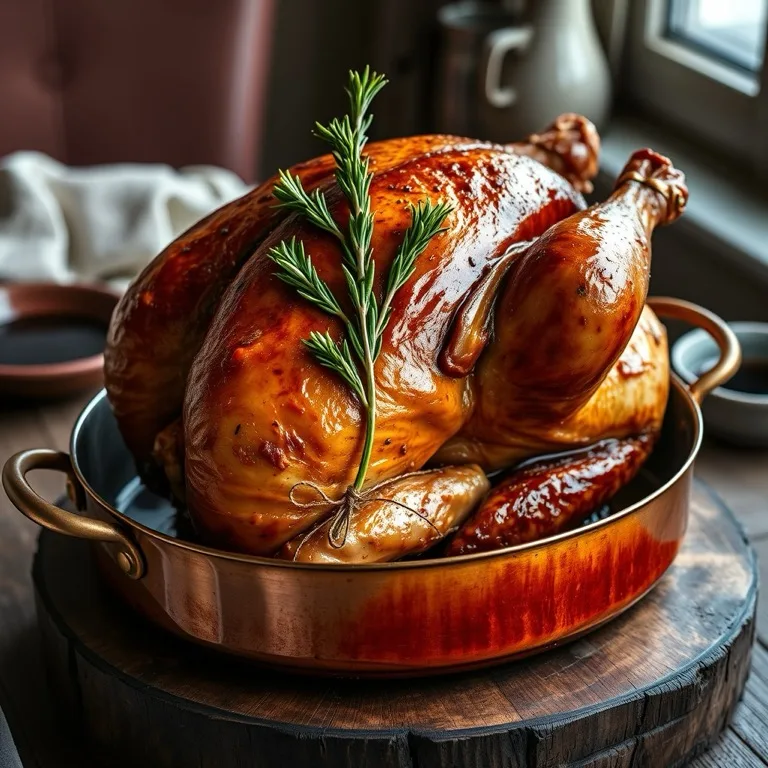
Quick answer: Make the stuffing first: sauté 4 oz of foie gras (or substitute rich duck liver pâté) in a hot dry pan 30 seconds per side, then push it through a fine-mesh sieve into a bowl while still warm. Stir in 2 tablespoons of finely minced fresh black truffle (or 1 tablespoon of good black truffle paste), 3 tablespoons of fine dry brioche breadcrumbs, 1/2 teaspoon of fine sea salt, and 1 teaspoon of fresh thyme leaves. Press plastic wrap directly onto the surface and refrigerate until completely firm, at least 2 hours. On the chicken: use your fingers to very carefully separate the skin from the breast and thigh meat, starting at the neck cavity and working slowly so the skin never tears — the skin is the casing that holds the stuffing in. Using a pastry bag, piping bag, or a zip-top bag with the corner snipped, pipe the cold, firm foie gras mixture under the skin in an even layer across both breasts and upper thighs. Season the cavity with salt, stuff it with 1/2 lemon and 2 sprigs of rosemary, and truss the bird. Refrigerate uncovered on a rack over a sheet pan for at least 8 hours (overnight is ideal) — the cold firms the stuffing so it does not melt and run out during the first minutes of high-heat roasting. Remove the chicken from the refrigerator 30 minutes before cooking. Preheat the oven to 450°F with a cast-iron skillet or heavy roasting pan inside on the middle rack. Place the trussed chicken breast-side up in the screaming-hot pan and roast at 450°F for 15 minutes — this sets the skin's crispness. Reduce the oven to 400°F and continue roasting, basting every 20 minutes with butter, until a thermometer at the thigh reads 165°F, about 45 to 55 minutes more. Rest the chicken on a rack for 10 minutes before carving. While it rests, make the truffled potato purée: boil 1 lb of Yukon Gold potatoes in salted water until very tender, rice them into a warm saucepan, then beat in 5 tablespoons of cold cubed unsalted butter and 1/3 cup of warm heavy cream, adding a splash at a time, until silky and emulsified; season with salt and stir in 1 teaspoon of black truffle paste (or 1 tablespoon of finely minced fresh black truffle). For the dark meat fricassee: remove the legs and thighs from the rested bird; in a small saucepan, sauté 1.5 oz of rehydrated morel mushrooms (or fresh cremini) in 1 tablespoon of butter with 1 minced shallot for 2 minutes, add 3 tablespoons of dry sherry, reduce by half, add 1/4 cup of heavy cream and 3 tablespoons of chicken stock, simmer 3 minutes until lightly thickened, season with salt and a pinch of thyme, then nestle the warm dark meat pieces into the sauce. To serve in the NoMad style: spoon the truffled potato purée into the center of each warm plate, lay slices of the breast (the foie gras layer is visible as a dark ribbon in each cross-section) on top, and arrange the dark meat fricassee alongside. At The NoMad, the whole chicken was first carried tableside intact before being taken to the kitchen to carve — if you have guests, replicate this moment.
Shop the tools
Gear matched to this recipe. These are Amazon affiliate links — we may earn a small commission if you buy, at no extra cost to you.
 Illustrative imageLodge 10.25" Cast Iron SkilletThe restaurant-grade sear most copycats depend onCheck price on Amazon →
 Illustrative imageInstant-Read Digital ThermometerNail fry-oil and doneness temps every timeCheck price on Amazon →
 Illustrative imageFine-Mesh Strainer SetSilky sauces and lump-free syrups — strains out every bit of pulpCheck price on Amazon →
 Illustrative imageRoasting Pan with RackLifts the bird off the pan so the drippings collect for gravyCheck price on Amazon →
As an Amazon Associate, Copycat Spices earns from qualifying purchases. Product images are generic illustrations, not the exact item listed.
The NoMad Chicken for Two (Daniel Humm's Famous Foie Gras and Truffle Roast Chicken, Made at Home)
The NoMad's legendary chicken for two — a whole Amish bird stuffed under the skin with foie gras, black truffle, and brioche, then roasted until it bastes itself — made at home. The restaurant closed in 2021. This is how to recreate NYC's most celebrated roast chicken, including a duck liver pâté substitution for those who can't source foie gras.
Hard
Prep: 45 min (plus 8 hr chilling)
Cook: 1 hr 15 min
Total: 10h 0m2 servings
~$4.50/serving
At home~$4.50/serving
vs
Restaurant~$20.25/serving
You save ~78%
The Story Behind the Recipe
Daniel Humm opened The NoMad restaurant inside the NoMad Hotel at 1170 Broadway in 2012, two years after his Eleven Madison Park earned four stars from The New York Times. The signature chicken for two — an Amish bird stuffed under the skin with foie gras, black truffle, and brioche, carried tableside before carving — became the most talked-about roast chicken in New York almost immediately. The Times called it transcendent. The Daily Meal named it the best roast chicken in America. At $84 for two people, it was the kind of splurge New Yorkers saved up for, and out-of-towners planned trips around.
The NoMad Hotel closed permanently in 2021, and with it the restaurant. The technique that made the chicken extraordinary — stuffing the cold foie gras mixture under the skin before an overnight chill so it firms into a solid layer and bastes the breast from below as it melts during roasting — is fully replicable at home. A version using duck liver pâté and black truffle paste costs roughly $40 for two. The whole bird, the tableside reveal, the truffled purée, the dark meat fricassee: none of it requires a Michelin kitchen.
Nutrition Facts
Per serving (2 servings)Calories920
Total Fat62g
Total Carbs24g
Dietary Fiber2g
Sugars2g
Protein67g
Sodium870mg
* Estimated values based on standard recipe preparation. Actual values may vary.
Ingredients
- Foie gras stuffing (make the day before or at least 8 hours ahead)
- For the chicken
- Truffled potato purée
- Dark meat fricassee
Instructions
Pro tip: This recipe tastes even better the next day. The flavors need time to meld together in the fridge.
Storage: Keeps in an airtight container in the fridge for up to 2 weeks. Freezer-friendly for up to 3 months.
Free PDF — instant download. We'll also send new seasonal copycat recipes now and then; unsubscribe anytime. Or just download it →
🎉 Your Halloween Cookbook is ready!
It's free — but if it's worth something to you, you can pay what you want. It keeps the recipes coming.
$
✓ Downloading your free Halloween Cookbook — check your downloads folder. Happy cooking!
Frequently Asked Questions
What was The NoMad restaurant, and why was the chicken so famous?
The NoMad was Daniel Humm's restaurant at the NoMad Hotel — the boutique hotel in the NoMad neighborhood of Manhattan (North of Madison Square Park, between 25th and 28th Streets on Broadway) — open from 2012 until the hotel's permanent closure in 2021. Humm, who also ran the three-Michelin-starred Eleven Madison Park with business partner Will Guidara, described The NoMad as a more relaxed, European brasserie to EMP's precision-driven tasting menu. The chicken for two became the restaurant's signature almost from opening month. New York Magazine's Adam Platt, Frank Bruni in the Times, and Gourmet's writers all singled it out. The reasons were specific: the technique of stuffing foie gras, black truffle, and brioche under the skin created a self-basting mechanism — the fat from the foie melted during roasting, saturated the breast meat and skin from below, and fused with the butter baste from above to produce a skin depth and a breast tenderness that a plain roast chicken simply cannot achieve. The $84 price for two people for an entire roasted chicken, carved tableside, also made it a spectacle. The NoMad Cookbook, published in 2015, includes the full recipe.
What does foie gras actually do in this recipe, and what is the best substitute?
Foie gras — the fattened liver of a duck or goose — serves a mechanical function here beyond flavor: its fat content (approximately 44 percent fat by weight, compared to roughly 4 percent for a chicken breast) means that when it is packed under the skin and the chicken goes into a 450°F oven, the foie gras melts from within and continuously bastes the breast meat and the underside of the skin with pure rich fat. A plain chicken breast loses moisture to the oven; this one is being continuously re-lubricated from the inside. The flavor contribution is secondary to this basting effect — the truffle and brioche carry most of the aromatic character. The best home substitute is high-quality duck liver pâté (sold in glass jars or canned, at specialty food stores like D'Artagnan, Whole Foods, or Wegmans). Duck liver pâté has a fat content roughly 50 to 60 percent as rich as foie gras and an iron-forward, livery flavor that is noticeably different from foie gras's silkier, sweeter character — but it still provides meaningful fat and flavor under the skin. Chicken liver pâté works as a second-level substitute (fat content lower still, flavor more aggressive). One sourcing note for California cooks: California bans both the production and the in-state retail sale of foie gras (Health and Safety Code sections 25980–25984, upheld by the Ninth Circuit in 2017), but subsequent litigation established that California residents may legally order it from out-of-state producers for personal use — so you can have it shipped to you by mail-order companies like D'Artagnan or Hudson Valley Foie Gras even though a California store or restaurant cannot sell it to you. Elsewhere in the US it is sold normally at specialty grocers.
Why does the stuffed chicken need to refrigerate overnight before roasting?
When you push foie gras or pâté under the skin, it is a soft, spreadable paste — it will run out from under the skin the moment the bird hits a hot oven, before the skin has time to set around it. The overnight refrigeration (or at least 8 hours) achieves two things: first, the cold firms the foie gras mixture back to a nearly solid consistency, so it doesn't liquify and escape before the skin tightens around it; second, the extended dry-air exposure in the refrigerator (uncovered, on a rack) draws moisture from the skin's surface, which is exactly what produces shattering, lacquer-like crackling rather than steam-softened skin. At The NoMad, Humm's prep team stuffed and trussed dozens of birds each afternoon and let them chill several hours before service. The chilling step is as important as the stuffing itself — skip it and you lose both the structural integrity of the stuffing and the skin quality.
What is the difference between fresh black truffle and black truffle paste, and is one worth the upgrade?
Fresh black truffle (Tuber melanosporum, the Périgord black truffle) is the genuine article — earthy, intensely aromatic, with a volatile compound profile (dimethyl sulfide, bis-methylthiomethane) that dissipates rapidly with heat. For this recipe's stuffing, which is pressed under the skin and roasts for over an hour, much of the fresh truffle's volatile aroma will escape during cooking regardless. The value of fresh truffle in the stuffing comes from the texture (visible dark flecks in the cross-section) and the residual flavor after volatile loss. Black truffle paste — cooked truffle purée in olive oil or sunflower oil, sold in tubes or small jars by companies like Sabatino Tartufi or Urbani — has already had its volatiles reduced in processing, making it better suited to high-heat applications than fresh truffle, and costs roughly 10 to 20 percent as much per serving. For this home version, black truffle paste in the stuffing and in the pomme purée performs near-equivalently to fresh truffle at a fraction of the cost. If you want to use fresh truffle, add it to the cold stuffing mixture and keep the mixing and roasting time as short as possible; the truffle aroma in the purée should be added off the heat just before serving.
How does The NoMad carve the chicken for two, and how should I replicate this at home?
At The NoMad, the whole roasted chicken was brought intact to the table on a board for the guests to see — this tableside presentation was part of the ritual, and part of why the dish was $84. A server then carried it back to the kitchen, where it was carved into a specific plate arrangement: the breast was sliced off the carcass and fanned across a pool of truffled pomme purée, with the foie gras layer visible as a dark ribbon in each cross-section slice; the legs and thighs were removed and used for a separate fricassee with morel mushrooms and cream, served alongside the breast slices. The two elements arrived back at the table on a single or divided plate. At home, replicate this structure: (1) bring the whole bird to the table for a moment if you have guests; (2) remove the legs and thighs and set aside for the fricassee; (3) run a knife along each side of the breastbone, then slice each breast on the diagonal so the foie gras layer is visible in each piece; (4) plate the breast slices on the purée, the fricassee alongside. Do not try to carve tableside unless you are very confident with a boning knife — the chicken's skin is the most delicate part and tears easily.
What are morel mushrooms, and what can I substitute if I can't find them?
Morel mushrooms (Morchella species) are a wildly foraged spring and early-summer mushroom with a hollow, honeycomb-textured cap and a deep, earthy, almost smoky flavor. Dried morels, available year-round at specialty grocers and online, require a 20 to 30 minute soak in hot water before cooking; save the soaking liquid and add a tablespoon to the fricassee for extra depth (strain through a coffee filter first to remove grit). Fresh morels are available in spring at farmers markets and high-end grocery stores. For this recipe, the fricassee's base of sherry, cream, and shallots will taste excellent with any strongly flavored mushroom: dried porcini (second-best substitute, very similar earthy depth), fresh king trumpet mushrooms, or even a combination of cremini and shiitake. Button mushrooms are too mild and watery; don't bother. If using dried porcini, soak them the same way as dried morels and use the soaking liquid identically.
What is pomme purée and how does it differ from regular mashed potatoes?
Pomme purée is the French kitchen's version of mashed potatoes, but the technique and fat ratio are categorically different. Regular mashed potatoes: boil, drain, mash, add butter and milk. Pomme purée: pass boiled potatoes through a potato ricer or drum sieve (a tamis) into a warm pan — never mash them, which develops starch and makes them gluey — then beat in cold cubed butter, adding it gradually until the purée absorbs it all, then thin to the right consistency with warm cream. The Robuchon version uses roughly 1 part butter to 2 parts potato; this recipe uses a somewhat lighter ratio (5 tablespoons for 1 lb of potato) to keep it complementary rather than overwhelming. The result is silkier, glossier, and richer than any mashed potato made by mashing or in a stand mixer. The two rules that matter: rice the potato (don't mash or blend), and add cold butter to warm potato (the temperature gradient is what creates the emulsion rather than a greasy pool). For the truffle version, stir in truffle paste at the very end, off the heat, so the volatile aroma doesn't cook off.
What wine works with this dish?
The NoMad's sommelier team famously paired the chicken for two with white Burgundy — specifically premier or grand cru Chardonnay from Puligny-Montrachet, Chassagne-Montrachet, or Meursault. The reasoning: the dish's fat profile is enormous (foie gras, butter baste, truffled butter purée, cream fricassee), and a lean wine collapses against it; white Burgundy's combination of body, texture, and high acidity cuts through the fat while the wine's stone-fruit and toasted-cream notes mirror the dish's own butter-and-truffle character. For home cooks at a more accessible price: California Chardonnay in the Burgundian style (Lioco, Ceritas, Peay) or a white Rhône (white Châteauneuf-du-Pape, Roussanne-dominant blends) both work well. If you prefer red: a pinot noir from Chambolle-Musigny or from the Sonoma Coast — light enough to not fight the truffle, earthy enough to echo it. Avoid anything tannic or full-bodied; the dish doesn't need more weight.
Can I substitute regular chicken from a grocery store, or is Amish chicken necessary?
You can use any high-quality whole chicken, but the bird choice matters for one specific reason in this recipe: the skin must not tear when you separate it from the breast. Standard commodity chicken (Tyson, Perdue) has thinner, more fragile skin from being raised faster and processed at scale; it tears more easily during the stuffing process. Amish chicken (available from D'Artagnan, Whole Foods, farmers markets) and air-chilled chickens (Bell & Evans is the most widely available) have thicker, more elastic skin from slower growth and better feed. Air-chilling (versus water-chilling) also produces drier skin, which crisps better. A 3.5 to 4 lb bird (without giblets) is the right size for two people with sides; larger birds require adjusting roast time. If you can only find a standard grocery chicken, work very slowly when separating the skin, use your palm rather than fingers to push through (less likely to tear), and chill the stuffing mixture until very firm before stuffing.
Love this recipe? Share it!
Made it? Buy us a coffee
Every recipe here is free, with no paywalls. If this one was a hit at your table, a small tip keeps new copycats coming.
$
💛 Support checkout is coming soon — the cookbook stays free either way.
The NoMad is a trademark of its owner, used here only to describe the dish this recipe recreates. This is an independent copycat written in our own words — Copycat Spices is not affiliated with, endorsed by or sponsored by The NoMad.
Ratings & Reviews
Rate this recipe
Click a star to rate