

Pin It

Turkey and the Wolf Collard Melt (The Triple-Decker That Beat Every Steakhouse in America)

Turkey and the Wolf Collard Melt (The Triple-Decker That Beat Every Steakhouse in America)
Jump to Recipe
Prep 20 min Cook 2 hr 45 min Serves 4 sandwiches
Quick answer: Melt 2 tablespoons of unsalted butter in a large Dutch oven or heavy pot over medium heat. Add 6 minced garlic cloves and cook, stirring, for 1 minute until fragrant. Add 3 tablespoons each of red wine vinegar and rice wine vinegar, 3 tablespoons sugar, 1 teaspoon Korean red pepper powder (gochugaru), 1 teaspoon Creole seasoning (Zatarain's), ½ teaspoon black pepper, ½ teaspoon kosher salt, and 2 cups of water. Bring to a simmer and cook for 5 minutes, stirring to dissolve the sugar. Add 1½ pounds of stemmed, washed, and roughly chopped collard greens in two or three large handfuls, tossing in the liquid to wilt. Cover tightly, reduce heat to low, and braise for 2½ to 3 hours, stirring every 30 minutes, until the collards are completely silky and soft — no resistance, no chew — and the braising liquid has reduced to a glossy, concentrated coating. Meanwhile, make the spicy Russian dressing: stir together ½ cup Duke's mayo, ¼ cup roughly chopped hot pickled cherry peppers, 1 teaspoon ketchup, ½ teaspoon gochugaru, ¼ teaspoon Crystal hot sauce, a pinch of smoked paprika, and salt and black pepper to taste. Make the coleslaw: combine 3 cups thinly sliced green cabbage, 3 tablespoons Duke's mayo, 1 tablespoon shaved white onion, 2 teaspoons white vinegar, ¼ teaspoon black pepper, and salt, massaging until the cabbage wilts slightly. To build each sandwich, butter 3 slices of seeded rye bread and place them butter-side-down on a baking sheet. Top 2 of the 3 slices each with 1 thick slice of Swiss cheese; leave the third slice bare. Broil on high for 2 to 3 minutes until the cheese melts and the bread is golden. Assemble the triple-decker from the bottom up: place one cheesy slice cheese-side-up on your board, pile on a generous handful of coleslaw, lay the second cheesy slice cheese-side-up directly on the slaw, spoon on a mound of braised collards, then slather the bare top slice with the spicy Russian dressing and set it dressing-side-down to close the sandwich. Press gently to compact. Cut diagonally and serve immediately.

Shop the tools

Gear matched to this recipe. These are Amazon affiliate links — we may earn a small commission if you buy, at no extra cost to you.

As an Amazon Associate, Copycat Spices earns from qualifying purchases. Product images are generic illustrations, not the exact item listed.

Turkey and the Wolf Collard Melt (The Triple-Decker That Beat Every Steakhouse in America)

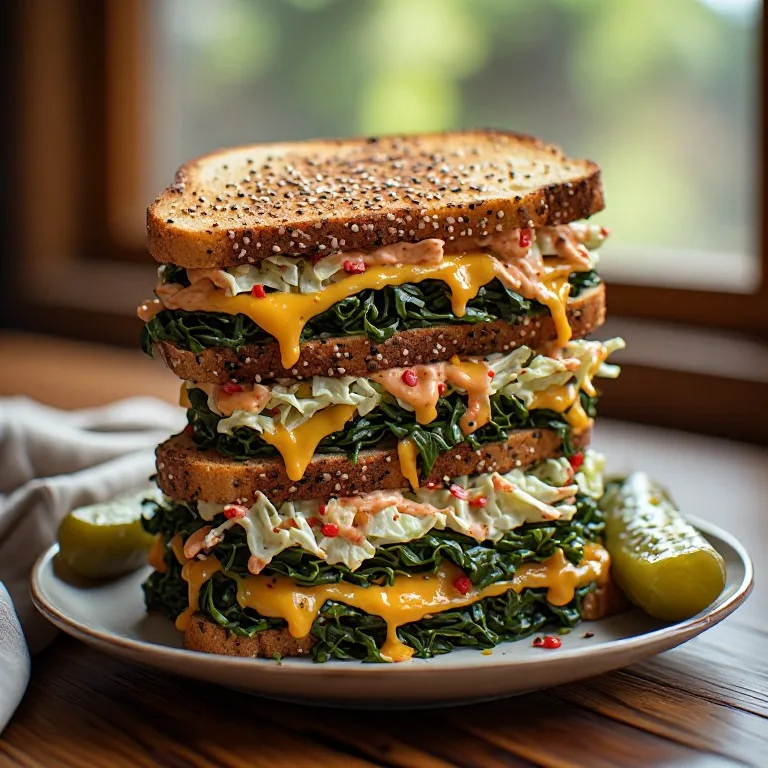
Turkey and the Wolf's collard melt is Bon Appétit's Best New Restaurant sandwich from New Orleans: Swiss-topped rye, collards braised for 2½ hours in red wine vinegar and gochugaru, creamy slaw, and a spicy pickled-cherry-pepper Russian dressing in a triple-decker stack. Here's the full technique.

Medium Prep: 20 min Cook: 2 hr 45 min Total: 3h 5m4 sandwiches servings ~$4.50/serving
Prep20 min
Cook2 hr 45 min
Total3h 5m
Servings
4
At home~$4.50/serving
vs
Restaurant~$20.25/serving
You save ~78%

The Story Behind the Recipe

Turkey and the Wolf's collard melt is Bon Appétit's Best New Restaurant sandwich from New Orleans: Swiss-topped rye, collards braised for 2½ hours in red wine vinegar and gochugaru, creamy slaw, and a spicy pickled-cherry-pepper Russian dressing in a triple-decker stack. Here's the full technique.

Nutrition Facts

Per serving (4 sandwiches servings)
Calories680
Total Fat42g
Total Carbs58g
Dietary Fiber7g
Sugars14g
Protein22g
Sodium1380mg

* Estimated values based on standard recipe preparation. Actual values may vary.

Ingredients

Instructions

💡
Pro tip: This recipe tastes even better the next day. The flavors need time to meld together in the fridge.
❄️
Storage: Keeps in an airtight container in the fridge for up to 2 weeks. Freezer-friendly for up to 3 months.
🎃 Free Halloween cookbook — download now The Copycat Halloween Cookbook A ready-made, photo-illustrated PDF of our best halloween copycat recipes — free to download, no building required. Pay what you want to support if you love it.

Free PDF — instant download. We'll also send new seasonal copycat recipes now and then; unsubscribe anytime. Or just download it →

Turkey and the Wolf is a counter-service sandwich shop at 739 Jackson Avenue in New Orleans’ Lower Garden District. No tableside service, no reservations, limited seating. Bon Appétit named it the Best New Restaurant in America in 2017. GQ and Food & Wine placed it among the most important American restaurants of the decade. A cookbook followed — Turkey and the Wolf: Flavor Trippin’ in New Orleans by Mason Hereford — and was nominated for a James Beard Award.

The restaurant’s signature dish is the collard melt: a triple-decker rye sandwich with Swiss cheese, braised collard greens, creamy coleslaw, and a spicy Russian dressing spiked with pickled cherry peppers. It is vegetarian by design — a riff on The Sam, a hot pastrami Reuben-style sandwich at the now-closed Stein’s Deli nearby, with collards standing in for the meat. The fact that it outsells nearly everything else on a menu full of fried bologna and smash burgers tells you something.

Hereford published the recipe on Food Network and in his cookbook, so this is not a secret formula. What most home versions miss is structural: the braise time, the specific heat source, and the triple-decker logic. Get those right and the sandwich is exactly what the restaurant serves.

Three things every home version gets wrong

The braise is 2½ to 3 hours, not 30 minutes. Every shortcut collard green recipe on the internet calls for 20 to 45 minutes of cooking. That’s enough time to make collards edible but not enough to make them silky. At the 30-minute mark, the greens still have a slight chew and a prominent bitter edge. Between hours 1 and 2, something changes: the cell walls fully break down, the vinegar works all the way through, the sugar rounds out the bitterness, and the collards collapse into a tender, meaty ribbon that holds its shape without being tough. By hour 2½, the pot liquor has reduced to a concentrated glaze that coats each piece. Under-braised collards fall out of the sandwich; properly braised ones stack cleanly.

Korean red pepper powder is not optional. Most copycat attempts substitute crushed red pepper flakes or cayenne. Neither is right. Gochugaru — Korean dried red pepper powder — is what the official recipe specifies, and it appears twice (in the braise, in the dressing). Gochugaru is fruity and moderately hot, not just hot. Its flavor has a sun-dried, almost sweet-chile quality that standard flakes lack entirely. The difference is noticeable in the finished sandwich: gochugaru gives the braising liquid a warm, rounded heat that builds gradually; flakes deliver a sharp upfront sting and then nothing underneath. Gochugaru is widely available at any Korean grocery, H Mart, or online.

It is a triple-decker, and that matters. Almost every home recreation builds a double-decker — two slices of bread with everything piled between them. The problem is thermal: the coleslaw is cold and the collards are hot and wet. Sandwiched together directly, the collard greens steam the coleslaw within about 60 seconds, turning it from cool and crisp into warm and wilted. The middle slice of Swiss-topped rye solves this. It acts as a physical barrier between the slaw compartment (below) and the collards compartment (above), so neither component compromises the other. The two separate bites — slaw-creamy, then collards-savory — only come together when you press the whole thing down.

The braising liquid is the recipe

The flavors of this sandwich are established entirely during the braise. Butter and minced garlic form the base; red wine vinegar and rice wine vinegar together provide acidity from two different angles (red wine vinegar is deeper, rice wine vinegar is brighter); sugar counteracts the collards’ bitterness; gochugaru gives heat with fruitiness; Creole seasoning (Zatarain’s, specifically, because it contains onion powder, thyme, paprika, and black pepper already balanced together) adds the Southern spice layer; and water dilutes everything enough to allow a 2½-hour braise without burning.

The ratio matters. Too much vinegar and the greens taste pickled rather than braised. Too little sugar and the bitterness of the collards fights through. The published recipe gets this right: equal parts red wine vinegar and rice wine vinegar, with sugar at the same volume, produces a pot liquor that is bright, slightly sweet, moderately hot, and completely savory all at once.

About the Russian dressing

The dressing is not an afterthought. Most Russian dressings are mayo plus ketchup plus relish. Turkey and the Wolf’s version replaces the relish with roughly chopped hot pickled cherry peppers — the whole pepper, seeds and all — plus gochugaru and Crystal hot sauce. The result is a dressing that’s tangy from the pickled peppers’ brine, deeply savory, and layered with two different kinds of heat. It’s much closer to a rouille or a spiced aioli than to the standard Russian dressing you’d find on a deli counter.

Duke’s mayo is specified throughout and worth using if you can find it. Duke’s contains no sugar — it’s sharper and more savory than Hellmann’s — and in a dish where the collards already carry acid and the dressing already carries sweetness from the ketchup, a sweet mayo would tip the balance. Duke’s is available throughout the South and at many Walmart locations nationally.

Make-ahead strategy

The collard greens are the only component that takes real time, and they are also the only component that actively improves with age. Made a day ahead and refrigerated overnight in their braising liquid, the collards deepen in flavor, the pot liquor thickens further, and the vinegar and sugar fully integrate. Reheat gently in a saucepan over medium-low heat before assembling.

The Russian dressing keeps refrigerated for two weeks. The coleslaw should be made within 4 hours of serving (any longer and the cabbage releases too much water and goes limp). The bread should be toasted immediately before assembling — rye bread crisps on the broiler in under 3 minutes.

On the day of serving, assembly takes about 20 minutes total.
🥗

Make It Healthier

Love Turkey and the Wolf Collard Melt (The Triple-Decker That Beat Every Steakhouse in America) but want a lighter version? Try these simple swaps:

  • ✓The sodium is primarily from the Creole seasoning, the pickled cherry peppers, and the Swiss cheese. To reduce it: use half the Creole seasoning and compensate with a little garlic powder and smoked paprika; rinse the cherry peppers before chopping; and use 1 slice of Swiss per sandwich instead of 2. These changes drop the sodium to roughly 900mg without changing the core character of the dish.

Frequently Asked Questions

What makes Turkey and the Wolf's collard melt different from regular braised collard greens?

Three things. First, the braise time: Mason Hereford braises for 2½ to 3 hours at a low simmer until the greens collapse into silky, almost stew-like ribbons that hold together on the sandwich without falling out. Most home versions cook collards for 20 to 30 minutes, which leaves them with a bite and a stronger bitter edge. Second, the acid-and-sugar balance: the braising liquid uses both red wine vinegar and rice wine vinegar together with a full 3 tablespoons of sugar per batch, which rounds out the natural bitterness of the greens and gives the pot liquor a brightness that plain chicken-broth collards don't have. Third, Korean red pepper powder — gochugaru — replaces the standard crushed red pepper flakes. Gochugaru is fruity, moderately hot, and slightly sweet rather than purely hot, and it gives the braising liquid a depth that flat-hot flakes don't approximate.

Why is it a triple-decker and not just a regular sandwich?

The triple-decker structure solves a specific textural problem: the coleslaw is cold and wet, and the collard greens are hot and braised. In a double-decker, they'd be stacked directly against each other, and within 60 seconds the residual heat from the collards would steam and wilt the coleslaw, collapsing it into a soggy mess. The middle slice of Swiss-topped rye acts as a thermal barrier — it separates the cool slaw compartment (bottom two slices) from the hot collards compartment (top two slices), so neither layer compromises the other. The extra slice also adds structural integrity: braised collard greens are slippery, and a second layer of rye gives the sandwich a stacking point. Mason Hereford credits the triple-decker format to The Sam at Stein's Deli in New Orleans — a hot pastrami with Swiss, coleslaw, and Russian dressing on rye — which Turkey and the Wolf explicitly riffed on, swapping collards for the pastrami.

What is gochugaru and can I substitute it?

Gochugaru is Korean dried red pepper flakes — ground to a coarse powder from sun-dried Korean chile peppers. It is fruity, bright red, moderately hot (about 4 on a 10 scale), and slightly sweet, with a flavor profile closer to a dried Calabrian chile than to cayenne or crushed red pepper. The Turkey and the Wolf recipe uses it twice: once in the collard braising liquid, once in the Russian dressing. In both cases it contributes heat plus a rounded, almost fruit-forward warmth. Standard crushed red pepper flakes are sharper and hotter without the sweetness; cayenne is hot and flat; smoked paprika is mild and smoky but not hot. There is no perfect 1:1 sub. If gochugaru is unavailable, use a combination: ½ teaspoon sweet paprika plus ¼ teaspoon cayenne per teaspoon of gochugaru gets you in the ballpark on heat level, though you'll lose the fruitiness. Gochugaru is widely available at H Mart, Korean grocery stores, and on Amazon.

Does the cheese have to be Swiss? Can I use white American?

The official Food Network recipe from Mason Hereford specifies thick-cut Swiss cheese — two slices per sandwich, one melted onto each of the two cheesy rye slices. Swiss is a good match here because it melts smoothly, has a mild nuttiness that doesn't compete with the vinegary collards, and holds its structure on the bread rather than running. White American cheese would also work — it melts more aggressively and adds a creamier, slightly saltier quality — and some home reconstructions use it based on regional tradition. What you should avoid: sharp cheddar (too assertive against the vinegar), provolone (too rubbery on rye), and mozzarella (too mild and stringy). Swiss or white American are both correct choices.

Why Duke's mayo and not regular mayonnaise?

Duke's is the preferred mayo across the American South and it appears twice in this recipe: in the coleslaw and in the Russian dressing. The key difference is that Duke's contains no sugar, making it tangier and sharper than Hellmann's or Best Foods, which are noticeably sweeter. In a dish where you're already adding sugar to the collards and ketchup to the Russian dressing, using a sweet mayo would push the sandwich toward cloying. Duke's tartness cuts through the richness of the Swiss cheese and braised greens. If you can't find Duke's, use Hellmann's Real (not Hellmann's with olive oil or the light version) and add a small squeeze of fresh lemon juice to approximate the tartness. Kewpie — the Japanese mayo — also works well: it's rich and eggy, and unsweetened.

How long does it take to make this at home? Can any part be made ahead?

The braised collard greens are the only time-intensive component, and they take 2½ to 3 hours of low simmer. The good news: they reheat perfectly and are actually better made a day ahead. Cooked and refrigerated overnight, the collards absorb the braising liquid and the flavors deepen considerably. The Russian dressing keeps in the refrigerator for up to two weeks and takes 5 minutes to make. The coleslaw can be made up to 4 hours ahead (any longer and it releases too much water). The only component that must be done at serving time is the cheese toast. Full timeline: make the collards the day before; make the dressing while the collards braise; make the slaw and toast the bread when ready to serve. Actual active time on the day of serving is about 20 minutes.

Is Turkey and the Wolf actually worth visiting? What else is on the menu?

Yes, and it's an unusual place to visit. It operates counter-service only — no tableside service, no reservations — out of a modest space at 739 Jackson Avenue in the Lower Garden District of New Orleans. Bon Appétit named it the Best New Restaurant in America in 2017; GQ and Food & Wine listed it among the most important restaurants of the decade. Mason Hereford's menu reads as deliberately lowbrow and earnest: fried bologna sandwiches loaded with chips and cheese, a deviled egg tostada with salsa macha, smashed double cheeseburgers, a fried chicken sandwich, and rotating specials. The collard melt has been on the menu since the beginning and is considered the signature. Hereford published a James Beard-nominated cookbook — Turkey and the Wolf: Flavor Trippin' in New Orleans — which includes this and several dozen other restaurant recipes.

Can I make this without meat? Is it already vegetarian?

The collard melt as written is vegetarian: the braising liquid uses water and butter (no chicken stock), and the sandwich contains only greens, Swiss cheese, coleslaw, and Russian dressing. The rye bread and Swiss are not vegan, but the dish requires no animal-based broth. This makes it one of the most interesting vegetarian options on a menu that is otherwise very meat-forward — Hereford has said in interviews that the collard melt proving itself as a best-seller alongside fried bologna was one of the things he's most proud of. If you are cooking for vegans, substitute olive oil for the butter in the braise, use vegan mayo in the coleslaw and dressing, and omit the Swiss (or use a vegan melting cheese).

What kind of rye bread should I use?

Seeded rye — a soft, mild rye loaf with whole caraway or mixed seeds on the crust, not the intensely sour, dense deli-style rye used in NYC delis. The bread should have enough structure to hold three layers without collapsing but be soft enough to press down into a manageable triple decker. Pepperidge Farm Deli Rye, a middle-of-the-shelf seeded rye from most grocery stores, is exactly the right texture. Avoid marble rye (too visually distracting, not the right flavor), very thin sliced rye (structurally insufficient), and sourdough rye (too sour, competes with the vinegar-braised collards). The butter applied before broiling is what crisps the bread surface: don't skip it.

Love this recipe? Share it!

Free PDF: our 12 most-wanted copycat recipes — instant download.

Made it? Buy us a coffee

Every recipe here is free, with no paywalls. If this one was a hit at your table, a small tip keeps new copycats coming.

$

Turkey and the Wolf is a trademark of its owner, used here only to describe the dish this recipe recreates. This is an independent copycat written in our own words — Copycat Spices is not affiliated with, endorsed by or sponsored by Turkey and the Wolf.

Ratings & Reviews

—
No ratings yet

Rate this recipe

Click a star to rate

Leave a Review

0/500

CS

Copycat Spices Editorial

Researched + fact-checked. Every recipe on Copycat Spices is built from published sources — official ingredient lists, brand-published recipes, interviews and food-science references — and fact-checked before it goes live, then written as clear, step-by-step instructions for home cooks of all skill levels.

Learn more about our mission →