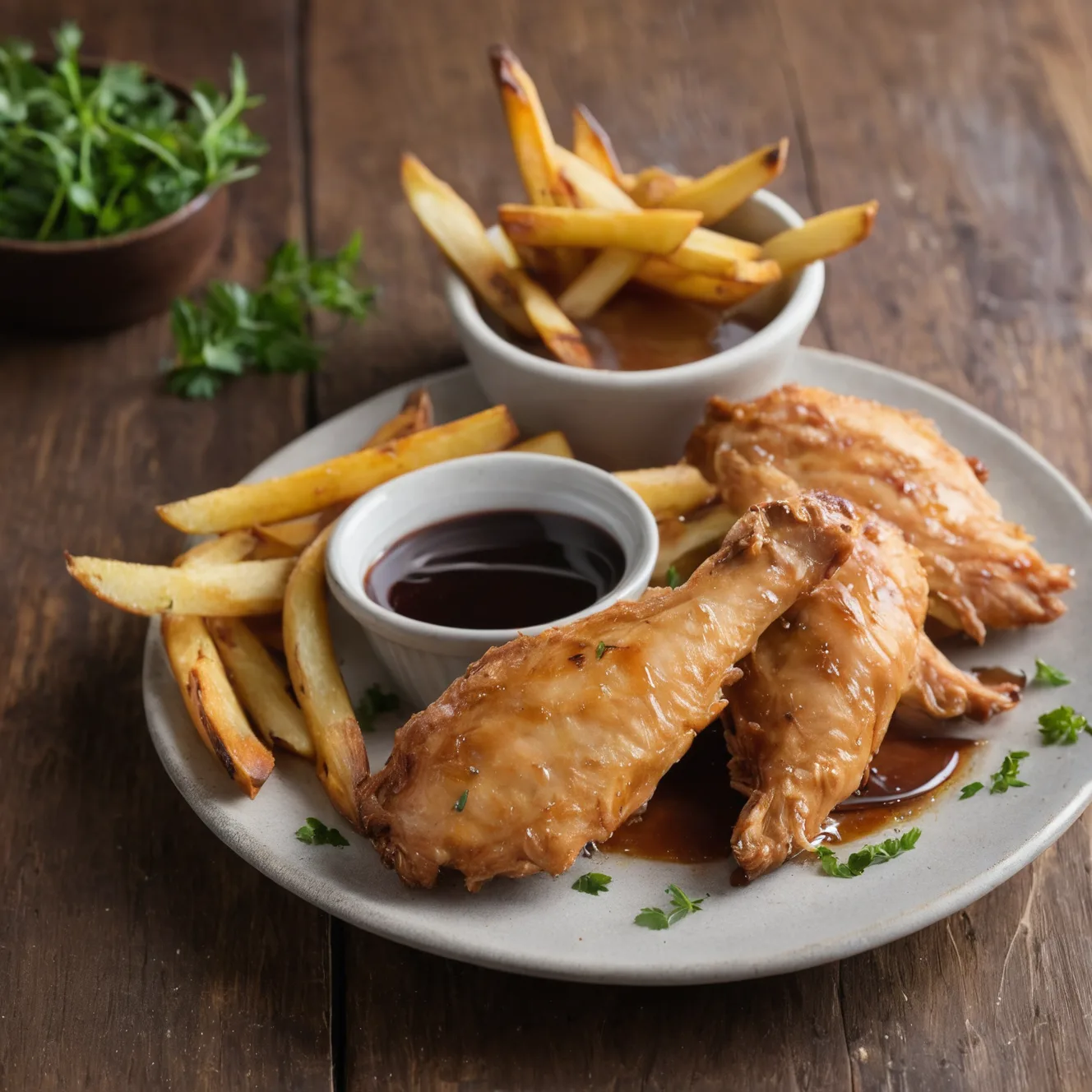
Applebee’s describes their chicken tenders as “hand-battered” — and for once, that isn’t just marketing language. A genuine wet batter, not a dry dredge, is what creates the light, crackling crust that a flour-and-cornstarch coating simply cannot replicate. Most copycat recipes get this wrong. They also get the Honey BBQ sauce wrong: the glossy body and rounded sweetness come from two specific techniques that shortcuts skip.
Here is what actually makes the difference.
Why a Sparkling Water Batter (Not a Dry Dredge)
Every dry-dredge copycat recipe produces a denser, heavier crust than what Applebee’s serves. The reason is physics. When cold sparkling water is added to the flour-cornstarch mix, the dissolved CO2 bubbles survive into the batter. When the coated chicken hits 350°F oil, those bubbles expand rapidly and set into the crust as it solidifies — creating a lightly porous, crackling texture.
This is what “hand-battered” actually means in the restaurant context: battered fresh in a wet batter, not pre-coated in a dry seasoned flour.
Use the batter immediately after mixing while the carbonation is active. Cold sparkling water keeps the bubbles tighter. Flat seltzer or room-temperature sparkling water defeats the purpose.
The Three Things Home Copycats Get Wrong
1. Skipping the wire rack rest. After coating each strip in the batter, most recipes say “fry immediately.” That is wrong. Place the coated tenders on a wire rack for 10 to 15 minutes before they go into the oil. During this rest, the batter sets against the chicken surface and bonds. Skip this step and the batter slides off in a clean sheet the moment the tender hits hot oil — because it never adhered.
2. Making the sauce with a shortcut. Ketchup plus a squeeze of honey is not Applebee’s Honey BBQ sauce. The restaurant version uses honey as the primary sweetener (not corn syrup), brown sugar as a secondary note, apple cider vinegar for tang, Worcestershire for umami depth, and smoked paprika for clean smoke. That combination is close but not what gives the sauce its glossy, restaurant-quality body. The actual finishing step — whisking cold butter into the finished sauce off heat — is what does it. Cold butter emulsifies into the hot sauce, rounding the acidity and giving a smooth, glossy consistency. Skip it and the sauce is sharp and thin.
3. Tossing the tenders in sauce. The Honey BBQ sauce is a dipping sauce at Applebee’s, not a glaze. Tossing tenders in sauce before plating turns the crust soft in under two minutes. Serve sauce on the side; dip each piece.
The Honey BBQ Sauce: What Makes It Different
The sauce profile is sweet-first, tangy-middle, smoky-finish — not one-note candy-sweet. Honey is the primary sweetener, which gives a floral note instead of the blunt sweetness of plain sugar or corn syrup. The smoked paprika delivers smoke that is clean and subtle, not harsh the way liquid smoke tends to be. And the butter finish is what separates a homemade sauce that tastes like restaurant quality from one that tastes like a bottle of Heinz 57 with honey mixed in.
Make the sauce ahead if possible. It improves after 24 hours as the flavors blend, and it keeps refrigerated for two weeks.
The Two-Stage Fry
The restaurant uses commercial fryers that maintain precise, stable oil temperatures. Home fryers struggle with temperature drops when cold chicken hits the oil. The two-stage method compensates.
First fry at 350°F: this stage cooks the chicken through to 165°F without over-browning the crust. Four to five minutes per batch.
Second blast at 375°F: once all the tenders have been first-fried, return them batch by batch to the now-hotter oil for 60 to 90 seconds. This is purely for the exterior — it creates the deep golden color and blistered, crackling surface you recognize from the restaurant.
Transfer each batch to a wire rack (not paper towels) to drain.
What to Serve With
The Applebee’s platter comes with seasoned fries — store-bought frozen fries seasoned with garlic powder, onion powder, smoked paprika, and salt work fine. The Honey BBQ sauce goes in a ramekin on the side. That is how the restaurant serves it.
If you want to replicate more of the Applebee’s experience, other menu items that pair well with this recipe include the Fiesta Lime Chicken for a side-by-side comparison of Applebee’s two most popular chicken preparations, and the Chicken Wonton Tacos if you want to do a full Applebee’s-at-home meal with an appetizer. The Honey Pepper Chicken is a related but distinct dish — pepper-forward with a heat bite instead of BBQ sweetness.
For a side-by-side on crust technique: Dave’s Hot Chicken Tenders build a craggy, shatter-crisp shell with a buttermilk double-dredge and a Nashville-style hot-oil spice paste — the opposite approach to this wet batter — and Zaxby’s Chicken Fingers also use a dry seasoned dredge. Read all three together and you can taste exactly how a dredge crust differs from a battered one.
Comparing Applebee’s Honey BBQ to Other Chain Versions
The closest chain comparison is Buffalo Wild Wings Honey BBQ Sauce, which uses a similar honey-forward base but is formulated as a wing toss (designed to coat and cling) rather than a dipping sauce. The BWW version is stickier and higher-sugar by design; Applebee’s version has a slightly cleaner finish.
For the Applebee’s sauce, the honey-to-vinegar balance is the key calibration. Too much honey and it tastes cloying; too much vinegar and the smokiness gets buried. The ratio in this recipe (⅓ cup honey, 2 tablespoons apple cider vinegar, 1 cup ketchup) matches the restaurant’s balance closely.
Nutrition: Restaurant vs. Home
The Applebee’s Chicken Tenders Platter with Honey BBQ sauce runs approximately 1,080 calories for the full platter without coleslaw, rising to about 1,460 with fries, slaw, and dipping sauce. Applebee’s doesn’t break out the tenders alone, but third-party trackers estimate the five tenders on their own at roughly 620 calories.
This home recipe, for 3 to 4 tenders with 2 tablespoons of Honey BBQ sauce, works out to roughly 420 calories per serving. The difference is serving size (the restaurant platter has 5 tenders; this recipe divides across 4 servings) and the controlled oil absorption from proper high-temperature frying rather than a commercial fryer running at volume.
For a lighter version, the air fryer instructions in the Healthier Tips section bring this to about 280 calories per serving.