


Pin It

L'Artusi Bucatini all'Amatriciana

L'Artusi Bucatini all'Amatriciana
Jump to Recipe
Prep 10 min Cook 30 min Serves 4
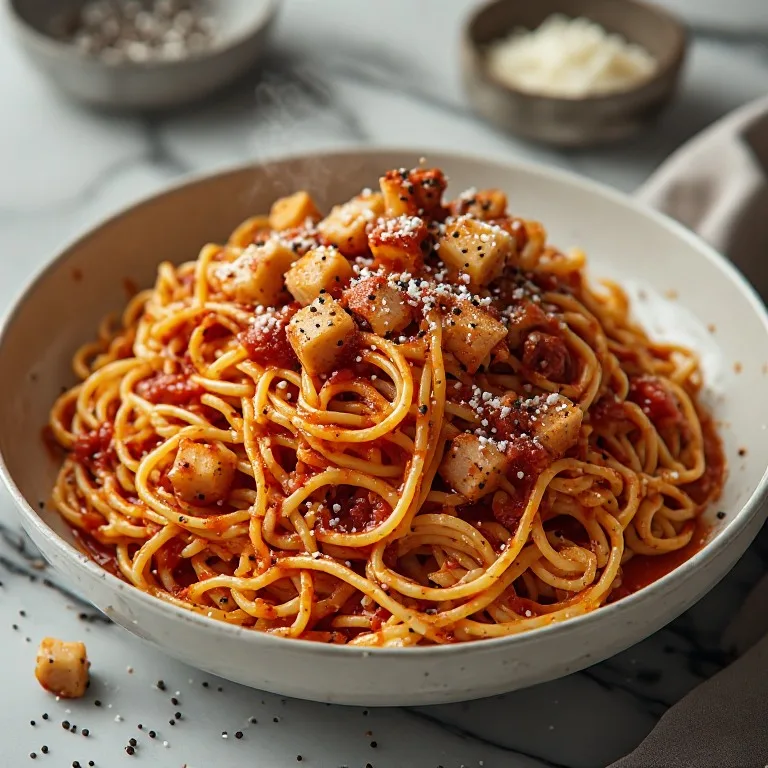
Quick answer: Cut 6 oz of guanciale into 1/4-inch lardons and cook them in a large skillet over medium-low heat for 8 to 10 minutes until the fat is fully rendered and the meat is crispy and golden. Remove the guanciale with a slotted spoon and set aside — leave all the fat in the pan. Raise heat to medium, add 1/2 teaspoon of dried Calabrian chile flakes, and toast for 30 seconds until fragrant. Pour in 1/4 cup dry white wine and cook until evaporated, about 90 seconds, scraping up any browned bits from the pan bottom. Add one 28-oz can of whole San Marzano tomatoes, crushing them by hand as they go in. Season lightly with kosher salt and simmer over medium-low for 15 to 18 minutes until the sauce is slightly reduced and shifted from bright red to a deeper, richer color. Meanwhile cook 1 lb of bucatini in well-salted boiling water, pulling it 2 minutes before package directions. Reserve 1 cup of pasta water. Toss the bucatini into the sauce over medium heat with a splash of pasta water and toss hard for 90 seconds, adding more water as needed until the sauce coats every strand. Off heat, toss in 1.5 oz of finely grated Pecorino Romano. Plate immediately, scatter the reserved crispy guanciale over each bowl, and finish with another pass of Pecorino and a crack of black pepper. L'Artusi charges $29 per portion. This recipe makes four for about $8 each.

Shop the tools

Gear matched to this recipe. These are Amazon affiliate links — we may earn a small commission if you buy, at no extra cost to you.

As an Amazon Associate, Copycat Spices earns from qualifying purchases. Product images are generic illustrations, not the exact item listed.

L'Artusi Bucatini all'Amatriciana

L'Artusi's famous bucatini all'amatriciana, made at home: crispy guanciale rendered low-and-slow, San Marzano tomatoes simmered in the fat, and bucatini finished in the sauce with Pecorino Romano. The $29 West Village pasta for about $8 a plate.

Medium Prep: 10 min Cook: 30 min Total: 40 min4 servings ~$3.85/serving
Prep10 min
Cook30 min
Total40 min
Servings
4
At home~$3.85/serving
vs
Restaurant~$17.32/serving
You save ~78%

The Story Behind the Recipe

L'Artusi opened in 2008 at 228 West 10th Street in the West Village and quickly became one of the most reliably excellent Italian restaurants in New York City. The room seats about 80 and takes reservations through Resy — booked weeks out on weekends, but without the celebrity spectacle that follows Carbone or the Michelin-star gravity of Marea. L'Artusi's reputation comes entirely from the food: hand-rolled pastas, honest Italian wines, and a guanciale-forward kitchen where cured pork cheek is treated as the foundation of the dish, not the accent. The bucatini all'amatriciana has been the signature since the restaurant opened.

Amatriciana traces to Amatrice, a town in the Lazio mountains, where it began as gricia — guanciale, Pecorino Romano, and black pepper — before tomatoes arrived from the New World. The canonical Roman version uses guanciale, San Marzano tomatoes, Pecorino, dried chili, and white wine. No onion. No garlic. L'Artusi's interpretation follows that canon without shortcuts: real guanciale slowly rendered so its fat becomes the sauce base, whole San Marzanos crushed by hand, and enough Pecorino to emulsify the final toss. The dish costs $29 at the restaurant. At home, with guanciale sourced from a specialty grocer or online, it runs closer to $8 a plate.

Nutrition Facts

Per serving (4 servings)
Calories680
Total Fat25g
Total Carbs86g
Dietary Fiber4g
Sugars7g
Protein24g
Sodium820mg

* Estimated values based on standard recipe preparation. Actual values may vary.

Ingredients

  • Guanciale and sauce
  • Pasta and finish

Instructions

💡
Pro tip: This recipe tastes even better the next day. The flavors need time to meld together in the fridge.
❄️
Storage: Keeps in an airtight container in the fridge for up to 2 weeks. Freezer-friendly for up to 3 months.
🎃 Free Halloween cookbook — download now The Copycat Halloween Cookbook A ready-made, photo-illustrated PDF of our best halloween copycat recipes — free to download, no building required. Pay what you want to support if you love it.

Free PDF — instant download. We'll also send new seasonal copycat recipes now and then; unsubscribe anytime. Or just download it →

L’Artusi Bucatini all’Amatriciana (The West Village Classic, Made at Home)

Prep time: 10 min Cook time: 30 min Servings: 4

L’Artusi opened in 2008 at 228 West 10th Street in the West Village and quickly became one of the most reliably excellent Italian restaurants in New York City. The room seats about 80 and takes reservations through Resy — booked weeks out on weekends, but without the celebrity spectacle that follows Carbone or the Michelin-star gravity of Marea. L’Artusi’s reputation comes entirely from the food: a tight menu of hand-rolled pastas, honest Italian wines, and a guanciale-forward kitchen where cured pork cheek is treated as the foundation, not the accent. The bucatini all’amatriciana has been the signature since day one.

The dish at L’Artusi costs $29. The version you make at home, if you source real guanciale, costs about $8 a plate.

What Makes Amatriciana Different from Other Tomato Pasta

Amatriciana is not a tomato pasta with pork added. It is a pork-fat pasta that uses tomatoes to balance and stretch the guanciale’s richness. Strip the tomatoes out entirely and you get its ancestor, pasta alla gricia — just guanciale, Pecorino, and black pepper. The distinction matters because it changes how you build the sauce: you render the guanciale first, low and slow, until the fat fully clarifies — then you cook everything else in that fat. The tomatoes go into the guanciale fat. The pasta finishes in the guanciale fat. The Pecorino emulsifies into the guanciale fat. Every flavor in the dish passes through the pork.

Guanciale — cured pork cheek — has a higher fat-to-meat ratio than pancetta and a cleaner, sweeter pork character with no smokiness. When rendered slowly over medium-low heat, the fat becomes translucent and the meat crisps to a chip-like texture that holds up as a garnish. This is the single most important step in the recipe. Rushed guanciale — cooked over high heat until it sizzles and browns quickly — renders less fat, stays chewier, and develops bitter caramelized edges that fight with the tomato. Give it 8 to 10 minutes at medium-low. Let the fat melt out completely before you move on.

The Roman Rules — and Why L’Artusi Follows Them

Amatriciana has a contentious history. The dish comes from Amatrice, a town in the Lazio mountains, where in 2015 the municipality officially codified the recipe: guanciale, San Marzano tomatoes, Pecorino Romano, dried chili, white wine, and pasta from Amatrice (the local wheat-only spaghetti). No onion. No garlic. No olive oil. No pancetta.

Most Roman trattorias follow this blueprint closely. L’Artusi does too, with one caveat worth noting: their Pecorino application. Most home recipes add Pecorino as a tableside topping only. L’Artusi tosses a portion of it directly into the pasta off heat, letting the residual heat and pasta water emulsify the cheese into a light coating. The same technique appears in carbonara and cacio e pepe. The result is a sauce that clings to the bucatini rather than sitting beneath it.

The Pasta: Why Bucatini

Bucatini is thick spaghetti with a hollow center. The hollow traps sauce inside the tube while the exterior picks up the Pecorino and guanciale fat, giving you two textures in one bite. The diameter — roughly 3mm, compared to 2mm for standard spaghetti — also means bucatini holds up to the weight of guanciale-fat sauce without going limp. L’Artusi uses it for both reasons.

If you cannot find bucatini, rigatoni or thick spaghetti (spaghettoni) are the best alternatives. Standard thin spaghetti works but tends to clump at the finish step, when you are tossing the pasta vigorously in the sauce.

Cost at the Restaurant vs. At Home

The $29 price at L’Artusi reflects West Village commercial rent, front-of-house staff, and a wine program. At home:

L’ArtusiHomemade (4 servings)
Per plate~$29—
Full batch (4 plates)~$116~$28–32
Per serving~$29~$7–8
Savings per plate—~$21

The guanciale is the only specialty-cost item — roughly $8 to $12 for 6 oz at an Italian deli or specialty grocer. Everything else is standard grocery territory.

The Three Techniques Most Home Versions Miss

1. Render the guanciale at medium-low, not medium-high

This is the most frequently rushed step. High heat produces crispy meat quickly but leaves most of the fat unreleased — you get chewy browned pieces and a dry pan. Medium-low heat over 8 to 10 minutes renders almost all the fat out, leaving the meat delicate-crispy and the pan with enough liquid fat to build a proper sauce. That fat is the entire flavor base.

2. Pull the pasta 2 minutes early and finish it in the sauce

Pasta cooked fully in water and then plated with sauce on top is a different dish from pasta that finishes its last 2 minutes in the sauce. In the sauce, the pasta absorbs the guanciale fat and tomato, the pasta starch thickens the sauce into a glossy coating, and the Pecorino binds everything together. Fully cooked pasta poured into sauce just gets coated on the outside — the inside is neutral.

3. Add the Pecorino off heat, not while still over the flame

Pecorino Romano is sharp and salty with a low melting point. Over direct heat it seizes into rubbery clumps. Off heat — with the pan still warm and pasta water helping emulsify — it melts smoothly into a faint white sheen across the sauce. This is why amatriciana, carbonara, and cacio e pepe all specify removing from heat before the cheese goes in.

Related Roman and NYC Italian Recipes

If you’re working through the Roman pasta canon or other New York Italian signatures, these pair naturally with this one:

🥗

Make It Healthier

Love L'Artusi Bucatini all'Amatriciana but want a lighter version? Try these simple swaps:

  • ✓Reduce the guanciale to 4 oz — the fat rendered from that amount is still enough to build the sauce base, and you get the same crispy garnish in smaller quantities. Saves about 60 calories per serving.
  • ✓Finish with 1 oz of Pecorino instead of 1.5 oz — it emulsifies enough to bind the sauce; the second half-ounce at the table is optional, not structural.
  • ✓Use whole-wheat or farro bucatini to raise fiber by 4 to 5g per serving; the guanciale fat and Pecorino's sharpness mask the earthier flavor better than in a lighter pasta recipe.
  • ✓Serve smaller portions (3 oz dry pasta per person instead of 4 oz) and round out the plate with a sharp bitter green salad — radicchio with lemon and olive oil is the classic Roman pairing and adds fiber and vitamins without competing with the pasta.

Frequently Asked Questions

What is guanciale and is there a good substitute?

Guanciale is cured pork cheek — the same cut that gives carbonara its characteristic richness. It is cured with salt, black pepper, and sometimes rosemary or juniper, then air-dried for weeks. The fat-to-meat ratio is higher than pancetta and the flavor is more delicate and porky, without the smokiness of bacon. It is the canonical ingredient in both amatriciana and carbonara. In New York City, you can find it at Eataly, Buon Italia, and most Italian specialty grocers. Online, vendors like Di Bruno Bros. and Salumi Artisan Cured Meats ship nationwide. For a substitute: pancetta (unsmoked cured pork belly) is the most acceptable swap — it lacks the sweetness of guanciale but has similar richness and no smoke. Thick-cut unsmoked bacon works in a pinch but changes the flavor profile noticeably. In all cases, the fat matters more than the meat — you are rendering the fat to build the sauce base, so using a lean substitute defeats the purpose.

Why bucatini specifically — can I use another pasta?

Bucatini — thick hollow spaghetti with a small hole running through the center — is the traditional pairing for amatriciana. The hollow traps the tomato-fat sauce inside while the exterior picks up the Pecorino, giving you two textures in one bite: a slick exterior coating and a sauce-filled interior. The diameter is thicker than spaghetti, which means it holds up to the guanciale's rendered fat without going limp. L'Artusi uses bucatini for this reason. If you cannot find it, rigatoni or thick spaghetti (spaghettoni) are the best substitutes — rigatoni because the ridges and tubes catch the chunky sauce, spaghettoni because it approximates bucatini's thickness. Standard thin spaghetti works but tends to clump and underdresses.

Is this authentic amatriciana or is L'Artusi's version different from the Roman original?

L'Artusi follows the Roman version closely, which is itself not identical to the Amatriciana original from the town of Amatrice. The Amatrice version uses no tomato at all — that dish is called pasta alla Gricia and predates the tomato's arrival in Italian cooking. The Roman version added San Marzano tomatoes and white wine. L'Artusi's kitchen uses guanciale, San Marzano tomatoes, Pecorino Romano, Calabrian chile flakes, and white wine — exactly the Roman canon. What sets L'Artusi's version apart from most home interpretations is the technique: the guanciale is rendered completely at low heat so the fat melts slowly and clarifies rather than sizzling and smoking, and the pasta is finished in the sauce — not sauced after draining — so the starchy pasta water emulsifies everything into a glossy, cohesive coating.

Do real San Marzano tomatoes matter here?

Yes, more than in most pasta recipes. San Marzano tomatoes grown in the volcanic soil of the Agro Sarnese-Nocerino valley south of Naples have a lower acidity, higher natural sugar content, and thicker flesh than standard canned tomatoes. In a sauce with only four or five ingredients, the tomato character is fully exposed — there is no long braise or heavy seasoning to smooth out harsh acidity. Look for cans labeled 'DOP San Marzano' (Denominazione di Origine Protetta) — brands like La Valle, Mutti Polpa, or Cento San Marzano DOP. Generic 'San Marzano style' tomatoes are not the same product. If genuine DOP San Marzanos are unavailable, Mutti Polpa or Bianco DiNapoli whole tomatoes are the best alternatives. Avoid pre-seasoned or diced canned tomatoes — the added salt and citric acid create an unbalanced baseline.

Does amatriciana use onion?

Not in the classic Roman or Amatrice versions, and not at L'Artusi. Onion is a common addition in home recipes and some trattorias, but it is considered non-traditional by the town of Amatrice, which codified the recipe officially in 2015. The argument against onion is that guanciale fat, properly rendered and combined with tomato and Pecorino, produces all the sweetness and body the sauce needs — onion adds moisture and a different sweetness that softens the sharp, salty contrast between the pork and the cheese. L'Artusi's version uses no onion or garlic. If you prefer some allium in the sauce, a small amount of thinly sliced shallot (not onion) softened in the guanciale fat before the wine goes in is the closest approximation.

Why does pasta at L'Artusi cost $29?

The price reflects multiple layers of cost that don't exist at home: New York City commercial rent in the West Village, front-of-house staff, a full wine program, and guanciale sourced from quality Italian producers. L'Artusi is also serving a dish that requires active kitchen time — the pasta is finished to order in the sauce — rather than pre-made. For context, the same pasta dish at a comparable restaurant in Rome costs roughly 12 to 16 euros. The markup in NYC is real and unavoidable for a restaurant operating at that level. At home, the main cost is the guanciale, which runs $8 to $12 for 6 ounces at specialty grocers. The rest of the recipe — bucatini, San Marzanos, white wine, Pecorino — runs under $12 total, putting the per-serving cost between $5 and $8 depending on ingredient sourcing.

Can I make this ahead of time?

The sauce — the tomato and rendered guanciale fat base — can be made 2 to 3 days ahead and refrigerated, or frozen for up to a month. When you're ready to serve, reheat the sauce gently over medium-low while you cook the pasta fresh. Do not cook the pasta ahead and mix it into the sauce early — bucatini absorbs liquid quickly and will become thick and gummy rather than saucy. The crispy guanciale is also best made fresh, but it holds for 2 to 3 days in the refrigerator and crisps back up in a dry skillet over medium heat in about 2 minutes. The Pecorino should always be added off heat at the last moment — adding it to a hot sauce causes it to seize rather than emulsify.

What wine pairs with bucatini all'amatriciana?

Amatriciana comes from the Lazio region of central Italy, and the traditional local pairing is Cesanese del Piglio — a medium-bodied red from Lazio with enough acidity to cut through the guanciale fat and enough fruit to match the tomatoes. It is hard to find in the US but worth seeking out if you can. More accessible options: Montepulciano d'Abruzzo (earthy, dark-fruited, excellent with tomato-pork combinations), Nero d'Avola from Sicily (rich, herbal, complementary to cured meats), or a light to medium Sangiovese like a Rosso di Montalcino or Morellino di Scansano. Avoid heavily oaked reds — the wood tannins fight with the Pecorino's sharpness. White wine: a crisp, mineral Frascati from Lazio, or Vermentino from Sardinia (Sardinia and Lazio both have strong guanciale traditions).

Love this recipe? Share it!

Free PDF: our 12 most-wanted copycat recipes — instant download.

Made it? Buy us a coffee

Every recipe here is free, with no paywalls. If this one was a hit at your table, a small tip keeps new copycats coming.

$

L'Artusi is a trademark of its owner, used here only to describe the dish this recipe recreates. This is an independent copycat written in our own words — Copycat Spices is not affiliated with, endorsed by or sponsored by L'Artusi.

Ratings & Reviews

—
No ratings yet

Rate this recipe

Click a star to rate

Leave a Review

0/500

CS

Copycat Spices Editorial

Researched + fact-checked. Every recipe on Copycat Spices is built from published sources — official ingredient lists, brand-published recipes, interviews and food-science references — and fact-checked before it goes live, then written as clear, step-by-step instructions for home cooks of all skill levels.

Learn more about our mission →