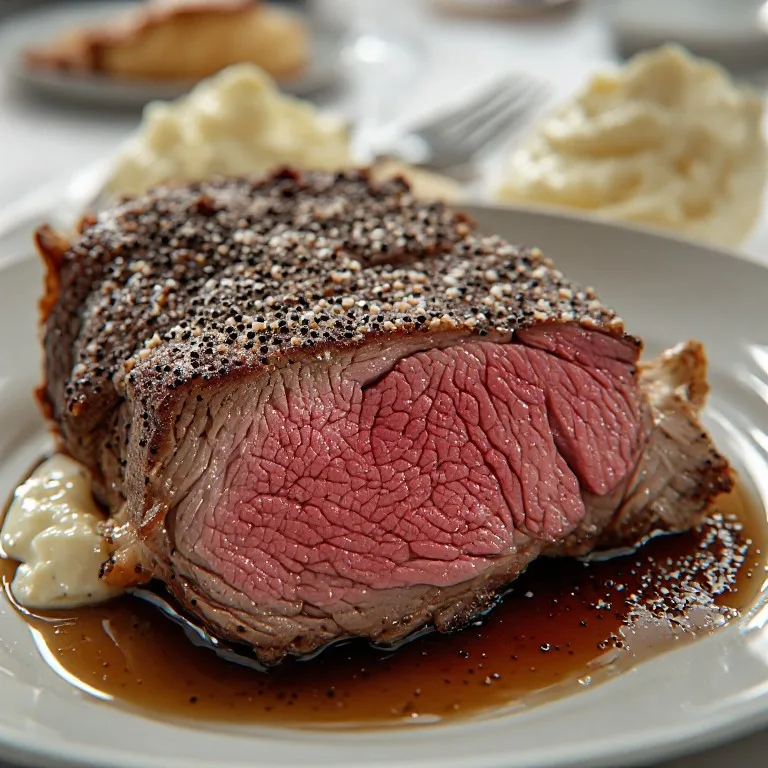
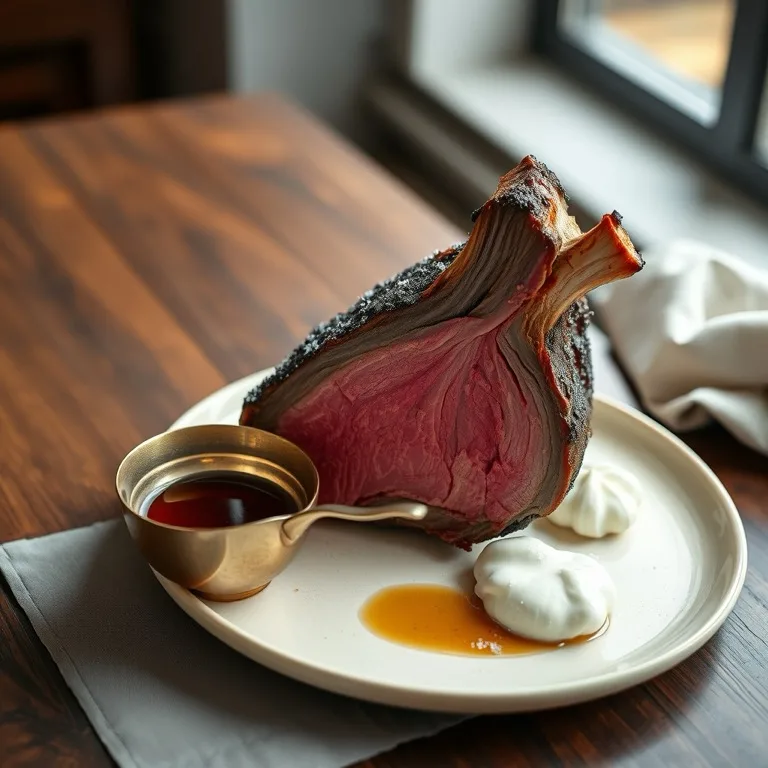
Quick answer: Season a 7-to-8 lb bone-in 3-rib roast (USDA Prime if available) with a thick paste of 3 tablespoons Diamond Crystal kosher salt, 2 tablespoons coarse black pepper, 1 tablespoon garlic powder, 1 tablespoon dried thyme, and 2 tablespoons neutral oil, rubbed into every surface. Refrigerate uncovered overnight on a wire rack (or at minimum bring to room temperature for 2 to 3 hours before roasting — this step is not optional for even cooking). Preheat your oven to 225°F. Set the roast bone-side down in a roasting pan with a meat thermometer inserted into the deepest part of the meat away from bone. Roast at 225°F until the internal temperature reads 120°F for medium-rare — roughly 3.5 to 4.5 hours for a 7 to 8 lb roast. Pull from the oven and rest uncovered for 45 minutes; the internal will climb to 125 to 128°F during the rest. For the steakhouse crust: return the roast to a 550°F oven (or highest broiler setting, 6 inches from element) for 10 to 12 minutes until a deep mahogany crust forms. While the roast rests, deglaze the roasting pan with 2 cups of beef stock, scraping up all browned bits, add 1 tablespoon Worcestershire, simmer 10 minutes, strain, season — that is the au jus. Carve by slicing off the rib-bone slab in one piece, then cutting 1/2-to-3/4-inch slices. Pool 3 tablespoons of hot au jus alongside each slice; serve cold horseradish cream on the side.
Shop the tools
Gear matched to this recipe. These are Amazon affiliate links — we may
earn a small commission if you buy, at no extra cost to you.
As an Amazon Associate, Copycat Spices earns from qualifying purchases.
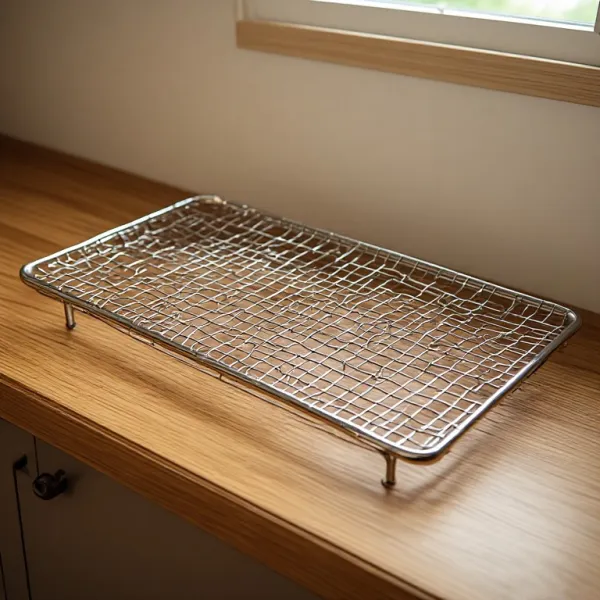
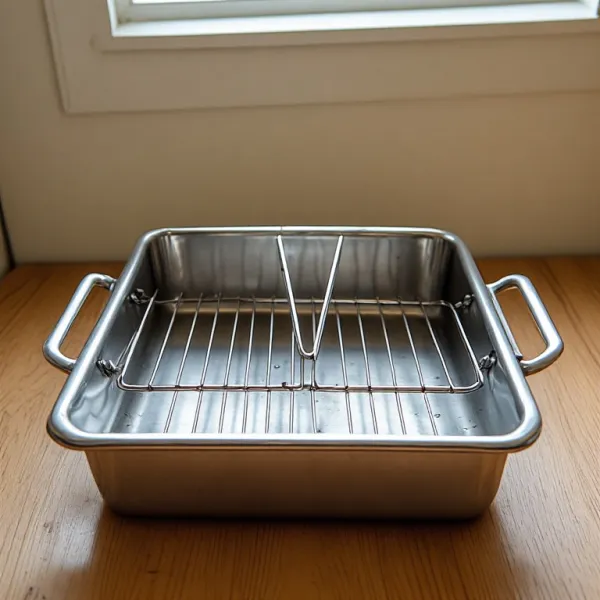
Product images are generic illustrations, not the exact item listed.
Smith & Wollensky Prime Rib (The Famous NYC Steakhouse Roast, Made at Home)
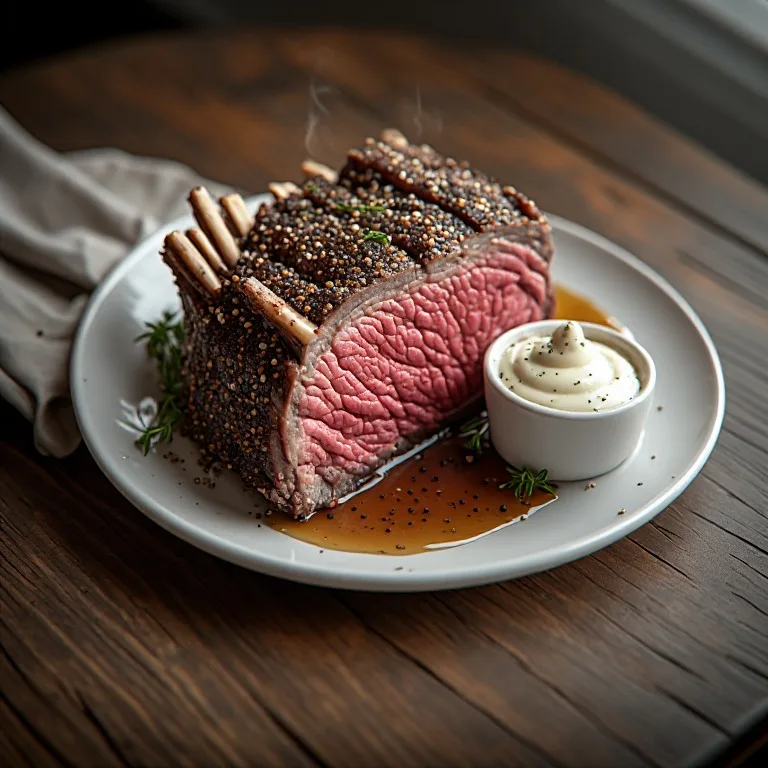
Smith & Wollensky's famous prime rib made at home: a USDA Prime standing rib roast seasoned with salt, pepper, garlic, and dried herbs, roasted low-and-slow at 225°F to a perfectly even medium-rare, then given a high-heat sear finish for the steakhouse crust. Served with house au jus and cold horseradish cream. The 26oz Classic Prime Rib at Smith & Wollensky runs $82; the full 3-bone roast at home feeds six for roughly $120 to $140.
Medium
Prep: 30 min (+ 2–3 hr room-temp rest)
Cook: 4 hr 30 min
Total: 8h 0m6 servings
~$4.50/serving
Prep30 min (+ 2–3 hr room-temp rest)
Cook4 hr 30 min
Total8h 0m
Servings
6
At home~$4.50/serving
vs
Restaurant~$20.25/serving
You save ~78%
The Story Behind the Recipe
Smith & Wollensky opened on the corner of 49th Street and Third Avenue in Manhattan in 1977 — in the space that had previously housed Manny Wolf's Steakhouse — founded by Alan Stillman and Ben Benson. Stillman had also created the original TGI Friday's. The restaurant's name came from a phone book, chosen essentially at random; Stillman's dogs were actually named Charlie and Ralph. Within a few years it was one of the definitive power-lunch destinations in New York, known for its green-painted walls, the sawdust-floored Wollensky's Grill downstairs, the Green Room wine cellar, and above all its in-house USDA Prime beef, dry-aged on premises — one of the few steakhouses to butcher and age their own beef rather than receive it pre-portioned. The 26oz Classic Prime Rib at the Manhattan location currently runs $82; the full roast, prepared daily from large primal-cut sections and often sold out before dinner service ends, is their most theatrical dish — served with a small pitcher of hot au jus and cold horseradish cream. The chain has since expanded internationally, including a Kuala Lumpur location that opened in 2025.
The technique that separates a great prime rib from a disappointing one is almost entirely temperature management, not seasoning. Smith & Wollensky roasts their prime rib at 325°F — a traditional approach that works in a professional kitchen with calibrated equipment and enormous primal roasts. At home, a lower temperature (225°F) produces more consistently even results: a 7 to 8 lb bone-in rib roast has 3 to 4 inches of thickness at its center, and at 325°F, the outer ring reaches well-done while the center is still climbing through rare. The result is the thick grey overcooked band that makes most home prime ribs disappointing. At 225°F, the roast heats slowly enough that the entire mass moves toward the target temperature at nearly the same rate, producing a roast that is an even medium-rare from edge to edge with only a thin (1/8-inch) well-done ring — which is then hidden by the high-heat crust applied at the end. The prime rib is dry-aged about 18 days at the restaurant, shorter than their steaks (22 to 28 days) because the slow roasting concentrates flavor in ways that compensate; at home, a 24-to-48 hour uncovered dry-brine in the refrigerator approximates some of that concentrated character.
Nutrition Facts
Per serving (6 servings)
Calories720
Total Fat50g
Total Carbs3g
Dietary Fiber0g
Sugars1g
Protein58g
Sodium860mg
* Estimated values based on standard recipe preparation. Actual values may vary.
Ingredients
The roast
For the au jus
For the horseradish cream
Instructions
💡
Pro tip: This recipe tastes even better the next day. The flavors need time to meld together in the fridge.
❄️
Storage: Keeps in an airtight container in the fridge for up to 2 weeks. Freezer-friendly for up to 3 months.
🦃 Free Thanksgiving cookbook — download now
The Copycat Thanksgiving Cookbook
A ready-made, photo-illustrated PDF of our best thanksgiving copycat
recipes — free to download, no building required. Pay what you want to support if you love it.
Free PDF — instant download. We'll also send new seasonal copycat recipes now
and then; unsubscribe anytime.
Or just download it →
🎉 Your Thanksgiving Cookbook is ready!
It's free — but if it's worth something to you, you can pay what you want.
It keeps the recipes coming.
$
✓ Downloading your free Thanksgiving Cookbook — check your downloads folder. Happy cooking!
CopycatSpices
Smith & Wollensky Prime Rib (The Famous NYC Steakhouse Roast, Made at Home)
Smith & Wollensky's famous prime rib made at home: a USDA Prime standing rib roast seasoned with salt, pepper, garlic, and dried herbs, roasted low-and-slow at 225°F to a perfectly even medium-rare, then given a high-heat sear finish for the steakhouse crust. Served with house au jus and cold horseradish cream. The 26oz Classic Prime Rib at Smith & Wollensky runs $82; the full 3-bone roast at home feeds six for roughly $120 to $140.
smith-and-wollensky · prime-rib · american · steakhouse
🕑Prep30 min (+ 2–3 hr room-temp rest)
🍳Cook4 hr 30 min
⏱Total8h 0m
🍽Serves6
⭐DifficultyMedium
Ingredients
The roast
1 bone-in standing rib roast, 3 ribs (7 to 8 lbs) — USDA Prime preferred; well-marbled Choice is a good substitute
2 tablespoons neutral oil (grapeseed, avocado, or vegetable)
For the au jus
Pan drippings from the roast
2 cups low-sodium beef stock
1 tablespoon Worcestershire sauce
Salt and black pepper to taste
For the horseradish cream
1/2 cup sour cream (or crème fraîche for a richer result)
3 tablespoons prepared horseradish, drained well
1 tablespoon Dijon mustard
1 tablespoon white wine vinegar
1/2 teaspoon fine sea salt
White pepper to taste
Instructions
1.Season and dry-brine (24–48 hours ahead, or 2–3 hours ahead minimum). Pat the roast completely dry on all surfaces with paper towels. In a small bowl, mix the salt, pepper, garlic powder, onion powder, thyme, rosemary, and oil into a thick paste. Rub the paste evenly into all surfaces of the roast — the fat cap, the meat surfaces, between the rib bones. Set the roast bone-side down on a wire rack set over a rimmed sheet pan. Refrigerate uncovered for 24 to 48 hours if time allows (the salt draws moisture out and then reabsorbs it, seasoning the meat throughout and drying the exterior for better crust formation). If cooking same-day, skip the refrigerator: season now and leave at room temperature for 2 to 3 hours.
2.Come to room temperature (mandatory, 2–3 hours before roasting). If refrigerating overnight, pull the roast from the refrigerator 2 to 3 hours before it goes into the oven. A 7 to 8 lb bone-in roast takes a full 2 to 3 hours to lose the cold from its center. Skipping this step produces the uneven 'gray band' exterior that separates home prime rib from the steakhouse version.
3.Roast low and slow. Preheat oven to 225°F. Place the roast bone-side down in a roasting pan or Dutch oven (no rack needed — the bones act as their own rack). Insert a leave-in probe thermometer into the deepest part of the meat, angled so the probe tip sits in the thickest area without touching bone. Roast at 225°F without opening the oven. The roast will take 3.5 to 5 hours depending on your specific oven and the exact weight — begin checking temperature at 3 hours. Pull the roast when the probe reads 120°F for medium-rare (the target after resting).
4.Rest (45 minutes). Transfer the roast to a cutting board. Do not tent with foil — the heat trapped under foil steams the crust soft. Rest uncovered at room temperature for 45 minutes. Internal temperature will climb 5 to 8°F during this period from carryover. After resting, the internal should read 125 to 128°F at medium-rare. While it rests, make the au jus and horseradish cream (steps 5 and 6).
5.High-heat crust finish (the steakhouse exterior). After the 45-minute rest, return the roast to a 550°F oven (or position it 6 inches below your broiler on its highest setting). Roast 10 to 12 minutes until the exterior is a deep mahogany and visibly caramelized — check at 10 minutes. The crust develops quickly at this temperature; do not leave unattended past 12 minutes. Pull and let stand 5 minutes before carving.
6.Make the au jus. While the roast rests after the low-and-slow stage, pour all pan drippings into a fat separator or measuring cup. Let stand 5 minutes until the fat rises. Pour the meat juices (bottom layer) into a medium saucepan, discarding the excess fat (leave 1 tablespoon of fat in the pan for flavor). Add 2 cups beef stock and the Worcestershire sauce. Bring to a boil, scraping any browned bits from the roasting pan into the saucepan. Reduce heat and simmer for 10 to 15 minutes until slightly reduced and deepened in color. Taste and adjust salt. Strain through a fine mesh strainer into a small pitcher for serving. Keep hot over low heat until ready to serve.
7.Make the horseradish cream. Combine sour cream, drained horseradish, Dijon, vinegar, salt, and white pepper in a small bowl. Stir to combine. Taste — the heat from the horseradish should be forward but not overwhelming; add more horseradish if needed. Refrigerate until serving. (Horseradish cream is served cold alongside the hot au jus — the contrast of temperatures is part of the presentation.)
8.Carve and serve. Stand the roast on its cut surface. Using a long, sharp carving knife, cut down along the rib bones to remove them in one connected slab — run the knife flush against the bone surface. Set the bone slab aside. Now slice the boneless roast into portions 1/2 to 3/4 inch thick, cutting perpendicular to where the bones were. Each portion should show the even medium-rare gradient from edge to center. To serve: pool 3 tablespoons of hot au jus in the center of each plate, lay the sliced prime rib on top, and place a tablespoon of cold horseradish cream to the side. The rib bones, cut into individual ribs, can be served separately — they are heavily flavored and among the best pieces of the roast.
Notes
Smith & Wollensky Prime Rib (The Famous NYC Steakhouse Roast, Made at Home)
Prep time: 30 min (+ 2–3 hr room-temp rest, plus optional overnight dry-brine) Cook time: ~4 hr 30 min Serves: 6 Difficulty: Medium
Smith & Wollensky’s prime rib — a USDA Prime standing rib roast, seasoned with salt, pepper, garlic, and herbs, slow-roasted at 225°F to an edge-to-edge medium-rare, then finished at 550°F for the steakhouse crust — made at home. Served with hot house au jus and cold horseradish cream. The restaurant charges $89+ per slice; the full 3-bone roast, feeding six, costs roughly $120 to $140 in ingredients at home.
The method that matters: come to temperature before roasting (2 to 3 hours out of the refrigerator), roast low-and-slow at 225°F (not 325°F), rest 45 minutes, then crust at maximum heat. That sequence is the difference between steakhouse prime rib and the gray-banded home version.
🥗
Make It Healthier
Love Smith & Wollensky Prime Rib (The Famous NYC Steakhouse Roast, Made at Home) but want a lighter version? Try these simple swaps:
✓Before rubbing with seasoning, trim the fat cap to 1/4 inch rather than 1/2 inch — this removes the thickest layer of exterior fat that renders primarily into the pan rather than into the meat, reducing the fat content per serving by roughly 10 to 15 percent without affecting the crust or flavor of the sliced meat.
✓Use au jus instead of horseradish cream as your primary condiment — the au jus has almost no fat (it is essentially reduced beef drippings and stock), while the horseradish cream adds roughly 60 to 80 calories and 6g of fat per tablespoon. The au jus also delivers more concentrated beef flavor than the cream-based condiment.
✓Choose an end cut rather than a center cut when carving — the end pieces (the two slices on each outer side of the roast) have more surface crust-to-meat ratio and a more developed, caramelized flavor, which means they deliver more taste per calorie than the center slices, which are larger and have proportionally more interior fat.
✓A serving of prime rib is traditionally one thick slice (roughly 10 to 12 oz cooked), but 6 oz is a realistic, satisfying portion when paired with a large green salad, roasted asparagus, or a vegetable-forward first course — reducing the per-person calorie contribution of the roast from roughly 700 to approximately 360 while still delivering the full flavor experience.
Frequently Asked Questions
What does USDA Prime mean, and do I need it for this recipe?
USDA grades beef on marbling — the white fat flecks distributed through the muscle. Prime is the top 2 to 3 percent of beef graded by the USDA, with the highest marbling score. The next grade down, Choice, covers roughly 50 percent of graded beef and still produces an excellent prime rib. Select grade is appropriate for braised dishes but produces a noticeably drier result for a roast. Smith & Wollensky specifically purchases and advertises USDA Prime beef for all their steaks and prime rib. At home, Prime-grade standing rib roasts are available at specialty butchers, Costco (their Choice grade is often on the high end of Choice), and national shippers like Allen Brothers, Snake River Farms, and Crowd Cow. If you cannot access Prime grade, a well-marbled Choice-grade rib roast from a reliable butcher still produces an excellent result — the difference is less dramatic in a slow-roasted prime rib than in a pan-seared steak, because the longer cooking time allows the lower marbling to render and baste the meat throughout.
Why does Smith & Wollensky's prime rib taste different from homemade versions?
Three factors: dry-aging, beef grade, and cooking scale. Smith & Wollensky dry-ages their prime rib roughly 18 days before roasting — shorter than their steaks (22 to 28 days) because slow roasting at 325°F concentrates flavor over several hours, which compensates for a shorter aging period. During aging, enzymatic activity breaks down collagen and muscle fibers, producing the concentrated, nutty, mineral-rich depth that fresh beef lacks. The moisture loss during aging also concentrates flavor — dry-aged beef is richer and more intensely 'beefy' than fresh. The restaurant also purchases USDA Prime — the top 2 to 3 percent of graded beef by marbling — while most supermarket beef is Choice. Finally, cooking dozens of roasts simultaneously in a professional kitchen produces different results than a single roast at home: professional roasting ovens maintain temperature more precisely, the volume of meat in the oven creates a more humid environment, and the heat recovery after the oven door opens is faster. Home cooks can close the first two gaps significantly by sourcing dry-aged Prime beef from a specialty butcher; the cooking environment gap is smaller, and this recipe's low-and-slow method compensates for home oven variability.
What is the difference between a standing rib roast and prime rib?
Technically, prime rib is a preparation method (slow-roasted standing rib roast served with au jus), not a specific cut. 'Standing rib roast' refers to the uncooked cut — the rib section of the beef with the bones still attached, which stands upright on its rib bones during roasting. 'Prime rib' originally referred to a roast made from USDA Prime beef, but the term has become generic for the dish regardless of grade. At Smith & Wollensky and other high-end steakhouses, the distinction is still meaningful — they use USDA Prime grade beef for what they call prime rib, and the name is accurate. For this recipe, ask your butcher for a 'bone-in standing rib roast, 3 ribs' — that is the cut. Specifying 'prime rib' may or may not communicate the same thing depending on the butcher.
Can I prepare this a day ahead for a dinner party?
The overnight dry-brine (salting uncovered in the refrigerator) is ideal and should be done 24 to 48 hours ahead — this is an active improvement, not a make-do. The actual roasting should happen the day you serve; prime rib does not reheat well from fully cooked. There is a middle ground for dinner party prep: roast the meat to 110°F (medium-rare is 120°F), rest 30 minutes, then refrigerate. Slice and rest at room temperature 2 hours before service. Return to a 250°F oven until internal reaches 120°F again (roughly 45 minutes), then do the high-heat finish. This method, called the 'two-stage roast,' is used by some professional catering operations but is a meaningful quality compromise versus day-of roasting. For a dinner party of 6, the simpler answer is: do the overnight dry-brine, start the roast 5 to 6 hours before dinner, and time the rest plus high-heat finish to land 15 minutes before you want to carve.
What internal temperature should I target, and what doneness does that produce?
Pull temperature (before resting), carryover rest target, and doneness level: 115°F pull / 120–122°F after rest = rare (bright red center, cool); 120°F pull / 125–128°F after rest = medium-rare (pink throughout, barely warm center — the Smith & Wollensky standard); 125°F pull / 130–133°F after rest = medium (some pink in center, warm throughout); 130°F pull / 135–138°F after rest = medium-well (faint pink). The carryover climb is 5 to 8 degrees for a large roast at this size and at this low roasting temperature — lower than you might expect, because the roast has been cooking at only 225°F rather than 325 to 350°F, so the thermal gradient between the interior and exterior is smaller. A leave-in digital thermometer (not instant-read) is essential for this recipe — checking temperature by opening the oven and inserting a probe every 30 minutes both disrupts the low-temperature environment and does not give you the continuous monitoring that a slow roast requires.
Smith & Wollensky uses 325°F — why does this recipe use 225°F?
Smith & Wollensky roasts at 325°F, which is the traditional steakhouse approach and works well in a professional kitchen: the ovens are precisely calibrated, the roasts are enormous (24-pound primal sections that retain heat differently than a 7 to 8 lb home roast), and cooks are monitoring continuously. At home, 325°F produces the classic problem: the outer 3/4 inch of the roast reaches well-done while the center climbs to medium-rare, creating the thick gray overcooked ring that makes most home prime ribs disappointing. At 225°F, the roast heats so slowly that the entire mass moves toward the target temperature at nearly the same rate, producing an overcooked ring of only 1/8 inch — which is hidden by the high-heat crust applied at the end. The 225°F approach adds roughly 90 minutes compared to 325°F for a 7 to 8 lb roast, but produces the edge-to-edge medium-rare gradient that makes professional prime rib recognizable. The tradeoff: 225°F does not form a crust on its own, which is why the recipe finishes the roast at 550°F or under the broiler for 10 to 12 minutes after the rest. If you want to use the restaurant's 325°F method, reduce the cook time to roughly 2 to 2.5 hours (start checking at 1 hour 45 minutes), expect a thicker well-done outer ring, and skip the high-heat finish since the surface will already have more crust.
How do I reheat leftover prime rib without cooking it further?
The only reliable method for leftover prime rib is low-temperature gentle reheating. Slice the cold leftovers to serving thickness. Arrange in a single layer in a baking dish. Pour 2 to 3 tablespoons of au jus or beef stock over the slices. Cover tightly with foil. Warm in a 250°F oven for 25 to 35 minutes until heated through but not steaming — the slices should feel warm to the touch, not hot. At 250°F, slices that start at medium-rare finish at medium-rare; the gentle heat does not push them further. Avoid the microwave — it continues cooking the meat unevenly and produces a different texture. The au jus or stock in the pan provides moisture that the direct radiant heat of the oven would otherwise drive off.
Every recipe here is free, with no paywalls. If this one was a hit at your table, a small tip keeps new copycats coming.
$
💛 Support checkout is coming soon — the cookbook stays free either way.
Smith & Wollensky is a trademark of its owner, used here only to describe the dish this recipe recreates.
This is an independent copycat written in our own words — Copycat Spices is not affiliated with,
endorsed by or sponsored by Smith & Wollensky.
Researched + fact-checked. Every recipe on Copycat Spices is built from published sources — official ingredient lists, brand-published recipes, interviews and food-science references — and fact-checked before it goes live, then written as clear, step-by-step instructions for home cooks of all skill levels.
Before you go — grab The Copycat Halloween Cookbook 🎃
Our best Halloween copycat recipes in one photo-illustrated PDF. Free, instant download.
Free PDF — instant download. We'll also send new seasonal copycat recipes now
and then; unsubscribe anytime.
Or just download it →
✓ Downloading your free Halloween Cookbook — check your downloads folder. Happy cooking!
We use privacy-friendly analytics to understand what recipes people love. By continuing, you consent to our use of cookies. Learn more
🎃 Get The Copycat Halloween Cookbook — freeInstant PDF, no sign-in. Pay what you want only if you'd like to support us. One email a week, unsubscribe anytime.