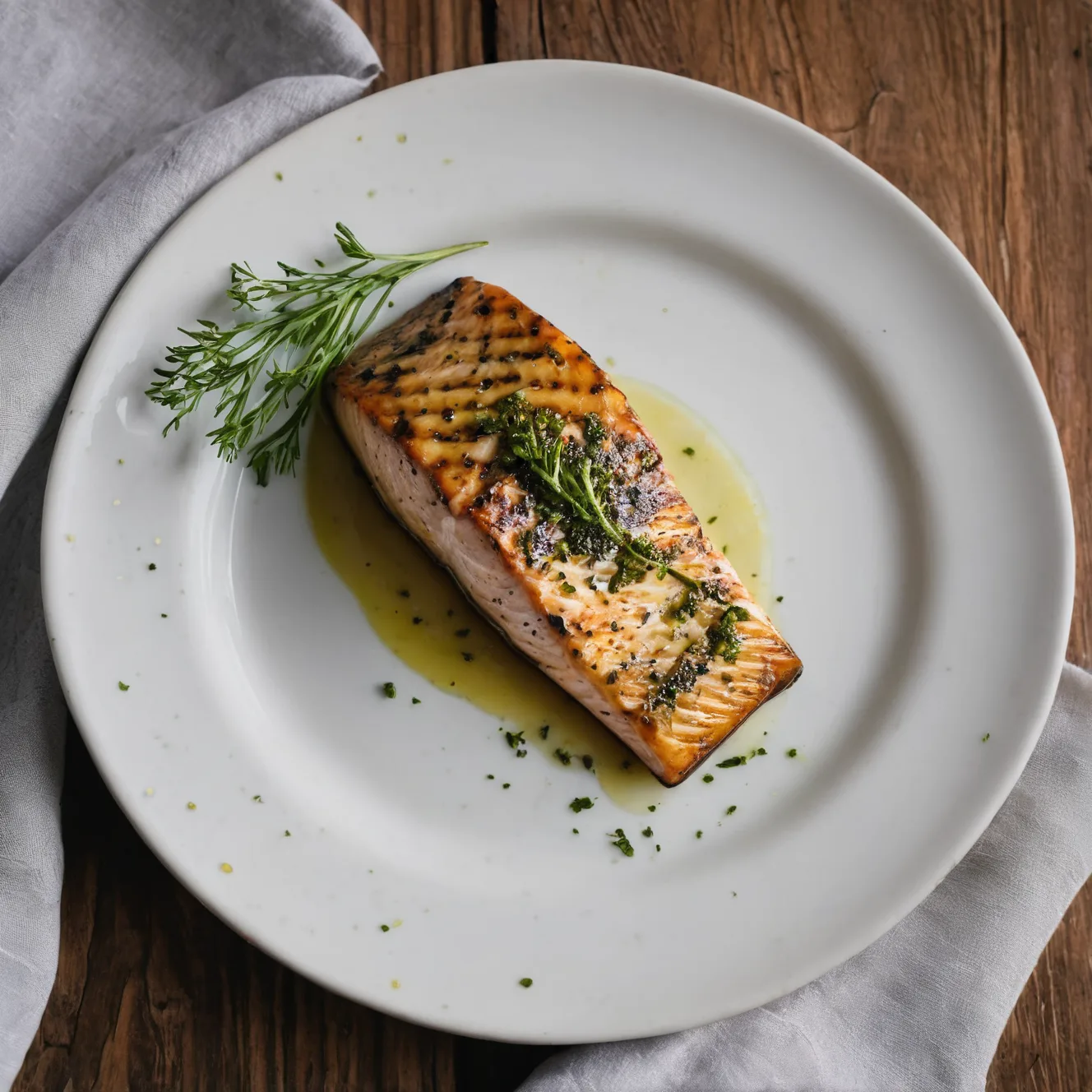
Copycat Texas Roadhouse Grilled Salmon
Prep time: 15 min (plus 20 min compound butter chill) Cook time: 10 min Servings: 4
Texas Roadhouse is a steak chain, and the Grilled Salmon sits in the Dockside Favorites section because it earns its place on its own terms. Norwegian Atlantic salmon — higher in fat and more forgiving under restaurant-level heat than generic farmed varieties — charbroiled at high temperature, finished with a lemon pepper compound butter that melts tableside into a glossy citrus sauce. At the restaurant, the 8-oz runs $22.99 including two Legendary Sides. Four home servings come out to about $35–40 total, or roughly $9–10 per person.
The recipe is simpler than you’d expect from a dish that competes with the steak section. The salmon seasoning is minimal: salt, pepper, garlic powder, and fresh lemon zest. The work is in the compound butter — cold butter mixed with lemon juice, lemon zest, and cracked pepper, rolled into a cylinder and refrigerated, then sliced onto the hot fillet where it melts slowly into a sauce as you eat. This is the element most copycat versions skip or replace with a generic lemon butter drizzle from a saucepan. The difference between cold compound butter melting on a hot piece of fish and warm butter poured over it is not subtle.
One callout before we start: the sodium on Texas Roadhouse’s published nutrition data for the 8-oz Grilled Salmon is approximately 2,100 milligrams — one of the higher figures in their seafood section, and essentially a full day’s worth of sodium in a single protein. This recipe brings that number down significantly (the homemade version is around 1,050mg per serving) by using measured salt rather than a restaurant pre-seasoning process. If sodium is a concern, see the Healthier Tips section below.
Cost Comparison: Home vs. Restaurant
| Texas Roadhouse | Homemade (4 × 8-oz servings) | |
|---|---|---|
| Grilled Salmon 8-oz + 2 sides | ~$22.99 per person | — |
| Feed 4 people | ~$92 | ~$35–40 total |
| Per serving | ~$22.99 | ~$9–10 |
The salmon accounts for most of the cost: four 8-oz center-cut Norwegian Atlantic fillets typically run $28–36 at a grocery fish counter depending on season. The compound butter is less than $2 in ingredients. Fresh lemons add about $1.50. The seasoning uses pantry spices.
The Norwegian Salmon Difference
Texas Roadhouse specifies Norwegian salmon — Norwegian Atlantic salmon — on their menu. This is not marketing language. Norwegian Atlantic salmon has meaningfully higher intramuscular fat content than generic farmed Atlantic from other origins, which keeps the fillet moist longer under the high heat of a commercial charbroiler. A restaurant charbroiler running at 450–600°F needs fish that can hold up to sustained direct heat without drying out before reaching the center. Norwegian-origin Atlantic salmon is the category standard for that reason.
At home, look for Norwegian-origin Atlantic salmon at fish counters — it is sometimes labeled specifically or available on request. If Norwegian origin isn’t available, any center-cut Atlantic salmon with high fat content performs well: look for white fat lines running through the flesh. The fat content matters more than the exact origin label.
The Lemon Pepper Compound Butter
This is the dish’s defining element and the most commonly missed step in copycat versions.
Compound butter is softened butter mixed with aromatics and chilled back into a solid. It is one of the oldest restaurant finishing techniques because it is stable (unlike a pan sauce, it can’t break), requires no extra cooking, and delivers more controlled flavor than drizzling warm butter. Texas Roadhouse’s version is lemon pepper butter: unsalted butter, fresh lemon juice, lemon zest, and cracked black pepper. That’s it. The simplicity is the point — the salmon’s natural flavor and the charbroil should come through, not a complex sauce.
The pepper in the butter is more assertive than it sounds. You want it present, not background: 1/2 teaspoon per 6 tablespoons of butter is the right ratio, and the pepper flavor should be noticeable in the finished butter. Freshly cracked pepper has more impact than pre-ground.
The butter must be truly soft before mixing. If it is too cold, it will not incorporate the lemon juice smoothly and will end up lumpy. If it is too warm or partially melted, it won’t roll properly and will fall apart when sliced. The target: it should leave a clear fingerprint when pressed, and it should blend with a fork without straining. Room temperature for 45–60 minutes from a refrigerated block is typical.
Make-ahead: The compound butter keeps refrigerated for one week and frozen for up to three months. It is a useful thing to have on hand for grilled chicken, steak, or any other fish.
Why the Seasoning Is So Simple
The steak section of the Texas Roadhouse menu uses a complex proprietary blend: salt, pepper, garlic, onion, paprika, turmeric, chili powder, and brown sugar. The brown sugar caramelizes on the flat-top into a dark crust that is a core part of the steak experience.
That blend would be wrong on salmon. Brown sugar applied to a delicate fish fillet at charbroiler temperatures would overpower the Norwegian salmon’s natural flavor and char before the center reaches temperature. The salmon seasoning is simpler by design: a clean, bright pre-seasoning that lets the fish and the compound butter do the flavor work. This is the single most common mistake in copycat recipes — applying a steak rub to the salmon because the other Texas Roadhouse recipes use it.
The Heat Level and Clarified Butter
Texas Roadhouse cooks the salmon on a commercial charbroiler running significantly hotter than a home stovetop can achieve. At home, cast iron on high heat gets you closest because it holds temperature under cold protein better than stainless or non-stick pans.
One adjustment from the restaurant method: use clarified butter or ghee for the searing step, not regular butter. Regular butter has milk solids that burn at high temperatures — at the heat level needed to properly sear salmon, regular butter will smoke aggressively and can develop a bitter char flavor. Clarified butter or ghee has had the milk solids removed and handles the heat cleanly. A small amount per batch is all you need.
If you have an outdoor grill, use it: the open flame and smoke produce a charbroiled flavor that a stovetop pan can’t fully replicate. Preheat to 450–500°F, oil the grates thoroughly, and cook the salmon skin-down (if skin-on) over direct heat.
What Sides Work
Texas Roadhouse serves the Grilled Salmon with two choice sides, the same format as their steak entrées. At home, the best pairings:
- Seasoned rice — mild and neutral, soaks up the lemon pepper butter pooling on the plate
- Steamed broccoli — cuts through the richness; the clean vegetable flavor is a better contrast than something starchy
- House salad with dressing on the side — the most calorie-aware full-plate option, and a good textural contrast with the rich fillet
- Copycat Texas Roadhouse Mashed Potatoes — buttery potatoes plus compound butter is an indulgent pairing that works, especially for a winter meal
- Copycat Texas Roadhouse Green Beans — the bacon-forward preparation adds a smoky note that complements the charbroiled char on the salmon
Tips & Variations
For the compound butter: The Texas Roadhouse version is lemon-pepper only. Additions that work without straying from the character: 1/4 teaspoon finely minced fresh dill (a classic salmon-butter pairing), a small amount of capers minced to paste (adds a briny note), or 1/4 teaspoon white pepper instead of black for a softer heat. Garlic in the butter is optional — it is not in the canonical Texas Roadhouse version, but it works if you want more depth.
For wild salmon: Wild Pacific varieties (sockeye, coho, king) are leaner than Norwegian Atlantic and overcook faster. Reduce cook time by about 1 minute per side and target 120°F internal temperature rather than 125–130°F. Wild salmon at 145°F is dry; the FDA guideline is conservative for fatty fish, and 120–125°F produces a meaningfully better texture.
For the 5-oz size: If you want to replicate the smaller portion (which brings the sodium down to roughly 1,300mg at the restaurant level), use 5-oz fillets and reduce the skin-down cook time by about 1 minute. The compound butter quantity stays the same — one round per fillet regardless of size.
Leftover salmon: Flake the leftover fillet over rice or grain with a squeeze of lemon, slice a round of compound butter on top, and eat it at room temperature — it reheats poorly in the microwave (uneven, and it makes the kitchen smell). A brief warm in a 300°F oven (6–8 minutes) preserves the texture. The lemon pepper butter is at its best right off the fish, not the next day.
See also: Copycat Texas Roadhouse Herb Crusted Chicken — the same restaurant’s chicken with a dill-basil-oregano crust and caramelized lemon; Copycat Texas Roadhouse Grilled Shrimp — garlic butter and char on shrimp using the same high-heat technique; Copycat Texas Roadhouse Steak Seasoning — the full steak rub and why the salmon uses a different, simpler blend; Copycat Texas Roadhouse Rolls — the honey-yeast rolls and cinnamon butter served alongside every entrée.