


Pin It

Fettuccine Alfredo (The Real Roman Original, No Cream)

Fettuccine Alfredo (The Real Roman Original, No Cream)
Jump to Recipe
Prep 10 min Cook 5 min Serves 4
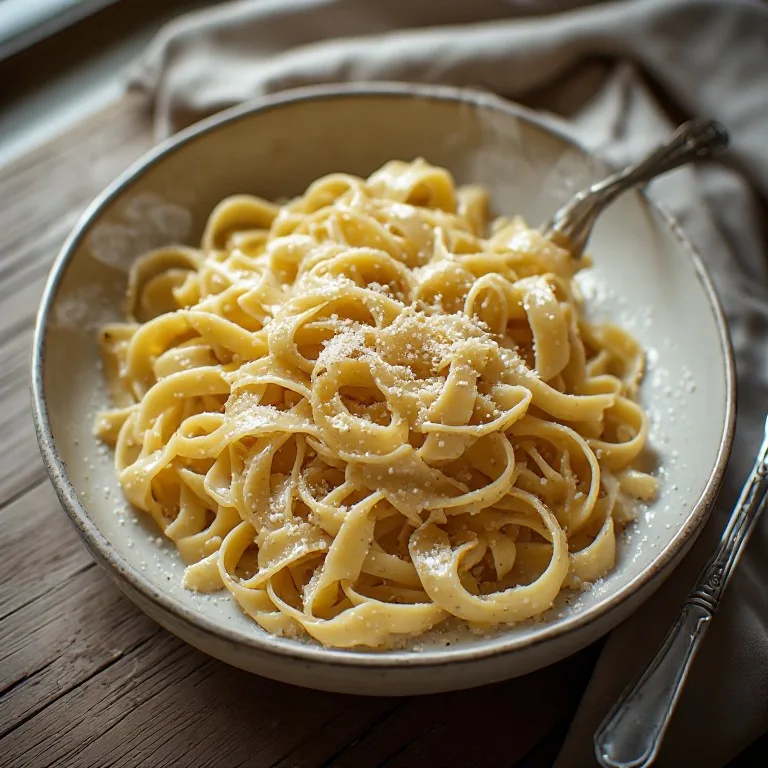
Quick answer: Bring a large pot of well-salted water to a boil. Cook 1 lb fresh fettuccine until very al dente — 2 to 3 minutes for fresh pasta, usually 1 minute less than the package says. Reserve at least 1 cup of pasta cooking water before draining. In a large warm bowl or wide pasta pan, add 6 tablespoons cold unsalted European-style butter, cut into small cubes. Using tongs, transfer the pasta directly from the water to the bowl — don't drain it completely, a little pasta water clings to the noodles and that's fine. Add 4 tablespoons of pasta water. Toss continuously and vigorously with tongs or a fork and spoon, the way Alfredo did tableside. The butter will melt and emulsify into the starchy water. Add half the Parmesan (1 cup finely grated on a microplane), toss another 30 seconds, add 2 more tablespoons pasta water, toss again. Add the remaining Parmesan, toss until the sauce is creamy, smooth, and coating every strand. If it looks tight, add pasta water a splash at a time. Serve immediately on warm plates. The whole process from pasta-in-water to pasta-on-plate takes about 5 minutes; have everything staged before the pasta goes in.

Shop the tools

Gear matched to this recipe. These are Amazon affiliate links — we may earn a small commission if you buy, at no extra cost to you.

As an Amazon Associate, Copycat Spices earns from qualifying purchases. Product images are generic illustrations, not the exact item listed.

Fettuccine Alfredo (The Real Roman Original, No Cream)

The original 1908 Roman fettuccine Alfredo, made at home: fresh pasta, cold butter, finely grated Parmesan, starchy pasta water. No cream. The creamy texture is pure emulsion — and it is extraordinary. This is the real homemade alfredo sauce.

Medium Prep: 10 min Cook: 5 min Total: 15 min4 servings ~$1.40/serving
Prep10 min
Cook5 min
Total15 min
Servings
4
At home~$1.40/serving
vs
Restaurant~$6.30/serving
You save ~78%

The Story Behind the Recipe

In 1908, Alfredo di Lelio opened a small trattoria on Via della Scrofa in central Rome. His wife Ines was recovering after giving birth and eating almost nothing, so Alfredo cooked her the only rich thing in the kitchen: the best unsalted butter from the market and a generous amount of freshly grated Parmesan, tossed tableside over freshly made fettuccine. She ate. He put it on the menu as "fettuccine al triplo burro" — triple butter fettuccine — and tossed each order himself, tableside, with a golden fork and spoon, as theater. The dish tasted like nothing else in Rome because it was nothing but the best of two ingredients.

In 1927, Douglas Fairbanks and Mary Pickford — then the most famous couple on earth, honeymooning in Europe — ate repeatedly at Alfredo's and gave him a gold fork and spoon engraved "To Alfredo the King of the Noodles." They took the recipe back to America. American cooks added cream, which the original never contained and still does not. The creamy texture in the real dish is pure emulsion: cold butter meeting starchy pasta water meeting finely grated cheese, all moving together over heat until the fat and starch become one smooth sauce. Alfredo's original restaurant still operates on Via della Scrofa; its offshoot (opened by Alfredo's grandson) is on Piazza Augusto Imperatore. Both serve it with golden utensils.

Nutrition Facts

Per serving (4 servings)
Calories550
Total Fat25g
Total Carbs37g
Dietary Fiber2g
Sugars1g
Protein26g
Sodium600mg

* Estimated values based on standard recipe preparation. Actual values may vary.

Ingredients

Instructions

💡
Pro tip: This recipe tastes even better the next day. The flavors need time to meld together in the fridge.
❄️
Storage: Keeps in an airtight container in the fridge for up to 2 weeks. Freezer-friendly for up to 3 months.
🎃 Free Halloween cookbook — download now The Copycat Halloween Cookbook A ready-made, photo-illustrated PDF of our best halloween copycat recipes — free to download, no building required. Pay what you want to support if you love it.

Free PDF — instant download. We'll also send new seasonal copycat recipes now and then; unsubscribe anytime. Or just download it →

Prep time: 10 min Cook time: 5 min Servings: 4

Fettuccine Alfredo is one of the most misunderstood dishes in the American kitchen. The version most people know — heavy cream, garlic, sometimes cream cheese, frequently served in a sauce thick enough to stand a spoon in — was invented in the United States. The original, made in Rome in 1908 by a man named Alfredo di Lelio for his ailing wife, has no cream at all. It never did.

The real dish is three ingredients: fresh pasta, the best unsalted butter you can find, and Parmigiano-Reggiano grated so finely it dissolves on contact. The creaminess is not dairy — it is emulsion, the same force that makes hollandaise coat a spoon and mayonnaise bind together. When cold butter meets starchy, hot pasta water meets finely grated hard cheese in a moving bowl, the fat breaks into microscopic droplets and suspends in the starch. The result is a sauce that looks and feels like cream but is made entirely of butter and cheese and the water the pasta cooked in.

It is also one of the best things you can eat. The flavor is pure: sweet butter, nutty aged Parmesan, the wheaty character of fresh egg pasta. Nothing is competing with anything else. There are no distractions.

The Origin

Alfredo di Lelio opened his restaurant at 21 Via della Scrofa in central Rome in 1908. His wife Ines had given birth to their son and was eating almost nothing during her recovery; Alfredo combined the richest things in his kitchen — good unsalted butter from the market and a generous amount of freshly grated Parmesan — and tossed them over freshly made fettuccine at her bedside. She ate.

He put it on the menu. He called it “fettuccine al triplo burro” — triple butter fettuccine — and tossed it himself at every table, with a fork and spoon, as a small performance. By the 1920s, the dish had a reputation that extended beyond Rome.

In 1927, Douglas Fairbanks and Mary Pickford — the two most famous film actors in the world, honeymooning in Europe — ate at Alfredo’s trattoria multiple times. On their way out of Rome, they gave him a gold fork and spoon engraved “To Alfredo the King of the Noodles.” The photographs appeared in Italian and American newspapers. American visitors began making pilgrimages. The dish crossed the Atlantic and entered American restaurant menus — where, for stability and ease, cooks added cream. The emulsified original was abandoned in favor of a version that was heavier, more forgiving, and almost completely different.

Alfredo’s original restaurant still operates on Via della Scrofa. His grandson operates a second location on Piazza Augusto Imperatore. Both toss the pasta tableside with golden utensils.

Why the Emulsion Works

The sauce has no thickener, no binder, and no cream. It works because of physics.

When pasta boils, it sheds starch into the water. That starch makes pasta water viscous — more viscous than plain water — and gives it the ability to hold fat in suspension. When you add cold butter to hot starchy water and agitate the mixture, the fat breaks into tiny droplets coated by starch molecules. Those droplets suspend in the liquid rather than pooling. The suspension is the sauce. It looks creamy because the fat droplets scatter light the same way cream does.

Finely grated Parmigiano-Reggiano accelerates the process. Parmesan contains both protein and fat; the protein acts as an additional emulsifier, helping stabilize the butter-starch suspension, and the fat adds richness to the final sauce. Coarse-grated Parmesan cannot do this — it sits as lumps rather than dissolving into the sauce. A microplane is not optional.

Three things break the emulsion:

  1. Too much heat. If the pan is scorching, the butter separates into greasy puddles. Use residual heat from the pasta and pasta water, not a burner turned up high.
  2. Too little starch. If the pasta water is nearly clear (not cloudy and slightly thick), there is not enough starch to hold the fat. This happens when the pot was too large, the cooking time was too short, or dried pasta — which releases less starch than fresh — was cooked in too much water.
  3. Too little movement. The emulsion requires constant tossing. Stop tossing and the fat begins to separate. Keep moving until the sauce is smooth and creamy, then serve immediately.
The Pasta

Alfredo used fresh egg fettuccine — pasta made with flour and eggs, cut into flat ribbons roughly 6mm wide. Fresh pasta releases more starch into cooking water than dried pasta and has a softer, more absorbent texture that drinks the emulsified sauce rather than being coated by it. The difference is noticeable.

If you can buy fresh pasta from an Italian market or specialty grocery store, do. Most grocery stores now carry refrigerated fresh pasta (usually near the egg case or deli section) that works well — brands like Trader Giotto’s, Rana, and Buitoni are adequate. The best result is homemade: flour, eggs, salt, a pasta machine, 30 minutes.

If using dried pasta, choose a bronze-die fettuccine from an Italian brand (De Cecco, La Molisana, Garofalo). Cook it to very al dente — 2 minutes less than the package says — and use more pasta water than you think you need to compensate for the reduced starch.

The Butter

Alfredo described his dish as “triple butter” — not because three types were used, but because the quantity was striking, even for Rome. He used noticeably more butter than a typical pasta sauce would call for. The butter is not a flavoring added at the end; it is the sauce. Use a quantity that feels generous.

European-style unsalted butter (82–84% butterfat) produces a richer, more flavorful emulsion than standard American butter (around 80%). Kerrygold, Plugrá, Président, and Vermont Creamery are all widely available. Salted butter will over-season the dish — Parmesan already contributes significant sodium.

Keep the butter cold until it goes into the bowl. Cold butter emulsifies more smoothly than room-temperature butter, which melts too fast and can pool before the starch has time to catch it.

The Cheese

Parmigiano-Reggiano, grated on a microplane into a fine, almost powdery texture. This is non-negotiable.

Pre-grated Parmesan — including the domestic cheese in the green canister — contains cellulose (an anti-caking agent), has minimal flavor compared to the real thing, and will not dissolve into the sauce. It produces clumps.

Buy a wedge of Parmigiano-Reggiano aged 24 months or more and grate it yourself immediately before cooking. The 24-month aging (the minimum to be labeled Parmigiano-Reggiano DOP) produces a complex, slightly crystalline, intensely savory cheese. Longer-aged Parmesan (36 or 40 months) is even more nuanced — deeper, nuttier, slightly sharper — and worth seeking out for a dish this simple, where the cheese is one of only three visible ingredients.

Serving

Serve on warm plates. A cold plate cools the pasta in 60 seconds, the emulsion firms, and the dish becomes a clump rather than a coating sauce. Run the plates under hot water for a minute before plating, or place them in a low oven for 5 minutes before service.

No black pepper, no parsley, no garlic, no lemon. The original has none of these and needs none of them. The dish is quiet and precise; additions muddy the point.

How This Compares to the Cream Version
Alfredo di Lelio originalAmerican cream version
CreamNone½ to 1 cup heavy cream
Butter6 tbsp (generous)2–4 tbsp
GarlicNoneUsually added
TextureLight, glossy emulsionThick, heavy, coating
FlavorSweet butter, nutty Parmesan, clean pastaRich, heavy, muted Parmesan
Calories per serving~550~650–800
Learning curveHigher (emulsion technique)Lower (cream is forgiving)

The cream version is simpler to make and more stable — cream is more forgiving than an emulsion, and the sauce holds for longer without breaking. The original is harder to execute but considerably more alive in flavor. Once you have made it correctly, the cream version tastes like a compromise.

More Classic Italian Pasta Dishes Made at Home
🥗

Make It Healthier

Love Fettuccine Alfredo (The Real Roman Original, No Cream) but want a lighter version? Try these simple swaps:

  • ✓Use 3 tablespoons of butter instead of 6 and compensate with more pasta water — the emulsion still holds with less fat, and the Parmesan carries the richness.
  • ✓Swap half the fettuccine for zucchini ribbons made with a julienne peeler: maintains volume while cutting carbs and calories without losing the sauce.
  • ✓Choose a 24- or 36-month aged Parmigiano-Reggiano — the deeper, nuttier flavor means you can use less of it with more impact, reducing saturated fat without losing character.
  • ✓Stir a small handful of frozen peas into the pasta water for the last 60 seconds of cooking — they add fiber, color, and a sweet contrast to the rich butter sauce.

Frequently Asked Questions

Why does the real fettuccine Alfredo have no cream?

Because Alfredo di Lelio made it in 1908 from whatever was in his kitchen — good butter and Parmesan — not from a recipe that called for cream. Cream was not part of the original, and the original trattoria in Rome still does not use it. The dish's creaminess comes entirely from emulsification: when cold butter meets starchy pasta water meets finely grated Parmesan in a hot, moving pan, the fat breaks into tiny droplets and suspends in the starchy liquid, creating a glossy, creamy sauce with no dairy beyond the butter and cheese. American cooks added cream at some point to make the emulsion more stable and forgiving — cream has a higher fat-to-water ratio than butter and emulsifies more easily. The result is richer and heavier, but it is not the dish Alfredo made. Once you taste the emulsified original, the cream version reads as muted and slightly gluey by comparison.

What is the technique for getting the emulsion right without breaking the sauce?

Three things cause the emulsion to fail: water too hot, Parmesan too coarse, or pasta too dry when it goes into the bowl. The water should be hot enough to melt the butter but not boiling — if the pan is scorching, the emulsion breaks into greasy strands. Use residual heat from the pasta and pasta water, not direct high heat. The Parmesan must be very finely grated — a microplane is essential, not a box grater. Coarse Parmesan does not dissolve into the sauce; it clumps. And the pasta should still be slightly wet when it enters the bowl — transfer it with tongs, not a strainer, so a small amount of pasta water clings to the noodles. That initial water, plus additional splashes added during tossing, is what the emulsion drinks. Toss continuously and vigorously throughout — the movement is what forms and maintains the emulsion, the way constant whisking keeps a béarnaise together.

Does this work with dried pasta, or does it have to be fresh?

It works better with fresh egg pasta — and Alfredo specifically uses fresh fettuccine, not dried. Fresh egg pasta releases more starch into the cooking water as it cooks, which makes the pasta water more viscous and better able to emulsify with the butter. The softer texture of fresh pasta also absorbs the sauce differently: the strands drink the butter-Parmesan coating rather than having it sit on the surface. Dried pasta produces a noticeably lighter, thinner pasta water and the emulsion is more fragile. That said, dried fettuccine is not disqualifying. If using dried pasta, cook it until very al dente, reserve extra pasta water, and work quickly. The dish is still dramatically better than any cream-based version. If you want the closest result to Alfredo's original, buy fresh pasta from an Italian market or make it at home with just flour, eggs, and salt — or use the refrigerated fresh pasta sold in the egg section of most grocery stores.

What kind of butter and Parmesan matter for this recipe?

The butter should be European-style unsalted, with a higher butterfat content (82–84%) than standard American butter (around 80%). European-style butter has a richer, more nuanced flavor and emulsifies more smoothly. Brands like Kerrygold, Plugrá, Président, and Vermont Creamery are widely available. If you use salted butter, the dish will be over-salted — the Parmesan already contributes significant sodium. The Parmesan must be Parmigiano-Reggiano, not a generic domestic Parmesan. Parmigiano-Reggiano aged 24 months or more has a complex, nutty, crystalline character that stands up to the butter and becomes the flavor of the dish. Pre-grated Parmesan from a green shaker is not Parmigiano-Reggiano; it contains cellulose (to prevent caking), has minimal flavor, and will not dissolve into the sauce correctly. Buy a wedge and grate it yourself on a microplane immediately before using.

Why does Alfredo's restaurant use a golden fork and spoon?

In 1927, Douglas Fairbanks and Mary Pickford gave Alfredo di Lelio a fork and spoon made of gold, engraved 'To Alfredo the King of the Noodles,' as thanks for his dish. The gift became famous and Alfredo turned it into a tradition: he tossed the fettuccine tableside, at every service, using gold utensils — a piece of theater that became as much a signature of the restaurant as the recipe itself. Photographs of celebrities posing with Alfredo and his golden fork appeared in Italian and American newspapers. The restaurant still performs the tableside toss with golden utensils today, though for paying customers rather than Hollywood royalty. The utensils are as much an artifact of the dish's legend as of its production.

Is this the same as cacio e pepe? What's the difference?

They share the same DNA — a Roman pasta sauce built on starch emulsification with no cream — but they are different dishes. Cacio e pepe uses Pecorino Romano (a sharper, saltier sheep's-milk cheese) and black pepper as the primary flavors; it typically uses dried pasta (tonnarelli or spaghetti) and includes no butter, or only a small amount. Fettuccine Alfredo uses Parmigiano-Reggiano and relies on a larger quantity of butter as the fat base; fresh egg fettuccine is the traditional pasta. The result is fundamentally different in flavor: cacio e pepe is sharp, salty, and peppery; Alfredo is sweet, rich, and milky. Both require the same technique — vigorous tossing with starchy pasta water to achieve emulsification — but the flavor destinations are distinct. Alfredo's dish was invented in Rome in 1908. Cacio e pepe is considerably older, with roots in shepherds' pasta made with ingredients that could survive long journeys without refrigeration.

How do you reheat leftover fettuccine Alfredo without losing the sauce?

The emulsion in leftover Alfredo is fragile and almost always breaks when reheated. When the dish cools, the butter solidifies and separates from the pasta and Parmesan; reheating it cold in a pan causes the fat to pool rather than re-emulsify. The best method: add the cold pasta to a non-stick pan over low heat with 2 tablespoons of water or low-sodium chicken broth per serving. Toss continuously as the pan warms — the additional liquid gives the butter something to emulsify into again. Add a tablespoon of fresh butter and a small amount of freshly grated Parmesan as you toss; the fresh fat and cheese help rebuild the sauce. Remove from heat as soon as it is warm and glossy. Microwave reheating works poorly — the uneven heat causes the fat to pool and the pasta to dry out simultaneously. The honest answer is that Alfredo is best eaten immediately, and the recipe is fast enough (5 minutes once the pasta is cooked) that making it fresh is nearly always the right choice.

Love this recipe? Share it!

Free PDF: our 12 most-wanted copycat recipes — instant download.

Made it? Buy us a coffee

Every recipe here is free, with no paywalls. If this one was a hit at your table, a small tip keeps new copycats coming.

$

Alfredo di Lelio is a trademark of its owner, used here only to describe the dish this recipe recreates. This is an independent copycat written in our own words — Copycat Spices is not affiliated with, endorsed by or sponsored by Alfredo di Lelio.

Ratings & Reviews

—
No ratings yet

Rate this recipe

Click a star to rate

Leave a Review

0/500

CS

Copycat Spices Editorial

Researched + fact-checked. Every recipe on Copycat Spices is built from published sources — official ingredient lists, brand-published recipes, interviews and food-science references — and fact-checked before it goes live, then written as clear, step-by-step instructions for home cooks of all skill levels.

Learn more about our mission →