Emeril Lagasse's Essence (Creole Seasoning)
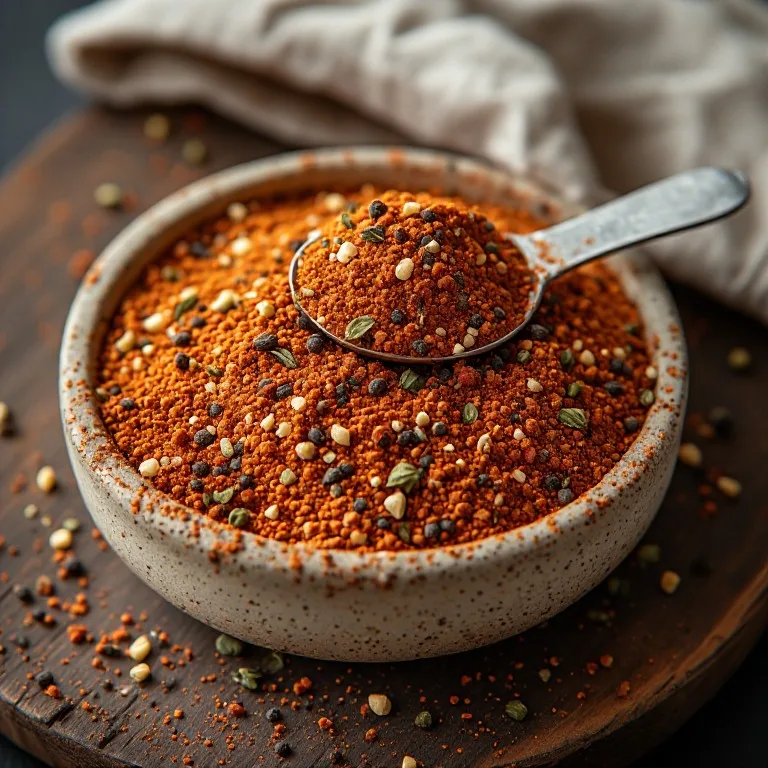
Quick answer: Measure 2½ tablespoons paprika, 2 tablespoons kosher salt, 2 tablespoons garlic powder, 1 tablespoon black pepper, 1 tablespoon onion powder, 1 tablespoon cayenne pepper, 1 tablespoon dried oregano, and 1 tablespoon dried thyme into a medium bowl. Whisk until fully combined — about 30 seconds — so the paprika is evenly distributed and no clumps of any single spice remain. Transfer to a clean glass jar with a tight-fitting lid. Label with the date. Store at room temperature away from heat and direct light. The blend keeps for up to 6 months; the herbs (oregano, thyme) are the first to fade. Use 1–2 teaspoons to season one pound of shrimp, chicken, fish, or pork. Yield: about 2/3 cup (32 teaspoons). Source: Emeril Lagasse and Jessie Tirsch, New New Orleans Cooking, William Morrow, 1993.
Shop the tools
Gear matched to this recipe. These are Amazon affiliate links — we may earn a small commission if you buy, at no extra cost to you.
 Illustrative imageLodge 10.25" Cast Iron SkilletThe restaurant-grade sear most copycats depend onCheck price on Amazon →
 Illustrative imageInstant-Read Digital ThermometerNail fry-oil and doneness temps every timeCheck price on Amazon →
 Illustrative imageNordic Ware Half Sheet PanCommercial-quality aluminum, bakes dead evenCheck price on Amazon →
As an Amazon Associate, Copycat Spices earns from qualifying purchases. Product images are generic illustrations, not the exact item listed.
Emeril Lagasse's Essence (Creole Seasoning)
Emeril Lagasse's Essence is the most famous celebrity chef spice blend in American home kitchens: 2½ tablespoons paprika, 2 tablespoons each of salt and garlic powder, plus 1 tablespoon each of black pepper, onion powder, cayenne, dried oregano, and dried thyme. From New New Orleans Cooking (William Morrow, 1993). Here are the exact proportions and the three things most homemade batches get wrong.
Easy
Prep: 5 min
Cook: 0 min
Total: 5 minmakes about 2/3 cup (about 32 tsp); serving size: 1 tsp servings
~$2.80/serving
At home~$2.80/serving
vs
Restaurant~$12.60/serving
You save ~78%
The Story Behind the Recipe
Emeril Lagasse grew up in Fall River, Massachusetts, the son of a French-Canadian father and a Portuguese mother, both obsessed with food. He studied culinary arts at Johnson & Wales University in Providence, then trained in Paris and Lyon. His break came in 1982, when Ella Brennan — the legendary owner of Commander's Palace in New Orleans — was looking for a new executive chef to succeed Paul Prudhomme. She hired Lagasse, then 23, after a five-day on-site interview, and he ran one of the most prestigious kitchens in the country for the next eight years. In 1990 he left to open Emeril's in the New Orleans Warehouse District, and in 1993 he and co-author Jessie Tirsch published New New Orleans Cooking (William Morrow), a book that distilled his Creole and Cajun approach for a national audience. That book introduced Essence — his all-purpose Creole seasoning blend — to American home kitchens. Julia Child featured him on her 1993 PBS series Cooking with Master Chefs, and Food Network picked him up the same year: The Essence of Emeril debuted in 1993–1994, and Emeril Live, shot in front of a studio audience starting in 1997, turned him into a household name. The "BAM!" catchphrase started on the early episodes of The Essence of Emeril: the cast and crew were shooting multiple episodes per day, and between the long setup times and the food they were eating, they kept nodding off. Lagasse would shout it to snap drowsy cameramen back to attention. He tried replacing it over the years but kept reverting. "Bam is just kinda me," he told Bon Appétit.
The blend itself has eight ingredients and a clear hierarchy. Paprika anchors it (2½ tablespoons — more than any other single spice), followed by salt and garlic powder at equal amounts (2 tablespoons each). Five one-tablespoon spices do the detailed work: black pepper, onion powder, cayenne, dried oregano, and dried thyme. The herbs — oregano and thyme — are what separate Essence from commercial Cajun seasoning, which typically skips them. The result is more complex than straight Cajun: warmer, slightly earthy, with a backbone of paprika sweetness. The salt amount is intentional and high: Essence is a primary seasoning, not a finishing spice. You use it to season a piece of chicken before it hits a hot pan, or to coat shrimp before the sauté — not to dust over food that's already been seasoned. Yield is about 2/3 cup. Stored in an airtight jar away from heat and light, it keeps for up to 6 months before the herbs start losing potency.
Nutrition Facts
Per serving (makes about 2/3 cup (about 32 tsp); serving size: 1 tsp servings)Calories5
Total Fat0g
Total Carbs1g
Dietary Fiber0g
Sugars0g
Protein0g
Sodium350mg
* Estimated values based on standard recipe preparation. Actual values may vary.
Ingredients
Instructions
Pro tip: This recipe tastes even better the next day. The flavors need time to meld together in the fridge.
Storage: Keeps in an airtight container in the fridge for up to 2 weeks. Freezer-friendly for up to 3 months.
Free PDF — instant download. We'll also send new seasonal copycat recipes now and then; unsubscribe anytime. Or just download it →
🎉 Your Halloween Cookbook is ready!
It's free — but if it's worth something to you, you can pay what you want. It keeps the recipes coming.
$
✓ Downloading your free Halloween Cookbook — check your downloads folder. Happy cooking!
Make It Healthier
Love Emeril Lagasse's Essence (Creole Seasoning) but want a lighter version? Try these simple swaps:
- ✓Reduce the salt from 2 tablespoons to 1 tablespoon to make a low-sodium version (sodium drops from ~350mg to ~175mg per teaspoon). Use the blend the same way, but add a pinch of kosher salt directly to the food when cooking so you can control the seasoning precisely. This is the best approach if you're watching sodium or cooking for someone on a restricted diet.
- ✓Use smoked paprika in place of regular sweet paprika: it won't reduce sodium or calories, but it adds a subtle wood-smoke character that works particularly well on grilled meats and roasted vegetables. This is a flavor modification, not a lighter one — swap only if you want the smokier profile.
- ✓Swap dried oregano for Mexican oregano (Lippia graveolens) if you can find it: it has a more citrusy, slightly more assertive character than Mediterranean oregano and pairs especially well with shrimp and fish — both common uses for Essence. The nutrition profile is identical.
- ✓Store in a small glass jar (not a plastic container): glass is airtight and doesn't absorb or impart any flavor, and clear glass lets you see the blend's color — vivid brick-red means the paprika is still fresh, faded orange-brown means the blend is past its prime and needs to be made fresh.
Frequently Asked Questions
What exactly is Emeril's Essence and why is it called Bayou Blast?
Emeril's Essence is an 8-ingredient Creole seasoning blend that Emeril Lagasse published in New New Orleans Cooking (1993). On his TV shows and in later cookbook recipes, he sometimes refers to the same blend — or a closely related variation — as 'Bayou Blast.' Both names refer to the same paprika-based, herb-forward seasoning. The Food Network recipe page labels it 'Emeril's Creole Seasoning (Essence).' There's no meaningful difference between the two names — they appear to have developed from different show contexts, with 'Bayou Blast' being used more theatrically on Emeril Live.
How does Emeril's Essence differ from commercial Cajun seasoning?
Commercial Cajun seasoning — Tony Chachere's, Zatarain's, McCormick Cajun — typically contains paprika, salt, garlic powder, pepper, cayenne, and onion powder, but skips the dried herbs. Emeril's Essence adds both dried oregano and dried thyme at 1 tablespoon each, which is what makes it taste noticeably more complex than standard Cajun. The herbs add an earthiness that moderates the heat slightly and works especially well with shellfish and chicken. If you use Essence in a recipe that calls for Cajun seasoning, the result will be slightly more herby — which is usually an improvement.
Is 1 tablespoon of cayenne too much? Can I reduce it?
One tablespoon of cayenne spread across 32 teaspoons of blend is about 1/32 of a teaspoon of cayenne per serving — moderate heat, not extreme. When you use 1 teaspoon of Essence on a portion of chicken, you're getting a tiny fraction of that cayenne. The official recipe calls for 1 tablespoon, and reducing it produces a milder blend that Emeril himself doesn't make. That said, if you or someone you're cooking for is very heat-sensitive, reducing to 1 teaspoon of cayenne is a reasonable adjustment — you lose some of the 'kick it up a notch' character but keep the rest of the flavor intact.
What does 'BAM!' mean and where did Emeril start saying it?
'BAM!' is Emeril Lagasse's signature on-camera exclamation, usually said when adding a bold ingredient — a shake of Essence, a handful of garlic — to a dish. He has said in multiple interviews that it started during production of The Essence of Emeril, his first Food Network show (1993–1994). The production day was long and the crew kept falling asleep between takes. He began shouting it to rouse drowsy cameramen. It stuck and became his trademark on Emeril Live starting in 1997. He tried replacing it with 'Pow!' at one point, but audiences kept waiting for 'BAM!' so it reverted. In a Bon Appétit interview he said: 'Bam is just kinda me.'
What do I use Emeril's Essence on?
The blend is a general-purpose Creole seasoning most commonly used on shellfish (shrimp, crawfish, crabcakes), chicken (seared, grilled, baked), fish fillets (catfish, redfish, snapper), and pork. Use 1–2 teaspoons per pound of protein as a dry rub, applied before cooking. It also works well in roux-based dishes like étouffée and gumbo (1 tablespoon per pot), as a seasoning in mac and cheese or deviled eggs, on roasted vegetables, and blended into compound butters. Emeril uses it in nearly every savory recipe in New New Orleans Cooking — it functions as the base seasoning the way kosher salt and black pepper function in other cuisines.
How long does homemade Emeril's Essence keep?
Up to 6 months in an airtight glass jar stored away from heat, light, and moisture. The limiting factor is the dried herbs (oregano and thyme): ground spices like paprika and garlic powder stay flavorful for 1–2 years, but whole dried leaf herbs begin to lose their volatile oils at 6–12 months. You'll know the blend needs refreshing when the color has faded from brick-red to dull orange-brown and the aroma when you open the jar is muted rather than sharp. Making a fresh batch takes 5 minutes and costs very little — there's no reason to use a faded batch.
Can I buy Emeril's Essence pre-made?
Yes. Emeril Lagasse sells a bottled version of Essence and other spice blends under the 'Emeril's' brand, available at major grocery chains, Target, Amazon, and Williams Sonoma. The commercial product uses the same basic formula but may use slightly different paprika varieties and precise salt grades than a home batch. The homemade version is meaningfully cheaper (the 8 bulk ingredients cost about $0.08–0.12 per teaspoon vs. approximately $0.25–0.35/tsp for the bottled product) and lets you adjust the cayenne and salt to your preference.
Love this recipe? Share it!
Made it? Buy us a coffee
Every recipe here is free, with no paywalls. If this one was a hit at your table, a small tip keeps new copycats coming.
$
💛 Support checkout is coming soon — the cookbook stays free either way.

Ratings & Reviews
Rate this recipe
Click a star to rate