

Pin It

Viral TikTok Gamja Jorim (Korean Braised Potatoes with Glossy Soy-Garlic Glaze)

Viral TikTok Gamja Jorim (Korean Braised Potatoes with Glossy Soy-Garlic Glaze)
Jump to Recipe
Prep 10 min Cook 25 min Serves 4 as a side dish
Quick answer: Halve 1.5 lbs (680g) baby potatoes (or cut small Yukon Golds into 1-inch pieces). Do not rinse or soak — surface starch thickens the sauce. In a wide skillet or shallow saucepan, heat 1 tablespoon neutral oil over medium-high heat. Add the potatoes cut-side down in a single layer and sear undisturbed for 3–4 minutes until golden. Flip once and sear the other cut side for 2 minutes. Add 5 cloves of minced garlic and cook 30 seconds. Pour in 1 cup (240ml) water, 3 tablespoons soy sauce, 2 tablespoons sugar (or oligodang syrup for better glaze), 1 tablespoon gochujang (Korean chili paste), 1 tablespoon rice wine or mirin, and 1 teaspoon gochugaru (Korean red pepper flakes). Stir, bring to a boil, then reduce to a vigorous simmer. Cover and cook for 12–15 minutes until the potatoes are tender all the way through when pierced with a skewer. Uncover, increase heat to medium-high, and cook for 5–8 minutes more, stirring frequently, until the sauce has reduced to a thick, shiny glaze that coats and clings to each potato — the liquid should be almost completely gone. Remove from heat. Drizzle 1 teaspoon sesame oil over the top, toss gently, and garnish with 1 tablespoon sesame seeds and 2 sliced scallions. Serve immediately as a side dish (banchan) or over rice.

Shop the tools

Gear matched to this recipe. These are Amazon affiliate links — we may earn a small commission if you buy, at no extra cost to you.

As an Amazon Associate, Copycat Spices earns from qualifying purchases. Product images are generic illustrations, not the exact item listed.

Viral TikTok Gamja Jorim (Korean Braised Potatoes with Glossy Soy-Garlic Glaze)

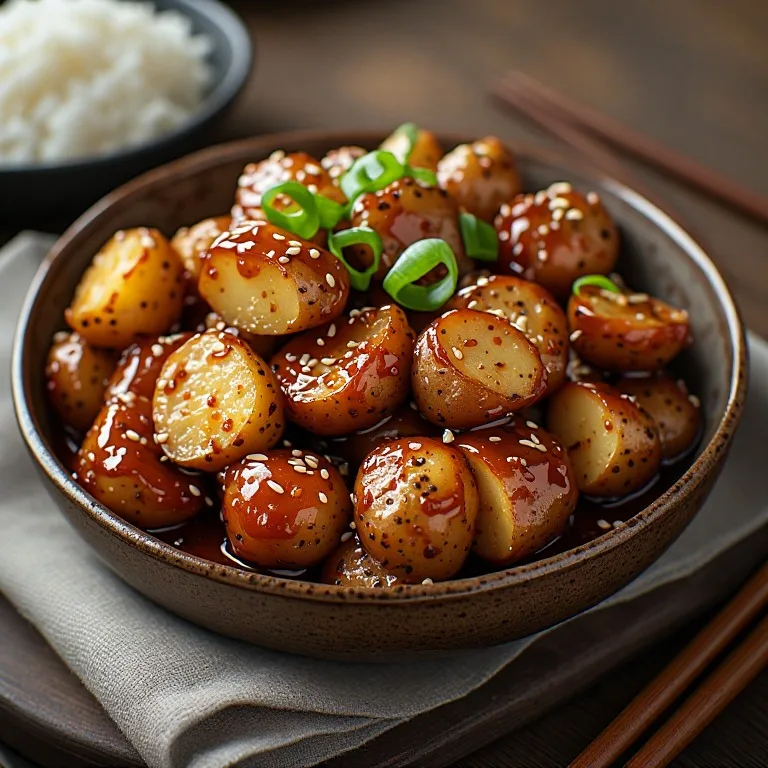
The Korean braised potatoes that keep going viral on TikTok: baby potatoes lacquered in a sweet, garlicky soy glaze until they look like they're wearing individual coats. The key is the final high-heat reduction that turns thin sauce into a thick, shiny lacquer — and why you want to leave the surface starch on the potatoes, not rinse it away.

Easy Prep: 10 min Cook: 25 min Total: 35 min4 as a side dish servings ~$4.50/serving
Prep10 min
Cook25 min
Total35 min
Servings
4
At home~$4.50/serving
vs
Restaurant~$20.25/serving
You save ~78%

The Story Behind the Recipe

The Korean braised potatoes that keep going viral on TikTok: baby potatoes lacquered in a sweet, garlicky soy glaze until they look like they're wearing individual coats. The key is the final high-heat reduction that turns thin sauce into a thick, shiny lacquer — and why you want to leave the surface starch on the potatoes, not rinse it away.

Nutrition Facts

Per serving (4 as a side dish servings)
Calories185
Total Fat5g
Total Carbs32g
Dietary Fiber3g
Sugars9g
Protein3g
Sodium490mg

* Estimated values based on standard recipe preparation. Actual values may vary.

Ingredients

  • Potatoes
  • Glaze
  • Finish

Instructions

💡
Pro tip: This recipe tastes even better the next day. The flavors need time to meld together in the fridge.
❄️
Storage: Keeps in an airtight container in the fridge for up to 2 weeks. Freezer-friendly for up to 3 months.
🎃 Free Halloween cookbook — download now The Copycat Halloween Cookbook A ready-made, photo-illustrated PDF of our best halloween copycat recipes — free to download, no building required. Pay what you want to support if you love it.

Free PDF — instant download. We'll also send new seasonal copycat recipes now and then; unsubscribe anytime. Or just download it →

Viral TikTok Gamja Jorim — Korean Braised Potatoes with a Glossy Soy-Garlic Glaze

Gamja jorim (감자조림) is the Korean side dish that TikTok turned into a craving. Small potatoes are seared, braised until tender, and then cooked down in a sweet, garlicky soy glaze until the sauce all but disappears and each potato is left wearing a thick, mahogany lacquer. The videos always hit the same beat: a spatula drags through the pan, the sauce flows back slowly like honey, and every potato comes up shining. That final shot is not a filter — it is a reduction technique, and it is the entire point of the dish.

If you want the short version: sear halved baby potatoes, braise them covered in soy, sugar, garlic, gochujang and water for 12 to 15 minutes, then blast the heat and reduce the sauce for another 5 to 8 minutes until it turns to glaze. Finish off the heat with sesame oil, sesame seeds, and scallions. The full method, the ingredient reasoning, and the fixes for a sauce that won’t thicken are below.

Why This Went Viral

Gamja jorim is quietly one of the most-cooked banchan in Korean homes, but it broke out online for the same reasons every good food video does. The glaze is the star: watching thin, watery braising liquid collapse into a glossy coating in the last two minutes is genuinely satisfying to watch, and it photographs beautifully against the deep brick-red of the gochujang version. It is also almost impossibly accessible — potatoes, soy sauce, garlic, sugar, and a Korean chili paste, cooked in one pan in under 40 minutes with no special equipment. And it is forgiving: unlike a fried dish, there is no window to miss, no oil temperature to watch. The reduction tells you exactly when it is done.

The version blowing up now leans on gochujang for color and controlled heat, but the dish is far older than the trend. Jorim — braising something in seasoned liquid cooked down to a coating — is a foundational Korean technique, and the plain soy-and-sugar version has been feeding Korean families for generations.

The Technique That Makes It Glossy

The whole dish turns on one idea: you start with liquid and you finish with almost none. Two things get you there.

First, do not rinse the cut potatoes. This is the step most recipes get backwards. For roasted potatoes you rinse away surface starch to maximize crisp — but jorim is a braise, and here that starch is what thickens the sauce and helps it cling. Rinsed potatoes give you a thin, watery sauce that never quite coats.

Second, respect the two stages. The covered braise is a gentle, steamy cook that gets the potatoes tender all the way through. The uncovered reduction is a hard, fast evaporation that concentrates the sauce into a glaze. Keep the heat genuinely high once the lid comes off, stir often so nothing scorches, and watch the last two minutes closely — the sauce goes from watery to glossy almost suddenly. When it flows back slowly off the spatula, stop.

A Note on Potato Size

The 12-to-15-minute covered braise cooks true baby potatoes (under about 1.5 inches across) through from raw. If your potatoes are bigger and you are only halving them, the inside can still be firm by the time the glaze is done — you end up with gorgeous, glazed potatoes that are underdone at the core. The fix is simple: cut larger potatoes into even 1-inch pieces, or give oversized halved potatoes a 5-minute parboil before searing. Always test with a skewer before you lift the lid; potato sizes vary and timing alone will lie to you.

What to Serve It With

Gamja jorim is banchan — a side, meant to sit alongside rice and a few other small dishes rather than star on its own. It is also a superb make-ahead: it keeps in the fridge for up to five days and the flavor deepens overnight. For a fast one-bowl dinner, pile it over rice with a fried egg and let the runny yolk cut the sweet-salty glaze. It sits happily next to other Korean staples — try it with viral TikTok tteokbokki, japchae, or a plate of Korean fried chicken.
🥗

Make It Healthier

Love Viral TikTok Gamja Jorim (Korean Braised Potatoes with Glossy Soy-Garlic Glaze) but want a lighter version? Try these simple swaps:

  • ✓Reduce the sugar to 1 tablespoon — the gochujang and soy sauce carry enough sweetness and body that the glaze will still coat the potatoes, just with less of the candy-like sweetness. The dish becomes less traditionally sweet but more savory and arguably more interesting.
  • ✓Use low-sodium soy sauce and reduce the quantity to 2 tablespoons — this brings the sodium down significantly while keeping the savory foundation. The glaze will be slightly thinner; compensate by adding 1 teaspoon of oligodang or corn syrup to maintain glaze consistency.
  • ✓Baby potatoes are a genuinely good source of potassium, vitamin C, and B6 — the braising method preserves more of these water-soluble vitamins than boiling (there's no water to leach into). The skins contribute fiber and a small amount of additional nutrients, which is why this recipe keeps them on.
  • ✓Skip the oil and braise the potatoes from raw, adding them directly to the sauce with the garlic without the searing step. The final dish is less visually dramatic (no golden sear, lighter color) but saves 120 calories from the oil. The glaze still coats well because of the surface starch.

Frequently Asked Questions

Do I need to parboil the potatoes first?

Not with baby potatoes — the 12–15 minute covered braise cooks them through from raw. The key is using potatoes that are genuinely small (under 1.5 inches across) or cutting larger potatoes into true 1-inch pieces. If your potatoes are larger than 1.5 inches and you're halving them, a 5-minute parboil first ensures the inside is fully cooked by the time the glaze stage finishes — otherwise you can end up with beautifully glazed potatoes that are still firm in the center. When in doubt, test with a skewer before removing the lid.

What is oligodang and where do I find it?

Oligodang (올리고당) is a Korean oligosaccharide syrup — a partially processed starch syrup that's slightly less sweet than sugar, doesn't crystallize when cooled, and produces a glaze that stays shiny and pliable for hours. It's standard pantry in Korean home cooking, used in most braised dishes (jorim). Find it at any Korean grocery store — H Mart, Zion, 99 Ranch (in the sauce aisle), or online. The bottle usually shows a yellow label with 올리고당 in large Korean text. If you can't find it, corn syrup is the closest Western substitute (same viscosity, similar non-crystallizing property); regular granulated sugar works but the cooled glaze looks less vivid.

How spicy is this?

With 1 tablespoon gochujang and 1 teaspoon gochugaru, this is mildly spicy — a warmth that builds slowly, noticeable but not hot. Gochugaru (Korean pepper flakes) runs 1,500–2,500 Scoville units, roughly half the heat of regular red chili flakes. Gochujang is fermented and sweet as much as it is spicy. If you want mild with no heat: use just 1 teaspoon gochujang and no gochugaru. If you want genuinely spicy: double the gochugaru to 2 teaspoons and add another half tablespoon of gochujang. Traditional versions without any gochujang are common too — the dish just loses the deep brick-red color.

Can I use regular chili flakes instead of gochugaru?

In a pinch, yes, but the result is noticeably different. Regular dried red chili flakes (like the ones at pizza restaurants) are hotter — about twice the Scoville units — and lack the fruity, slightly smoky quality of gochugaru. If substituting, use half the quantity and expect a sharper, more aggressive heat rather than the rounded warmth of the real thing. Gochugaru is sold at Asian grocery stores, many mainstream grocery stores in the international aisle, and online — it's worth buying a bag, which lasts for months in the freezer and is the same pepper used in kimchi.

My sauce isn't reducing to a glaze — it's just bubbling liquid. What's wrong?

A few possibilities. First: the heat isn't high enough. After removing the lid, the heat should be at medium-high — you should see active, vigorous bubbling across the whole surface. Second: the pan is too small. In a narrow, deep pan, evaporation is slow. If you're using a small pan, transfer everything to the widest pan you have after the braising stage. Third: you rinsed or soaked the potatoes, removing the surface starch that helps the sauce thicken — you may need to add 1 teaspoon of cornstarch dissolved in 1 tablespoon of water and stir it into the sauce during the reduction. The sauce usually turns the corner from liquid to glaze suddenly and quickly — keep the heat up and stir frequently once it starts thickening.

Can I make this ahead or does it have to be served immediately?

Gamja jorim is actually one of the best make-ahead Korean sides. It's a banchan — a side dish designed to be made in quantity and refrigerated. Store in an airtight container in the fridge for up to 5 days. The glaze deepens and becomes even more flavorful after a day. To reheat: place in a skillet with 2 tablespoons of water over medium heat, stirring, until the glaze reconstitutes and the potatoes are warmed through — about 3 minutes. If made with oligodang, the glaze looks nearly identical to fresh after reheating; sugar-based glaze may need a quick additional reduction to shine up again.

What's the difference between gamja jorim and regular braised potatoes?

The difference is the jorim technique. 'Jorim' in Korean cooking refers specifically to braising in a seasoned liquid that is cooked down to a glaze — the reduction step is not optional, it's the defining technique. Regular braised potatoes are served in their cooking liquid (a braise where the liquid remains). Gamja jorim starts with liquid but ends with none — the sauce has fully concentrated into a coating rather than a pool. The texture difference is significant: jorim potatoes are individually coated, not swimming in sauce. The analogy in Western cooking is the difference between a stew (liquid remains) and a ragù reduced to a coating (most liquid gone, sauce clings to the pasta).

Can I add vegetables or protein to make it a full meal?

Yes, but gamja jorim is traditionally a pure-potato dish (it's one of about 100 types of jorim using a single main ingredient). The most common additions in Korean cooking are: a handful of dried anchovies (myulchi) added at the same time as the garlic for umami depth; or sliced onion (¼ large onion) added with the garlic, which softens to a jammy sweet element. For protein, firm tofu cut into 1-inch cubes can be added with the potatoes — it absorbs the glaze beautifully. Sliced Korean fish cake (eomuk) is another traditional addition. For a full one-pan meal, serve the gamja jorim over rice and top with a fried egg — the runny yolk against the spicy-sweet glaze is genuinely excellent.

Love this recipe? Share it!

Free PDF: our 12 most-wanted copycat recipes — instant download.

Made it? Buy us a coffee

Every recipe here is free, with no paywalls. If this one was a hit at your table, a small tip keeps new copycats coming.

$

Ratings & Reviews

—
No ratings yet

Rate this recipe

Click a star to rate

Leave a Review

0/500

CS

Copycat Spices Editorial

Researched + fact-checked. Every recipe on Copycat Spices is built from published sources — official ingredient lists, brand-published recipes, interviews and food-science references — and fact-checked before it goes live, then written as clear, step-by-step instructions for home cooks of all skill levels.

Learn more about our mission →